

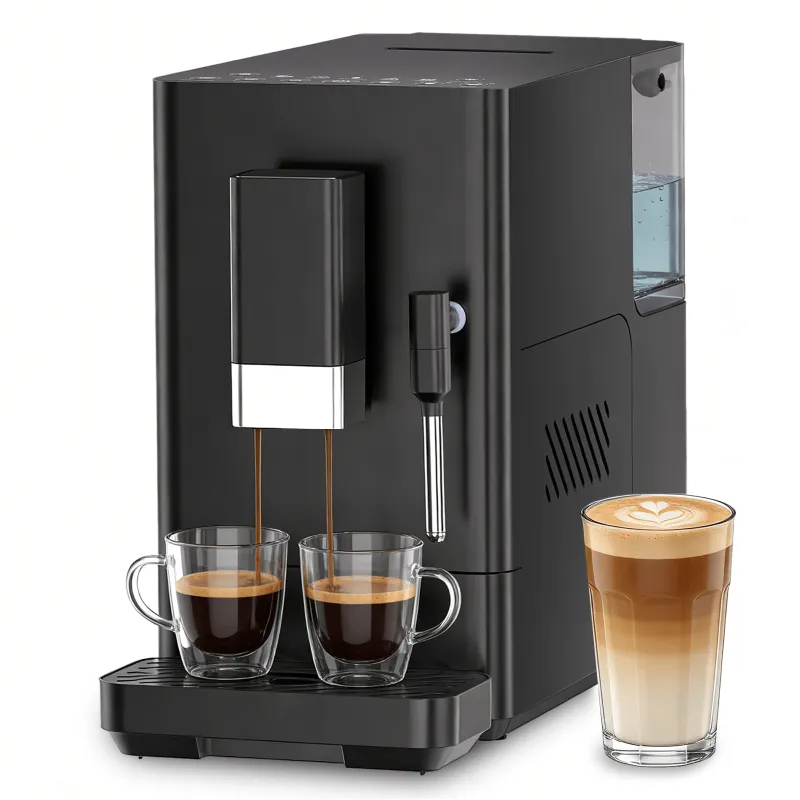
You descale a cowsar espresso machine by pushing a mild acid solution through the brew path in short bursts, letting it dwell briefly, then flushing with clean water until the water runs tasteless. The order and the timing matter far more than the brand of descaler: heat plus strong acid plus a long soak is exactly what pits boilers and dries out seals. Below is the sequence we use on our own cowsar espresso machine, the solutions worth buying, and the habits that keep scale from coming back.
Why Your Cowsar Espresso Machine Scales Up
Every tank of tap water leaves a thin film of calcium and magnesium carbonate behind when it is heated. In a small espresso boiler or thermoblock, that film builds into hard scale, narrows the water channels, and forces the pump to work against resistance. You will usually notice it before it becomes a repair:
- The pump sounds louder or more strained than it did when new.
- Shots run fast and thin, then slow to a trickle, because the flow path is partly blocked.
- Steam comes out in sputters rather than a steady jet.
- White crust appears around the group head, steam tip, or reservoir seat.
- Temperature drifts, so the same beans suddenly taste sour or bitter.
How often you need to descale depends on your water hardness and how many shots you pull, not on a fixed calendar. Soft or filtered water in a light-use kitchen might mean twice a year. Hard water and daily double shots can call for a descale every few weeks. If you can see scale, you waited too long.
Before You Start: What to Have Ready
- Food-grade citric acid, or a descaler labeled safe for espresso machines and aluminum or thermoblock parts.
- Two full reservoirs of filtered or soft water for flushing.
- A soft cloth, a small brush for the steam tip, and a shallow container to catch discharge.
- Your machine manual, because a few models specify a proprietary cycle.
- Ten to twenty minutes of attention. Descale is not a set-and-forget task.
If you are still deciding on the machine itself, you can check the latest price and current offer before you stock up on descaler.
Step-by-Step: Descale Your Cowsar Espresso Machine Safely
- Switch off and let it cool completely. Acid on a hot boiler is the fastest way to damage seals.
- Empty and rinse the reservoir so you are not diluting your descaler with hard water.
- Mix the solution to the label ratio. For citric acid, many home users work with roughly a tablespoon per liter of warm water, but the descaler label always wins.
- Run a third of the solution through the group in short bursts, stopping when the flow turns steady. Then let it sit for ten to fifteen minutes.
- Repeat twice more, and pulse a little solution through the steam wand so the thermoblock and valve get the same treatment.
- Dump the remaining solution, rinse the reservoir, and flush with clean water through the group and steam wand, two to three reservoirs' worth.
- Taste the flush water. If it is neutral, you are done. If it tastes sour or metallic, keep flushing.
- Pull one sacrificial shot and throw it away, then brew normally.
Never let the machine run dry, and never extend the dwell past what the label says in the hope of a deeper clean. More time is not more effective once the acid has finished reacting.
Choosing a Descaler That Is Safe for the Boiler
| Descaler | Safe for espresso boilers | Notes |
|---|---|---|
| Citric acid, diluted | Yes | Cheap, food safe, short dwell only |
| Lactic acid descaler | Yes | Gentler on seals, made for espresso machines |
| White vinegar | Only if the manual allows it | Harsh on rubber, unpleasant to flush out |
| Overnight vinegar or lemon soak | No | Long acid contact attacks metals and gaskets |
| Hydrochloric or sulfamic acid | No | Industrial strength, not for home machines |
Mistakes That Pit, Crack, or Kill the Boiler
- Soaking overnight. Scale dissolves in minutes, but acid keeps eating metal and rubber for hours.
- Descaling a hot machine. Thermal shock plus acid is the classic way to spring a leak.
- Skipping the steam wand. The wand has its own narrow path and scales up faster than the group.
- Forgetting the flush. Residual acid in the boiler ruins the taste of every shot after.
- Descaling a machine caked in coffee oils. Oils trap scale; purge and wipe first, or you clean half the problem.
- Forcing stiff valves or a stuck steam knob. Soak and re-treat instead of applying leverage.
Habits That Push Descale Day Further Out
- Use filtered water. It is the single biggest lever on scale, and it makes every shot taste cleaner.
- Flush a little water through the group after each session and wipe the dispersion screen.
- Purge the steam wand immediately after every use, then wipe it.
- Do not leave water sitting in the reservoir for weeks; refill with fresh water.
- The same water logic applies across a kitchen. If a 10 cup coffee machine or a cowsar nugget ice maker lives on the same counter, filtered water cuts scale in all of them.
Shipping, Weight, and Buying With Our Code
Espresso machines are heavier than they look, and countertop space is usually the real constraint. If you are comparing a machine's shipping weight against your shelf, our 33lbs in kilos page handles the conversion without guesswork, and the store page covers delivery details for the wider range, from the cowsar ice maker and mini fridge lineup to cowsar grills.
When you are ready to buy descaler or a spare reservoir, grab the code first. The current offer is 15% off sitewide, which is a sensible moment to add the accessories that make descaling easier. For a wider look across the range, our Cowsar store overview covers espresso machines, ice makers, wine coolers, and mini fridges side by side.
One last habit worth building: log your descales. Write the date on the box of descaler and note how the pump sounded beforehand. After two cycles you will know your machine's real rhythm far better than any generic schedule.
 Shopping at Cowsar? See today's verified Cowsar discount code
Frequently asked questions
Can I use white vinegar to descale a cowsar espresso machine?
Only if your manual explicitly allows it. Vinegar is acetic acid and is harsher on rubber seals and aluminum parts than a citric or lactic acid descaler, and the smell lingers through several tanks of flushing. A machine-safe descaler is the lower-risk choice.
How long should I leave descaler in the boiler?
Follow the label, which is usually ten to fifteen minutes in short cycles rather than one long soak. Scale reacts quickly; extended contact mostly attacks seals and metal. Never leave acid in overnight.
How do I know when my cowsar espresso machine needs descaling?
Watch for a louder pump, uneven or slow flow, sputtering steam, temperature drift, and white crust around the group or steam tip. Visible scale means it is already overdue, so descale at the first of those signs.
Will descaling fix a machine that has stopped pumping water?
Sometimes, if scale is the only blockage, but a failed pump or a scaled-up valve will not clear with descaler. Run one proper descale cycle first, and if flow does not return, stop and have the machine serviced rather than repeating the treatment.
Does filtered water really reduce how often I need to descale?
Yes. Filtered or low-mineral water leaves far less calcium carbonate behind, so scale builds much more slowly. It is the cheapest long-term protection for an espresso machine, a 10 cup coffee machine, or an ice maker.