

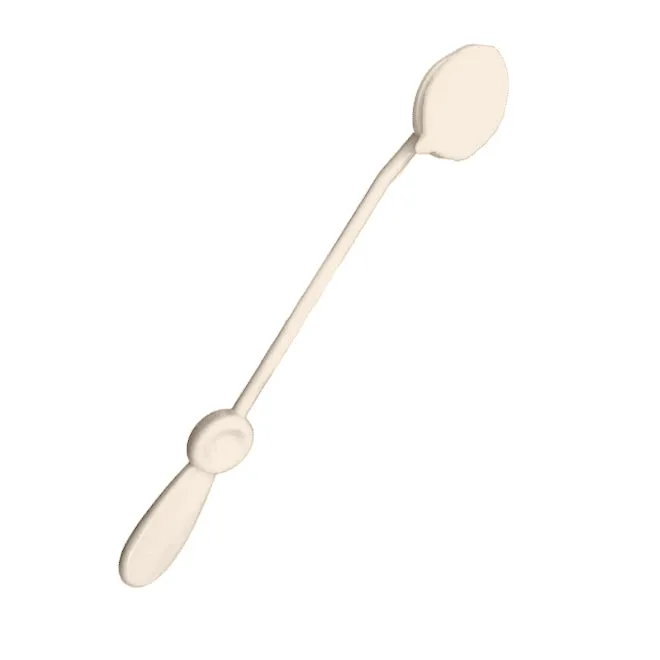
A back moisturiser applicator is a long-handled tool that holds lotion on a pad or roller so you can coat your back evenly without twisting, reaching, or asking someone else. If you have ever given up on the middle of your back and let it stay dry, the fix is a tool, not more contortion. Below we compare the two main styles, explain how to load and use them, and cover the products worth pairing with them.
Why reaching your back is harder than it looks
Your back has the largest continuous skin surface on your body and the worst mechanical access. The midpoint between the shoulder blades sits beyond most people's reach, and the shoulder joint does not rotate far enough to let a palm lie flat against the spine. So people do one of three things:
- Skip the middle entirely and moisturise only what they can touch
- Over-apply to the easy-to-reach sides, leaving an uneven film
- Ask a partner, which is not always an option
Dry skin on the back is common for the same reason: it is the area most often washed with hot water, scrubbed with a cloth, and then left unmoisturised. A dedicated tool solves the reach problem, and it also solves the consistency problem, because a pad spreads product more evenly than a hand can.
Back moisturiser applicator vs. lotion applicator for back
These two terms get used interchangeably, and in practice the difference is the design of the head and handle rather than the job. Both are application tools built to extend your reach. Here is how the common versions differ.
| Feature | Back moisturiser applicator | Lotion applicator for back |
|---|---|---|
| Head type | Often a curved pad or roller that follows the spine | Usually a flat pad, sponge, or soft bristle head |
| Best for | Creams, body butters, thick moisturisers | Lotions, gels, thin fluids and self-tan |
| Handle | Long, sometimes curved or hinged | Straight or slightly angled, often extendable |
| Grip and pressure | Built for pressing cream into skin | Built for sweeping lotion over a wide area |
| Cleaning | Pad usually detaches | Head often unscrews or snaps off |
The practical rule: if your product is thick enough to sit on the skin as a visible dollop, a curved pad-type head works harder for you. If it is thin and runny, a wide flat head spreads it faster. Many people keep both, and honestly that is the sensible answer if you use both a heavy body cream and a lighter lotion.
If you want a single tool that handles most creams, look at the back moisturiser applicator. If you mostly apply thin lotions or sunless tanner, the lotion applicator for back is the more natural fit. Both are on the store, and you can check the latest price before you commit.
How to apply lotion to your back without help
The technique matters as much as the tool. Follow this order and you will get an even coat in under a minute.
- Apply your lotion to the pad, not your hand. A blob the size of a large coin is usually enough for one pass. Too much product makes the pad slide instead of spread.
- Start low and work up. Place the head at the base of your spine, then sweep upward in long, overlapping strokes. Gravity helps thin lotion travel downward, so starting high wastes product.
- Rotate the handle, do not crane your neck. Turn your wrist to angle the head across your back rather than twisting your torso to see what you are doing.
- Overlap each stroke by half. This is the step people skip, and it is the reason edges end up dry.
- Do a second light pass on the shoulder blades. They are the driest and most commonly missed zone.
- Wipe the pad before you put the tool away. Product left in a damp pad is a bad idea.
If your back is prone to breakouts, keep the moisturiser pass separate from any treatment product and give each layer time to absorb. Body acne and dryness often coexist, and layering the wrong way round makes both worse.
The order of operations for a dry skin routine
A dry skin routine for the back works best applied thinnest to thickest:
- Cleanse with warm, not hot, water
- Treat if needed (more on this below)
- Hydrate with a lotion or cream while skin is still slightly damp
- Seal with a heavier cream on the driest patches
Applying product to damp skin is the single biggest improvement most people can make, because it traps water rather than trying to add it later.
Pairing the applicator with the right body products
The tool is only as good as what you load into it. Here is how the store products map onto a back routine.
For everyday moisture
A glycolic acid body lotion does two jobs: it hydrates and it helps smooth rough, bumpy texture on the upper arms and back. Load it into the applicator and sweep upward. Glycolic acid can increase sun sensitivity, so use it at night and be diligent about sun protection. The U.S. FDA's cosmetics guidance is a useful plain-language reference for how over-the-counter skincare ingredients are regulated.
For texture and clogged pores
Exfoliate before you moisturise, not after. A salux cloth is a long nylon exfoliating cloth that reaches the back naturally, and a buff puff is easier to control on the shoulders and upper back. Use either two or three times a week, gently. If you have active breakouts, swap to a benzoyl peroxide pimple cream on the spots and keep it away from the dry margins, or use a cream for zits if your skin tolerates benzoyl peroxide poorly.
For scalp and hair care
Scalp problems often get blamed on the back or neck, but the answer usually sits on your head. If you have flaking, a pyrithione zinc anti dandruff shampoo or a zinc shampoo targets the yeast that drives most dandruff. A hair scrubber helps work shampoo down to the scalp instead of the hair, which matters if you have thick hair. Rinse thoroughly and lean forward slightly so residue does not run down your back.
For hands and face
Dry hands and a dry back are the same problem in different places. Keep a hand treatment such as dry hands by the sink, and use mineral powder makeup if you want lighter coverage that does not aggravate breakouts. Dry hands also make gripping a long handle harder, which is a small but real usability point.
Choosing the right applicator for your body
There is no single best length. Work out your reach first, then buy.
- Measure from your wrist to your opposite shoulder blade with your arm bent. That distance tells you the minimum useful handle length.
- Check the head width. A narrow head is precise but slow. A wide head covers ground but is harder to control around the shoulder blades.
- Look for a detachable head. You are applying product to a damp, warm environment. A pad you cannot remove is a pad you cannot wash properly.
- Consider grip. A textured or contoured handle helps if you have dry hands, arthritis, or limited hand strength.
- Check the weight. A light handle is easier to steer across the whole back in one session.
For skin type guidance, the general principle holds: oily and acne-prone skin does better with lighter lotions and salicylic or benzoyl peroxide spot treatment, while dry skin benefits from ceramide-rich creams applied to damp skin. Sensitive skin should patch test any new acid product on the forearm first.
Care, cleaning, and how long these tools last
A reusable applicator needs a short cleaning routine or it turns into a hygiene problem.
- Rinse the pad with warm water immediately after each use.
- Wash with a mild soap weekly, or use a separate pad per product if you apply both a treatment and a moisturiser.
- Air dry head-up, never in a closed cabinet.
- Replace pads when they stiffen, discolour, or hold smell.
- Wipe the handle with a damp cloth and dry it before storing.
Most handles are plastic or coated metal and last years. Pads are the wear item. Buy a spare set if you use the tool daily.
Where to buy and what to expect from the code
Both applicator styles sit alongside the rest of the Dr. Bailey Skin Care range on the store, including the exfoliating cloths, shampoos, and treatment products mentioned above. The current offer is 22% off sitewide. You can grab the code before ordering, and the same page covers discount code basics, how to redeem offers, product ingredient lists, and shipping and returns questions. If you are buying more than one item, it is worth comparing the full range first and checking the latest price at checkout so you only place one order.
Our honest take: if you buy one thing, buy the applicator that matches your main moisturiser. That is the product with the most obvious daily payoff, because it turns a skipped step into an easy one.
 Shopping at Dr. Bailey Skin Care? See today's verified Dr. Bailey Skin Care discount code
Frequently asked questions
How do I use a back moisturiser applicator properly?
Load the pad with a blob of product roughly the size of a large coin, then sweep upward from the base of your spine in long overlapping strokes. Rotate the handle to angle the head rather than twisting your torso, and give the shoulder blades a second light pass.
Is a lotion applicator for back the same as a back moisturiser applicator?
They do the same job but differ in head design. A back moisturiser applicator usually has a curved pad built to press thicker creams into the spine, while a lotion applicator for back tends to have a wider flat head suited to runnier lotions and gels.
Can I use the applicator with glycolic acid body lotion?
Yes, and it spreads more evenly than a hand. Apply it in the evening since glycolic acid increases sun sensitivity, and use a separate pad if you also apply a treatment cream so the products do not mix in the pad.
How often should I clean the applicator pad?
Rinse the pad with warm water right after each use and wash it with mild soap once a week. Replace it when it stiffens or holds odour, and always let it air dry head-up rather than storing it damp.
Will an applicator help if my back breaks out?
It helps with even application, but you still need to treat the breakouts. Use a benzoyl peroxide pimple cream or a gentler spot cream on affected areas after your moisturiser has absorbed, and keep exfoliating cloths to two or three gentle sessions a week.
Where can I find a discount code for these products?
The store's coupon page has the current offer, which is 22% off sitewide, plus details on how to redeem offers and the shipping and returns policy. Check it before you order.