

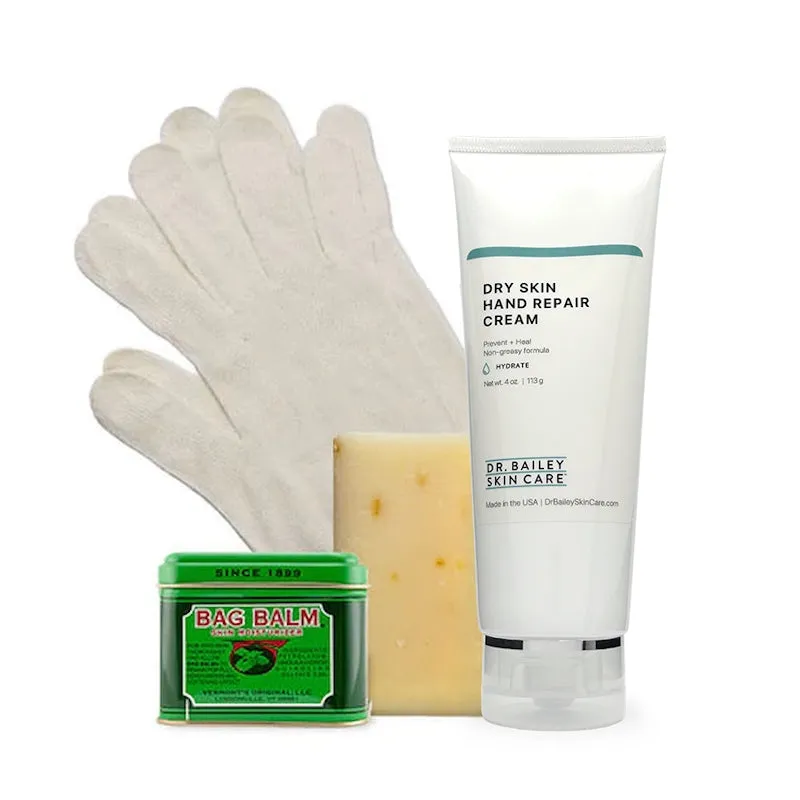
Dry hands in winter are usually a barrier problem, not a moisture problem, so the treatment that works is one that both holds water in and repairs the lipid layer rather than a thin lotion you have to reapply hourly. In this guide we cover what to look for on an ingredient list, the order to layer your hand treatment, and how to fit it into a full winter routine alongside the body and scalp products we test from Dr. Bailey Skin Care.
Why dry hands crack in winter and not in summer
Cold air holds less humidity, and indoor heating pulls more moisture out of the room. On top of that, the skin on your hands has very few oil glands compared with your face or back, and you wash them constantly. Soap strips surface lipids, water evaporates, and the skin flexes every time you make a fist. That combination is why the cracking shows up in the knuckles and between the fingers first.
- Low humidity speeds up water loss through the skin.
- Frequent hand washing removes the oils that normally slow that loss.
- Cold wind and repeated wet-to-dry cycles leave skin rough and tight.
- Hot water feels good in January and makes the problem worse.
If your hands sting when you apply anything, that is a sign the barrier is already compromised. Treat it as a repair job for a week or two, not a maintenance job.
What to look for in a hand treatment for dry hands
The best hand treatment for dry hands does two jobs at once: humectants pull water into the upper skin, and occlusives plus emollients keep it there. A product that only does the first job will feel great for twenty minutes and then leave you reaching for the tube again.
- Humectants: glycerin, hyaluronic acid, urea, panthenol. These attract water.
- Emollients: shea butter, squalane, fatty alcohols, dimethicone. These soften and smooth the surface.
- Occlusives: petrolatum, beeswax, lanolin. These form the seal that stops evaporation.
- Ceramides and niacinamide: support barrier repair over days, not minutes.
- Short ingredient lists: fewer fragrance allergens and essential oils matter on broken, cracked skin.
Look at the order of the ingredient list, not the front of the tube. Ingredients are listed by concentration down to about one percent, so anything after that point is present in small amounts. The U.S. FDA's cosmetics labeling guidance explains how that list is regulated, which is genuinely useful when two products both claim to be "intensive."
Our pick for this job is dry hands, a concentrated treatment built for the cracking and roughness that shows up in cold weather rather than a lightweight everyday lotion.
How to layer a hand treatment so it actually holds
Layering is where most people lose the benefit. The rule is thin-to-thick, damp-to-dry, and seal last.
- Wash with lukewarm water and a gentle cleanser, then pat rather than rub. Leave the skin slightly damp.
- Apply a humectant-rich layer first while the skin is still damp so it has water to draw on.
- Follow with the treatment that contains your emollients and occlusives. Use more than you think you need on the knuckles and fingertips.
- Seal the edges with a balm or a thin layer of the same treatment over the cuticles and between the fingers.
- Repeat after every wash for the first week, then drop to morning and night.
Two habits do the heavy lifting overnight. Apply a thicker layer before bed and, if your hands are badly cracked, wear cotton gloves over it. In the daytime, keep the tube where you wash your hands most, not in a drawer upstairs. A hand treatment you cannot reach will not get used.
Build the rest of the winter routine around it
Dry hands rarely travel alone. In winter we see the same pattern in the same customers: tight hands, itchy shins, flaky scalp, and breakouts under heavy clothing. Treating all of it with one product is the reason so many routines stall. Match the product to the body part.
| Concern | What we reach for | Where it fits |
|---|---|---|
| Cracked, tight hands | dry hands | After every wash, thicker at night |
| Rough arms, legs, shins | glycolic acid body lotion | Evening, after showering |
| Flaking, scaly scalp | pyrithione zinc anti dandruff shampoo | Two to three washes a week |
| Hard-to-reach back | lotion applicator for back | Every time you moisturise |
Two things worth knowing before you add anything new. First, exfoliating acids and retinoids do not belong on cracked hands; the skin is already compromised. Second, if you are layering an exfoliating body lotion, use it on the body only and keep your hand treatment separate, or you will sting the fissures.
For the back and shoulders, a back moisturiser applicator means you actually reach the whole area instead of the middle third, which is the difference between a routine that works and one that leaves patches. Pair it with a salux cloth once or twice a week for texture, or a buff puff if you prefer something smaller and gentler in the shower.
Scalp, face, and body: what not to skip
The same cold-weather drop in humidity that causes dry hands also triggers flakes and breakouts, and those need active ingredients rather than more moisturiser.
- Dandruff and scalp care: a zinc shampoo is the medicated option when the scalp is inflamed and itchy, not just flaky. Work it into the scalp with a hair scrubber rather than your nails.
- Body breakout care: a benzoyl peroxide pimple cream for spots on the back and chest, and a cream for zits for the face, are not interchangeable. Benzoyl peroxide bleaches fabric, so keep it off good towels.
- Mineral makeup range: if your skin is reactive in winter, the mineral powder makeup line is the lower-irritation option, and it sits better over a repaired barrier than over flaking skin.
Read the full ingredient list before you introduce anything new, especially if your hands are cracked and everything stings. Patch test on the inner forearm for a couple of nights first.
Who this routine suits and who should change it
This layering approach suits most people with seasonal dryness, office heating, frequent hand washing, or outdoor work. It also suits anyone whose hands feel tight within minutes of drying.
Change it up if:
- You have eczema or psoriasis. Fragrance-free, short ingredient lists matter more than texture. Ask a dermatologist before adding acids anywhere.
- Your hands crack and bleed. Stop exfoliating entirely and treat it as broken skin until it closes.
- You are prone to fungal infections between the fingers. Keep the area dry and see a clinician rather than sealing it under an occlusive.
- You have contact dermatitis from work. Gloves and barrier cream during the shift matter more than any night treatment.
Where to buy and how to use our code
We test these products ourselves, and the pricing and offers change through the year. Rather than quote a number that may be out of date, check the latest price and current offer on the store page before you order. The code is applied at checkout, and the same page covers how to redeem offers plus shipping and returns.
Quick discount code basics: the code is sitewide, so you can stack a hand treatment and a body lotion in one order and still get the discount. Start with the hand treatment and one body product, run it for two weeks, then decide what else your dry skin routine actually needs. That beats buying six products at once and guessing which one helped.
 Shopping at Dr. Bailey Skin Care? See today's verified Dr. Bailey Skin Care discount code
Frequently asked questions
How often should I apply a hand treatment for dry hands in winter?
Apply after every hand wash for the first week, then twice a day once the cracking settles. A thicker layer at night, with cotton gloves over it if your hands are badly cracked, does more than reapplying a thin layer all day.
Can I use glycolic acid body lotion on my hands?
Not while they are cracked. Exfoliating acids on compromised, fissured skin sting and slow healing. Keep the glycolic acid body lotion for arms, legs, and body, and use a dedicated hand treatment until the skin closes.
What ingredients should I look for in a hand treatment?
Look for a mix of humectants like glycerin or urea, emollients like shea butter or dimethicone, and an occlusive such as petrolatum or beeswax to seal water in. Ceramides and niacinamide help the barrier repair over time.
Do I need the back moisturiser applicator if my hands are the problem?
They solve different problems. The applicator is for reaching your back and shoulders properly, while the hand treatment is for cracked hands. Many people use both in the same winter routine because dry skin rarely stays in one place.
Where can I find the current discount code for these products?
The store coupon page has the current offer and instructions for redeeming it at checkout. We link to it rather than quote a figure because offers change through the year.