
How to Choose a Changing Robe Your Kids Will Actually Use After Swimming

The Short Answer
A childrens changing robe gets used swim after swim when it fits with room to grow, has a proper hood and a warm, quick-drying lining, and is easy enough for your child to get on and off without help. Get those three things right and it becomes part of the routine instead of a bag-filler. Get them wrong and it lives in the boot of the car.
We have tested changing robes with kids who swim year-round, and the difference between a robe that works and one that does not usually comes down to sizing decisions parents make before buying. Here is exactly what to check.
Why Fit Matters More Than Any Other Feature
Kids will only use a childrens changing robe if they can actually change inside it. That means the robe needs enough length to cover them for modesty while they wiggle out of wet swimmers, but not so much length that they trip or the hem drags through puddles.
- Room to grow, not room to drown. Most robes run in age brackets. Pick the bracket your child will be in next season, not the one after. Two sizes up means the sleeves flop and the hood slides over their eyes, which is the fastest way to make a kid refuse to wear it.
- Check the sleeve style. Wide sleeves let arms out for towel-drying hair or doing up a seatbelt. Narrow sleeves are warmer but more restrictive.
- Test the zip with wet hands. If your child cannot work the zip themselves after a swim, you become the designated zip-puller every time. A chunky zip they can grip wins over a sleek one.
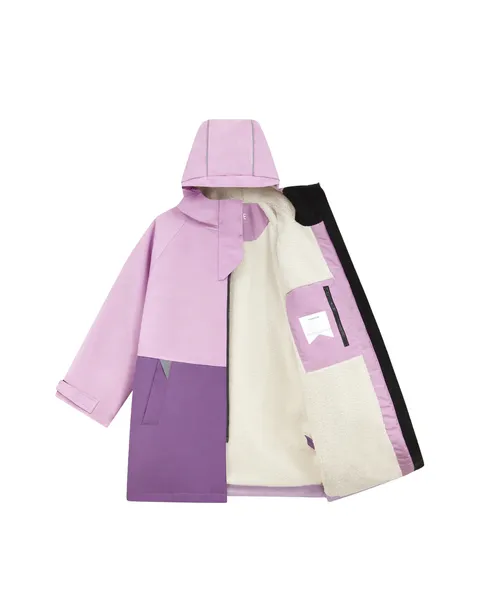
A well-sized option like this childrens changing robe covers the shoulder-to-knee range most swimmers need, and the hood does the heavy lifting for warmth.
Fabric: What the Outside and Inside Should Do
Changing robes do two jobs at once. The shell handles the weather; the lining handles the kid.
- Outer shell: a water-resistant shell stops wind chill and light rain from soaking through while your child changes on a breezy seafront. It does not need to survive a monsoon, but it should bead water for a few minutes at least.
- Inner lining: look for a soft fleece or towelling-style lining. Towelling absorbs wet skin and hair; fleece feels warmer instantly. Fleece is usually the better pick for cold-water swimmers, towelling for indoor pools and summer beach trips.
- Weight: thick lining means warmth but also bulk in a swim bag. If the robe travels to school swim lessons every week, a lighter lining gets used more.
If your child swims outdoors in colder months, pair the robe with warm layers for the walk back to the car. A kids winter coat over dry clothes is the step a lot of families skip, and it is the one that stops the post-swim shivers. For rain on pool-run days, a yellow waterproof raincoat doubles as high-visibility outerwear on dark mornings.
Hood, Pockets, and the Details That Get Used
The features kids actually notice are the small ones.
- A lined hood that stays up in wind. Drawcords help, but check they cannot be pulled tight enough to be a snag risk.
- A front pocket big enough for goggles, a snack, or cold hands. Kids use pockets constantly on the walk from the water.
- A wide, roomy cut through the body, which is what makes private changing possible in a car park or on a busy beach.
- Machine washability. A robe that smells of chlorine by week three is a robe that stays home. Check the care label before you buy, not after.
For a comparison of how the main styles on the market stack up, Independent reviews like Best kids changing robes 2026: Tested and reviewed are a useful benchmark for lining warmth and durability. If you want to browse a wide range of sizes and colours in one place, Kids' Changing Robes gives a good sense of what age brackets and price points look like across the market.
Poncho vs Full Robe: Which Suits Your Child?
Both styles do the same job, but they suit different ages and habits.
| Style | Best for | Watch out for |
|---|---|---|
| Poncho | Younger kids, quick pool changes, summer use | Less coverage in wind; sleeves are usually just drape |
| Full zip robe | Older kids, outdoor and cold-water swimming, sitting in to change | Bulkier to carry; usually costs more |
A simple rule: if your child can dress themselves confidently, a poncho is fine. If they are changing in car parks, on beaches, or in wind, the full-zip childrens changing robe is worth the extra size in the bag.
Making It Part of the Routine
The best gear is the gear that gets used without being asked for. A few habits that help:
- Keep it packed with the swim bag, not hung in the wardrobe. If it travels with the goggles, it gets used.
- Let your child pick the colour. Ownership matters. A robe they chose is a robe they wear.
- Dry it properly between uses. Hang it inside out over a door or radiator rail so the lining dries fully and never goes musty.
- Warm up the rest of the kit too. Dry socks, a hat, and something warm for the journey home make the robe feel like part of a system rather than a one-off fix.
Post-swim routines work best when they are easy. On quieter afternoons, small comforts help too. A soft rspb bird plush tucked in the bag for younger siblings, or a quick game with kookoo birds toys on the drive home, turns the swim trip into something they ask to do again.
Where to Buy and What to Pay
Prices for childrens changing robes vary a lot with lining thickness and shell quality, so rather than quoting a number that may be out of date, check the latest price and grab the code on our ToastieExplorer discount page, where the current offer gives 15% off all orders. We test discount codes before we publish them, so what you see there is what works.
If you are buying for a year-round swimmer, it is worth spending up for a thicker lining and a genuinely water-resistant shell. If the robe is for weekly pool lessons, a lighter poncho-style robe will serve just as well and pack down smaller.
Frequently asked questions
What size childrens changing robe should I buy?
Pick the age bracket your child will be in next season rather than the one they are in now, so there is room to grow. If the sleeves swallow their hands or the hood slides over their eyes, size down, because an oversized robe is the one kids stop wearing.
Is a poncho or a full-zip changing robe better for kids?
Ponchos suit younger children and quick indoor pool changes, while full-zip robes offer more coverage and warmth for outdoor swimming, windy beaches, and changing in car parks. If your child dresses themselves confidently and swims in summer, a poncho is usually enough.
Can a changing robe replace a towel?
Mostly, yes. A good lining absorbs wet skin and hair, so many families skip the towel entirely at indoor pools. For outdoor swims in winter, a small towel for the hair plus a warm lining robe is a better combination.
How do I stop a changing robe from smelling of chlorine?
Machine wash it according to the care label and hang it to dry fully with the lining turned out between uses. A robe that dries properly every time rarely develops a musty or chemical smell.
Are changing robes warm enough for outdoor winter swimming?
A thick fleece-lined robe with a water-resistant shell makes a real difference against wind chill straight after a cold swim. For the walk back to the car, add dry warm layers such as a kids winter coat, because the robe alone is not a substitute for getting dressed.
Where can I get a discount on a childrens changing robe?
Check our ToastieExplorer discount code page, where we list the current offer of 15% off all orders. We verify codes before publishing them, so the code you find there is one that works.