
What Is a Galileo Thermometer and How Does It Work?

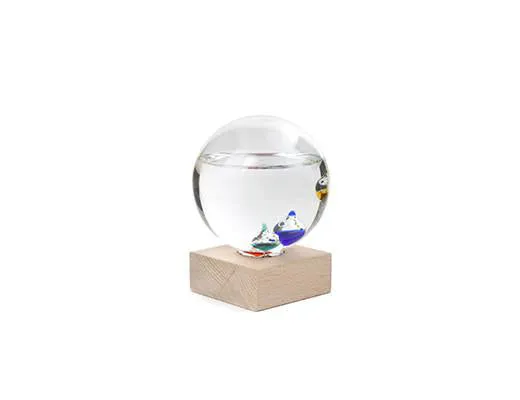
Few scientific instruments blend physics and home décor as elegantly as the Galileo thermometer. Suspended in a tall glass cylinder, colorful glass bulbs rise and fall with the temperature, turning an ordinary weather reading into a mesmerizing display. But this isn't just a pretty ornament — it's a working thermometer based on a real scientific principle discovered more than 400 years ago.
In this guide, we'll explain what a Galileo thermometer is, how it works, how to read it accurately, and what to look for if you're thinking about buying one (including how much a quality galileo thermometer price typically runs). And if you love gifts inspired by science and space exploration, stick around — a galileo thermometer pairs beautifully with pieces like a galileo telescope or a classic golden globes decorative globe.
What Is a Galileo Thermometer?
A Galileo thermometer (sometimes called a Galilean thermometer) is a vertical glass tube filled with a clear liquid — usually a sealed hydrocarbon or water-alcohol mixture — containing several glass bubbles of varying density. Each bubble is attached to a small metal temperature tag, typically ranging from about 18°C to 28°C (64°F to 82°F).
Despite the name, Galileo Galilei almost certainly didn't invent this exact device. It's named in his honor because it operates on a principle he famously exploited: the relationship between temperature and density in liquids. The modern design appeared centuries after Galileo's work, but the physics is authentically his.
If you want a deeper dive into the history and mechanics, the team at Galileo's Thermometer | Physics & Astronomy offers an excellent university-level explanation, and Galileo Thermometer catalogues it as a classic example of physical data visualization.
Galileo Thermometer How It Works
Here's the science in plain language. When a liquid is heated, it expands and becomes less dense. When it cools, it contracts and becomes more dense. Each glass bubble inside the tube is calibrated during manufacturing to have a density that's very slightly different from the others.
The principle at work is buoyancy:
- If a bubble is less dense than the surrounding liquid, it floats to the top.
- If a bubble is more dense than the surrounding liquid, it sinks to the bottom.
- The bubble whose density most closely matches the liquid's current density hovers near the middle.
The calibrated tag on each bubble tells you the temperature at which that bubble is neutrally buoyant. As room temperature changes throughout the day, you can watch bulbs quietly drift up and down — a slow-motion physics demonstration sitting on your desk or bookshelf.
Galileo Thermometer How to Read It
This is the part that trips up new owners, so let's be precise about galileo thermometer how to read it properly:
- Look for the cluster. Ignore bubbles sitting alone at the very top or very bottom. They've already been "passed" by the current temperature.
- Find the middle group. The temperature is determined by the lowest bubble in the upper cluster — that is, the lowest bubble that is still floating.
- Read its tag. That floating bubble's metal tag shows the current temperature.
- Check for a gap. If no bubbles are floating (or none are sinking), the actual temperature falls between the tags of the lowest sinking bubble and the highest floating bubble. You can estimate the midpoint, or simply accept the ~2°C resolution.
A common mistake is reading the lowest bubble in the whole tube. Remember: the answer is the lowest floating bubble, not the bottom one. For a friendly walkthrough with examples, see “How does a Galileo thermometer work ....
Galileo Thermometer Accuracy: What to Expect
Let's be honest about galileo thermometer accuracy. A Galileo thermometer is accurate within its design limits, but those limits are real:
- Resolution is coarse. Most models have bubbles at 2°C (about 4°F) intervals, so it gives you a range, not a decimal-precise reading.
- It reads ambient temperature only. It measures the air around the tube, so keep it away from direct sunlight, radiators, and drafts.
- Thermal lag. The liquid inside takes time to adjust, so readings lag behind sudden temperature changes by minutes.
- Manufacturing calibration matters. Cheap vintage-style reproductions can be mis-calibrated. A well-made galileo thermometer vintage design from a reputable seller will perform much more reliably.
Think of it this way: it's a genuinely functional thermometer, but its superpower is making temperature visible and beautiful. For lab-grade precision, you'd want a digital sensor — but no digital readout drifts lazily through a glass column like glowing glass orbs.
Galileo Thermometer Price: What Should You Pay?
Galileo thermometer price varies widely based on size and finish:
- Small desk models (11–15 inches): roughly $20–$40
- Standard display models (17–24 inches): roughly $40–$80
- Large statement pieces (24+ inches) with matching barometers: $80–$150+
More bubbles generally means finer temperature resolution and a more impressive visual range. If you're browsing a galileo thermometer amazon listing, pay attention to bubble count, liquid quality, and whether the unit ships with protective packaging — glass columns are fragile in transit.
Money-saving tip: Before you buy anywhere, check our The Space Store discount code page — there's currently 10% OFF sitewide, which applies to thermometers and everything else in the collection.
Galileo Thermometer and Barometer: The Classic Combo
Many traditional weather stations pair a galileo thermometer and barometer in one wooden or brass frame, sometimes alongside a hygrometer. The combination is clever because the two instruments tell complementary stories:
- The thermometer shows how warm or cold the air is right now.
- The barometer tracks air pressure, which hints at coming weather changes.
Together they make a handsome, conversation-starting weather station that requires no batteries — a rarity in modern gadgets. Mounted beside a day globe or a rotating golden globes piece, it completes a study corner that celebrates exploration and discovery.
Who Is a Galileo Thermometer a Good Gift For?
A Galileo thermometer is one of those rare gifts that works for almost anyone with a hint of curiosity:
- Science teachers and students — it's a live buoyancy demo you can keep on a desk
- Space and astronomy fans — it honors Galileo, the father of observational astronomy, which is why it pairs so naturally with a galileo telescope or a working The Space telescope
- History buffs — pair it with a The Space tellurium or a copy of scott kelly's astronaut memoir for a gift set spanning four centuries of discovery
- Home office decorators — it adds color, motion, and intellect to any shelf
- Everyday adventurers — combine it with solar eclipse solar glasses for safe sky-watching, a nasa watch for precision timing, or a space space suit collectible for the true enthusiast
And for the person who has everything? A galileo thermometer plus a fisher space pen — the pen that writes in zero gravity — makes a genuinely memorable pair: one instrument born from Renaissance physics, the other from the Space Age.
How to Care for Your Galileo Thermometer
A little care keeps yours working and looking great for decades:
- Keep it out of direct sunlight — UV can fade the liquid and heat it unevenly.
- Avoid temperature shocks — don't place it next to heaters or air conditioners.
- Handle gently — the glass column and bubbles are fragile; never lift it by a bubble.
- Dust with a soft, dry cloth and clean the glass with a slightly damp one.
- Store upright — laying it on its side can stress the bubbles and tags.
Final Thoughts
The Galileo thermometer is proof that a scientific instrument can be both honest physics and gorgeous décor. It won't replace your weather app, but it will do something no app can: make the invisible dance of temperature and density visible, right on your shelf. Whether you're buying it as a gift, a teaching tool, or a conversation piece for your own home, it's one of the most satisfying low-tech gadgets you can own.
Ready to add one to your collection? Browse our galileo thermometer and don't forget to grab the current 10% OFF sitewide code from our The Space Store discount code page before you order.
Frequently asked questions
How do you read a Galileo thermometer?
You read the lowest glass bubble that is still floating in the tube. Its attached metal tag shows the current temperature. If no bubbles are floating, the temperature lies between the lowest sinking bubble's tag and the highest floating bubble's tag.
Is a Galileo thermometer accurate?
Yes, within its limits. It typically resolves temperature to within about 2°C (4°F) and measures ambient air temperature, so it's accurate as a room thermometer but not precision-grade.
What is the difference between a Galileo thermometer and a barometer, and can they be combined?
Yes. Many weather stations pair the two in a single frame. The thermometer shows current temperature while the barometer tracks air pressure changes that hint at incoming weather.
How much does a Galileo thermometer cost?
Most quality models cost between $20 and $150 depending on size and bubble count. Small desk versions start around $20–$40, while large display models with matching barometers can exceed $100.
Did Galileo invent the Galileo thermometer?
It's named after Galileo Galilei because it relies on his discovery that liquid density changes with temperature. Galileo himself did not invent this exact design — it was developed later in his honor.