

Best Multiport Charging Stations for Home Offices in 2024
Multiport charging stations solve the most annoying problem in home offices: too many devices and not enough outlets. We tested charging hubs that work seamlessly with modern work setups, from standing desks to smart furniture, and found the options that deliver reliable power without turning your workspace into a cable jungle.
A good charging station does more than add ports. It organizes your cables, protects your gear from surges, and integrates cleanly into your office aesthetic. Whether you run a creator desk packed with monitors and peripherals or a minimalist setup with a smart table, the right hub keeps everything powered and accessible.
What Makes a Great Charging Hub for Work Spaces
The best multiport charging stations balance capacity, speed, and footprint. Look for these features when shopping:
- Port variety – USB-C PD for laptops, USB-A for accessories, and AC outlets for monitors or desk lamps
- Total wattage – At least 65W if you charge a laptop, 100W or more for multiple high-draw devices
- Cable management – Built-in channels or clips to route cables neatly
- Surge protection – Essential for expensive electronics; check the joule rating
- Compact design – Vertical or low-profile models save desk real estate
Avoid hubs with only USB-A ports if you own recent phones or tablets. USB-C Power Delivery is now the standard for fast charging, and older ports waste time.
How Multiport Charging Stations Fit Into Modern Office Furniture
Today's work furniture often hides or integrates power, and a standalone charging station complements that approach. If you use a desktop wind tunnel or windsible desktop wind tunnel to stay cool during long sessions, place your charging hub near the back edge of your desk so cables route behind the airflow device instead of tangling in front.
For hybrid furniture like a fridge in coffee table or refrigerator coffee table, a compact hub tucked beside the appliance keeps your phone and tablet charged while you work from the couch or a lounge chair. A nightstand fridge in a bedroom office benefits from the same setup, giving you one charging spot for late-night work gear and morning devices.
Mount or secure your hub under the desk or behind a monitor arm to keep the surface clear. Velcro strips or adhesive cable mounts prevent the station from sliding when you unplug devices.
Choosing Between Desktop and Wall-Mounted Options
Desktop charging stations sit on your work surface or clamp to the edge. They are easy to access and simple to relocate, but they occupy space. Wall-mounted or under-desk models free up the surface entirely and work well in permanent setups.
Desktop stations suit flexible arrangements. If you switch between sitting and standing, or you move your laptop between rooms, a portable hub travels with you. Pair one with a creator desk that already includes cable channels, and the result is a clean, modular power system.
Wall-mounted or clamp models work best in fixed home offices. Mount the hub on the wall behind your monitor or under the desk surface, then route cables through grommets. This approach is ideal if you never move your gear and want zero visible clutter.
| Type | Best For | Tradeoff |
|---|---|---|
| Desktop station | Flexible setups, portable use | Takes up surface space |
| Wall-mounted | Permanent desks, zero clutter | Harder to relocate |
Check whether your smart table or other furniture already includes built-in USB ports. If it does, a desktop station adds redundancy; if not, it fills the gap.
Port Configuration and Power Allocation
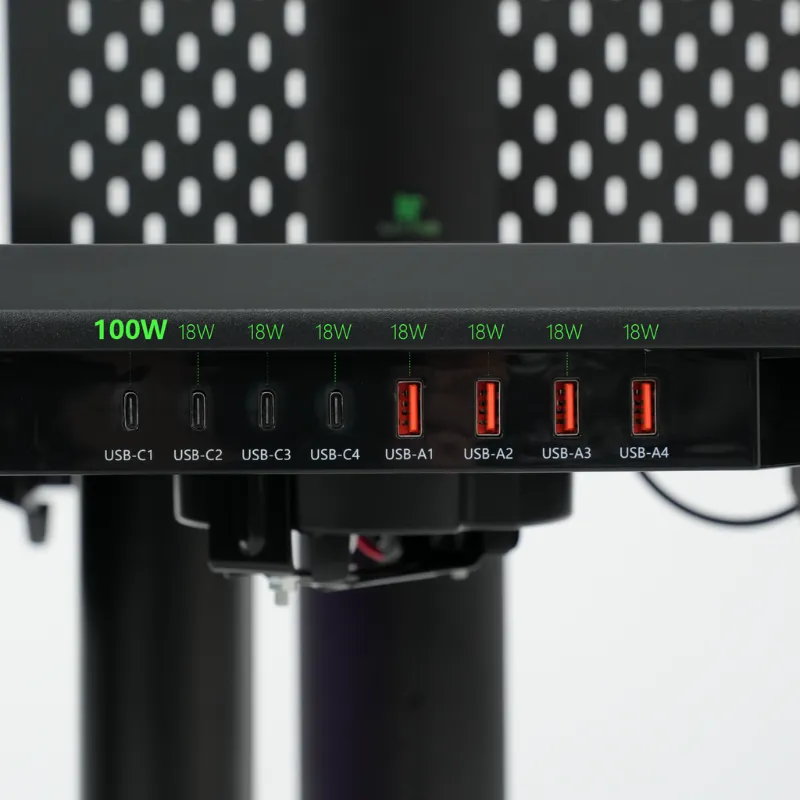
Not all ports deliver the same wattage. A hub rated for 100W total might split that as 65W to one USB-C port, 18W to another, and 5W each to USB-A ports. Plugging in a laptop, tablet, and two phones all at once can trigger power negotiation, slowing charge speeds.
For home office use, prioritize these configurations:
- One high-wattage USB-C PD port (65W+) for your laptop
- One or two mid-wattage USB-C ports (18–30W) for tablets or fast-charging phones
- Two to four USB-A ports (5–12W) for wireless mouse dongles, keyboards, or older accessories
- Two AC outlets for monitors, desk lamps, or a desktop windtunnel
Avoid hubs that split power evenly across many ports unless you only charge low-draw devices. A six-port hub rated at 60W total delivers just 10W per port, too slow for modern phones.
Grab the latest Livtab code before you buy—the current offer saves $100 sitewide, which covers most of the cost of a premium charging station.
Cable Management and Desk Organization
Even the best charging hub creates clutter if cables sprawl everywhere. Route cables along the back edge of your desk or through built-in channels. Use velcro ties to bundle cables together, and leave a small loop of slack near each device so you can unplug without strain.
Place your hub within arm's reach but out of your primary work zone. The back-left or back-right corner of your desk works well. If you use a creator desk with a monitor arm, mount the hub on the arm's vertical pole using a VESA adapter bracket or adhesive mount.
For setups that include unconventional furniture—like a fridge in coffee table or nightstand fridge—run the charging station's power cable behind or under the piece so it is invisible from your usual seated position. This keeps the focus on your work, not your infrastructure.
Safety Features and Surge Protection
Cheap hubs skip essential safety circuits. Look for:
- Surge protection rated at 1,000 joules or higher
- Overcurrent and short-circuit protection to prevent fires
- Temperature monitoring that throttles or shuts down if the hub overheats
- Certifications like UL, ETL, or FCC to confirm the unit passed third-party testing
Never daisy-chain charging stations into power strips or extension cords. Plug the hub directly into a wall outlet to avoid overload. If your office uses a desktop wind tunnel or other high-draw device, confirm your circuit can handle the combined load—most home office circuits are rated for 15 amps (1,800W).
Check current pricing and apply our discount code to save on the safest, highest-rated hubs we tested.
Who Should Invest in a Premium Charging Station
A $20 hub works fine if you only charge a phone and a pair of earbuds. Invest in a premium station if you:
- Charge a laptop, tablet, and multiple accessories daily
- Work with expensive electronics that need surge protection
- Value cable management and a clean desk aesthetic
- Use your home office for video calls where visible clutter is distracting
Pair a premium multiport charging station with furniture designed for modern work—like a smart table or creator desk—and you will build a power system that scales as your device collection grows. The upfront cost pays off in fewer adapters, less cable chaos, and faster charge times across every device you own.
 Shopping at Livtab? See today's verified Livtab discount code
Frequently asked questions
How many devices can a multiport charging station power at once?
Most quality hubs handle four to eight devices simultaneously, but total wattage matters more than port count. A 100W hub can fast-charge a laptop and two phones, while a 30W hub with six ports will charge everything slowly.
Do I need surge protection in a home office charging hub?
Yes. Surge protection rated at 1,000 joules or higher shields laptops, monitors, and other expensive gear from voltage spikes. It is especially important if your home has older wiring or frequent storms.
Can I use a charging station with a standing desk or smart table?
Absolutely. Mount the hub under the desk or secure it to the frame with velcro or adhesive mounts. This keeps cables out of the way when you adjust height or move components.
What is the difference between USB-A and USB-C PD ports?
USB-C PD delivers higher wattage and charges laptops and tablets quickly. USB-A is slower and works best for accessories like keyboards, mice, or older phones. Modern hubs should include at least one USB-C PD port.
Will a multiport hub work with a creator desk or other furniture?
Yes. Charging stations integrate easily with any desk or furniture. Route cables through built-in grommets or along the back edge, and mount the hub under the surface or on a monitor arm for a clean setup.
How do I know if a charging station has enough wattage for my laptop?
Check your laptop's power adapter label for its wattage requirement. Most ultrabooks need 45–65W, while gaming or workstation laptops need 85–100W. Choose a hub with at least that much wattage on a single USB-C PD port.