

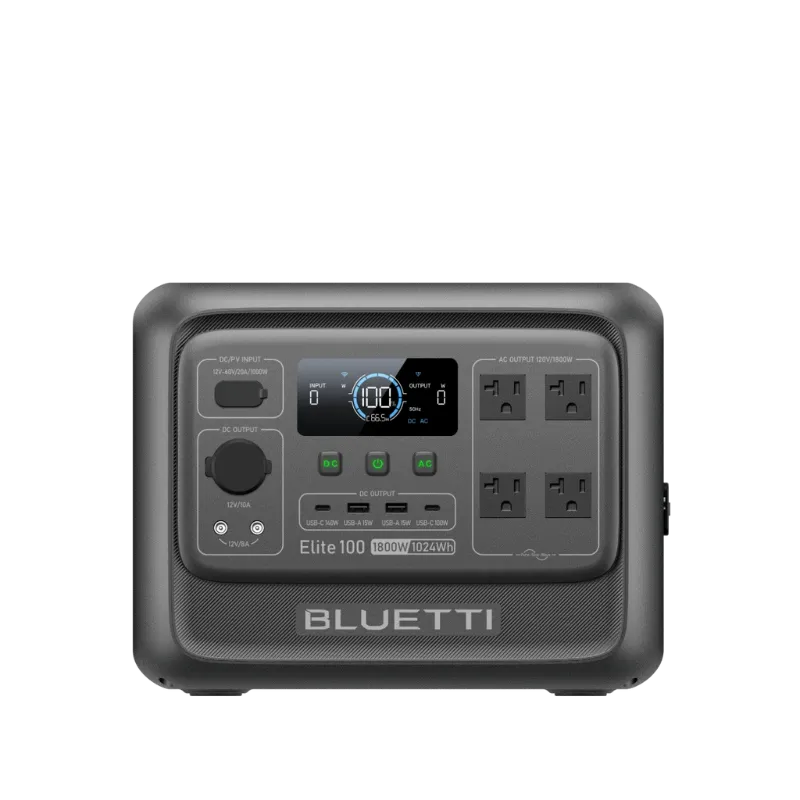
The bluetti elite 1800w portable power station can run most household essentials and many power tools, but only if you add up running watts and surge watts before you plug in. This guide walks through real load planning: what each appliance actually draws, where people get caught out, and when to add a second unit or an expansion battery.
We test loads on our own gear and cross-check specs against the manufacturer sheet, so treat the numbers below as planning rules rather than promises. For current capacity, output, and pricing on any BLUETTI unit, check the latest price on the store page.
Start With Two Numbers: Running Watts and Surge Watts
Every appliance has a running draw (what it uses while working) and a surge draw (the brief spike at startup). The surge is what trips most people up.
- Resistive loads like kettles, space heaters, and incandescent lights pull roughly their rated wattage with little surge.
- Motor loads like fridges, compressors, pumps, and circular saws can spike two to three times their rating for a second or two.
- Electronics like laptops, routers, and TVs are small and easy, but charger bricks add up faster than people expect.
Add up running watts first. Then find the single largest surge in your list and add it to the rest of the running total. That combined figure is what the inverter has to survive, and it is the honest test of any bluetti elite 1800w portable power station.
What the Elite 1800W Handles Well
In practice, an 1800W-class station covers a working day of mixed loads comfortably.
- Fridge or chest freezer on a cycling duty cycle, as long as the startup surge fits
- Laptop, monitor, router, phone chargers all at once with headroom left
- LED lighting for a room or a job site
- Small power tools such as drills, jigsaws, and a shop vac
- CPAP, fans, and small medical devices overnight
- Projector, TV, and soundbar for an evening
What it will not do is run multiple high-draw heating appliances simultaneously. A space heater plus a kettle plus a microwave is a three-way fight you will lose. Run them one at a time and the same unit behaves fine.
Where People Get Caught: Heaters, Greenhouses, and Big Motors
Heating is the biggest load trap in off-grid planning. A resistance heater pulls its full rating continuously, which drains any battery fast. If you are heating a greenhouse off grid, a solar greenhouse heater that moves air or stores thermal mass uses a fraction of the power of a resistive element. Pair a passive or low-draw solar heater for greenhouse setup with a solar greenhouse heater fan, and the station only has to run a small blower instead of a heating element.
The same logic applies to tools. A table saw or air compressor may surge past the inverter's peak even though its running watts look reasonable. Check the nameplate, then check the locked-rotor or startup figure.
Sizing Up: When One Station Is Not Enough
If your load list keeps growing, you have three honest options.
- Cut the load. Swap resistive heat for a lower-draw alternative.
- Stagger the loads. Run the big appliance, then the next one.
- Add capacity. Either a second station or an expansion battery.
The bluetti b300k expansion battery is the cleanest route if you already own a compatible BLUETTI unit. It increases stored energy without adding another inverter, so you keep one screen, one set of ports, and one charging routine. For a bigger jump, step up to the bluetti ac200p portable power station, which gives you more headroom for simultaneous loads.
| Option | Best for | Load profile it suits |
|---|---|---|
| bluetti elite 1800w portable power station | Everyday backup and job sites | Mixed small loads, one big appliance at a time |
| bluetti elite 30v2 | Grab-and-go and small devices | Phones, laptops, lights, cameras |
| bluetti ac200p portable power station | Home backup and larger tools | Multiple loads plus higher continuous draw |
| bluetti b300k | Extending an existing setup | Same loads, longer runtime |
Charging and Recharging in Canada
Capacity is only half the story. How you refill the battery decides whether the setup is practical.
- Wall charging is fastest and the default for home backup.
- Solar input works well in summer, less so in a Canadian winter with short days and low sun angles, so plan for roughly double the panel wattage you think you need.
- Vehicle charging matters for road trips and work trucks. A dc to dc battery charger charges from the alternator while you drive, which is far more efficient than a 12V socket cable.
If you are building a van or trailer setup, a bluetti rv solar system combines panels, a station, and DC charging into one plan. That is the configuration most Canadian off-grid users end up wanting, because it covers summer solar and winter alternator charging in the same system.
Putting a Load List Together
Write it down before you buy. Five minutes with a notebook saves a return.
- List every device you want to run.
- Find the wattage on each nameplate or label.
- Note which ones have motors and need a surge allowance.
- Mark which ones must run at the same time.
- Total the simultaneous running watts, then add the largest surge.
If the total sits comfortably under the inverter rating with margin, you are fine. If it is close, size up. Running an inverter near its ceiling for long stretches is how you shorten its life.
For bigger builds, the bluetti apex 300 + b500k + solarx 4k bundle covers whole-home backup territory, and the smaller bleuetti 300 Portable is a sensible companion unit for rooms far from the main station. If you are shopping from outside Canada or comparing regional pricing, browse the bluetti philippines collection for the same product family.
Who This Station Suits
The bluetti elite 1800w portable power station is the right pick if you want one unit that covers outages, camping, and moderate job-site work without hauling something heavy. It is the wrong pick if your core need is continuous electric heating, or if you plan to run a welder or a large compressor.
Buy the station that fits your real load list, then grab the code before checkout. Our 5% off all orders offer applies storewide, and it is worth checking the current offer before any BLUETTI CA purchase since bundle pricing moves around.
 Shopping at BLUETTI CA? See today's verified BLUETTI CA coupon code
Frequently asked questions
Can the bluetti elite 1800w portable power station run a full-size fridge?
Usually yes, provided the fridge's startup surge fits within the inverter's peak output. Add the fridge's running watts to your other simultaneous loads and check the compressor's startup figure on the label before committing.
How do I know if I need an expansion battery like the BLUETTI B300K?
If your loads fit the inverter but the battery drains faster than you want, you need more stored energy rather than more output. The B300K adds capacity to a compatible unit without adding a second inverter or screen.
Will it run a space heater?
It can run a small resistive heater, but heating drains stored energy very quickly. For greenhouse or shed heating, a solar greenhouse heater with a low-draw fan is a far better match for battery power.
What is the difference between the Elite 1800W and the AC200P?
Both are portable power stations, but the AC200P is built for heavier continuous loads and home backup, while the Elite 1800W is easier to move and better suited to mixed small loads with one larger appliance at a time.
Is there a BLUETTI CA coupon code available?
Yes, our store coupon page currently lists 5% off all orders. Check that page before checkout because bundle and seasonal offers change.
Can I charge it from my truck while driving?
Yes, using a DC to DC battery charger connected to the alternator. It is significantly faster and more reliable than charging from a 12V accessory socket.