

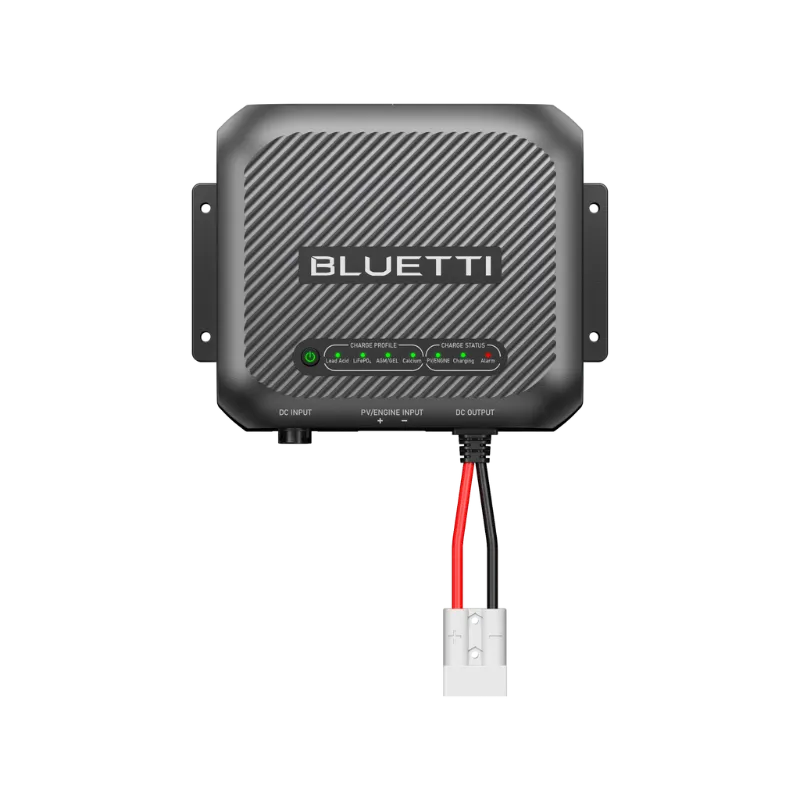
Sizing a dc to dc battery charger is mostly arithmetic: take your house battery bank's amp-hours, pick a charge rate the battery manufacturer allows, then check that the charger's output plus your vehicle's own loads stays comfortably under your alternator's rating. Get those three numbers right and the rest of the build falls into place. Here is how we work through it on real van and truck camper conversions, plus where a dc to dc battery charger fits alongside portable power stations and solar.
Step 1: Work out your usable battery bank size
Everything starts with the house battery, not the charger. Add up the amp-hours you plan to install, then convert to usable capacity.
- Lithium (LiFePO4): roughly 90 to 100 percent usable, so a 200Ah bank gives you close to 200Ah.
- AGM or lead-acid: plan on about 50 percent usable, so a 200Ah bank gives you around 100Ah.
- Expansion batteries count too. If you are growing the bank later, size the charger for the final number, not today's.
Once you know usable amp-hours, estimate your daily consumption in amp-hours (fridge, lights, fan, laptop, inverter losses). The gap between what you use and what solar replaces is what the charger has to cover on driving days.
Step 2: Pick a charge rate your battery actually wants
Battery makers publish a recommended charge current, usually expressed as a fraction of capacity. Many lithium brands are happy in the 0.2C to 0.3C range, which means a 200Ah bank takes roughly 40A to 60A. Lead-acid prefers slower charging, often around 0.1C to 0.2C. Check your battery's datasheet rather than copying someone else's build.
Two practical limits keep this honest:
- A charger bigger than the battery's max charge current is wasted money and can shorten battery life.
- A charger much smaller than the recommended rate means long drives that never quite top the bank off.
Step 3: Check what your alternator can spare
This is where most builds go wrong. Your alternator already feeds headlights, the blower motor, the ECU and the starting battery. A dc to dc charger adds load on top.
- Aim to keep total charging draw at a sensible fraction of the alternator's rated output, not right at the limit.
- Smart alternators on modern vans vary their voltage, which is exactly why a voltage-sensing dc to dc charger beats a simple relay.
- If you are close to the ceiling, choose a smaller charger or plan charging around driving time instead of idling.
A charger with an adjustable output current is the safest buy, because you can dial it back if you upgrade lights, a winch or a second battery later.
Step 4: Match driving hours to the charge you need
A 40A charger running for two hours of driving puts roughly 80Ah back into the bank. If your daily deficit is 100Ah, you need more driving, more solar, or a bigger charger. Do this calculation before you buy anything, because it tells you whether a dc to dc charger alone can carry the build or whether it is only part of the picture.
When a portable power station beats hardwiring a charger
Not every camper needs a full alternator charging system. If you are building a weekend rig, a work truck, or a setup you want to move between vehicles, a portable power station covers a lot of ground with zero wiring.
The bluetti ac200p portable power station is the sort of unit people ask about for van life because it handles AC and DC loads from one box, and you can recharge it from the vehicle, solar, or shore power. If you want a smaller, grab-and-go option for a truck camper or a teardrop, the bleuetti 300 Portable and the bluetti elite 30v2 cover lights, phones and a laptop without touching your vehicle's electrical system.
For a bigger build that mixes hardwired charging with expandable storage, the bluetti b300k expansion battery lets you add capacity to a compatible station instead of rebuilding a battery bank. We have a full BLUETTI B300K expansion battery breakdown in the buying guide if you want the detail.
| Setup | Best for | Charging path |
|---|---|---|
| Hardwired dc to dc charger plus house battery | Full-time van builds with big banks | Alternator, then solar |
| Portable power station | Weekend campers, work trucks, rentals | Vehicle 12V, solar, shore power |
| Station plus expansion battery | Growing builds that want flexibility | Solar and AC, plus vehicle input |
Pairing the charger with a BLUETTI RV solar system
Most capable builds end up with two charging sources: the alternator while driving and solar while parked. A bluetti rv solar system handles the parked half of that equation, and it is worth planning both at the same time so your wiring, roof space and battery bank all agree with each other.
A few things we check before committing:
- Roof real estate. Measure usable roof area before you fall in love with a panel count.
- Charge controller compatibility. Match controller voltage and current to the array and to the battery.
- Cable runs. Long runs from the roof need heavier cable to avoid voltage drop.
- Future expansion. Leave a spare port or a fused busbar for the next addition.
If you are also heating a growing space off grid, the same planning logic applies, and we cover solar greenhouse heater off grid setups separately because the load profile is completely different from a camper.
How much charger do you actually need?
A simple sanity check before you buy: compare the charger's output to the battery's recommended charge current, then compare the total draw to what your alternator can spare. If the charger number is the smaller of the two, you are in good shape. If it is bigger on either count, step down a size.
For Canadian buyers, stock, pricing and shipping change often, so grab the code before you check out, and confirm current pricing on the store page rather than relying on an old screenshot. We keep the BLUETTI CA coupon code page updated with the live offer, which currently runs 5% off all orders.
Who this sizing process suits
- Full-time van lifers: hardwired dc to dc charger plus solar, sized generously.
- Truck camper owners: a mid-size charger and a compact station for small loads.
- Weekend and rental builds: portable power only, no vehicle wiring at all.
- Off grid cabin and greenhouse users: solar-first with a charger as backup, not the primary source.
If you are building around a bundle, the bluetti apex 300 + b500k + solarx 4k packages generation and storage together, which removes a lot of the guesswork. Buyers comparing the larger end of the range should also read our BLUETTI AC200P review notes before deciding, and shoppers outside Canada can browse the bluetti philippines collection for regional availability.
Sizing is not glamorous, but it is the difference between a build that keeps the fridge running in November and one that dies by the second cloudy day. Do the three numbers first, then choose hardware.
 Shopping at BLUETTI CA? See today's verified BLUETTI CA coupon code
Frequently asked questions
Do I need a dc to dc battery charger if I already have solar?
Yes, for most van and truck camper builds. Solar handles your parked hours and the charger recovers capacity while you drive, so the two sources cover different parts of the day. A build with only one of them usually runs a deficit in winter.
Can I install a dc to dc charger with a smart alternator?
Yes, and a voltage-sensing charger is the right choice. Smart alternators drop their output voltage to save fuel, which confuses simple relay-based setups, while a proper charger reads the signal and manages current deliberately.
Is a portable power station a replacement for a hardwired charger setup?
For weekend and part-time builds, often yes. Units like the BLUETTI Elite 30V2 or the AC200P recharge from a vehicle 12V socket or solar and need no wiring. Full-time builds with large banks still benefit from a dedicated charger.
How do I know if my charger is too big for my battery?
Compare the charger's output to the maximum charge current in your battery's datasheet. If the charger exceeds that number, step down a size. Oversized charging rarely helps and can shorten battery life.
Where can I check current BLUETTI pricing in Canada?
Use the BLUETTI CA coupon page for the live offer and current pricing, since stock and promotions change frequently. The page is updated with the active discount rather than a fixed list price.