

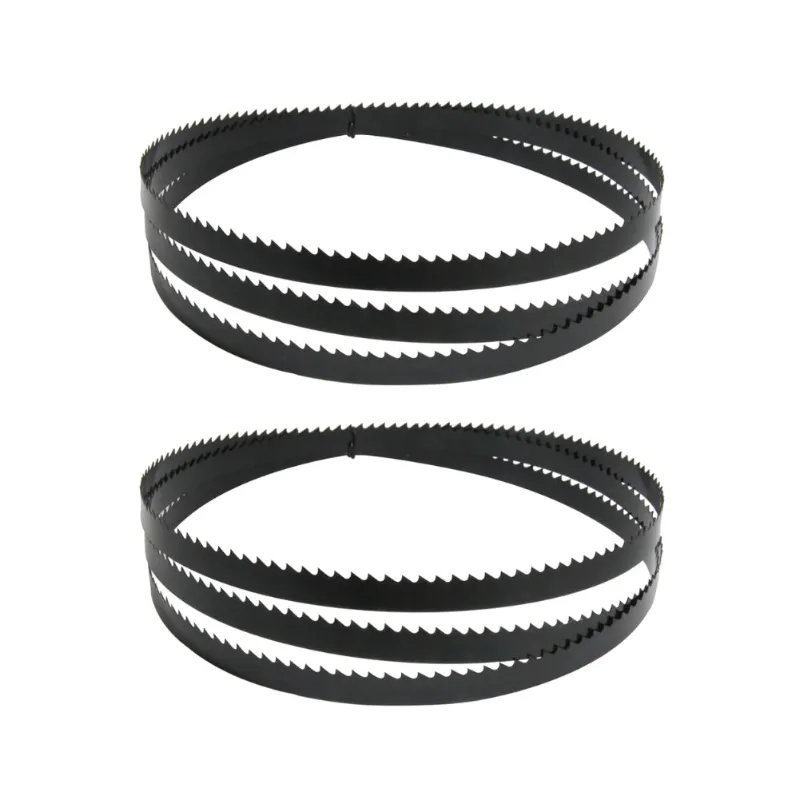
Metal cutting band saw blades are chosen by matching tooth pitch to the thickness of the material you cut, then confirming blade length and width fit your specific saw. Get the pitch right and the blade lasts; get it wrong and you burn teeth on the first cut. This guide walks through the sizing, tooth count, and care decisions that actually matter, and points to the band saw blades and 44 7/8 bandsaw blade we keep on hand for these jobs.
Start With Material Thickness, Not Brand Names
Tooth pitch is the single biggest factor in band saw blade selection. Pitch is teeth per inch (TPI), and it needs to match how thick the workpiece is at the cut.
- Thin stock, tube, and sheet (under 1/4 in): go fine, roughly 14 to 18 TPI, so at least three teeth stay engaged in the cut.
- Solid bar and thick plate (1/4 in to 1 in): a mid pitch around 10 to 14 TPI clears chips without stalling.
- Heavy solid sections (over 1 in): coarse, around 6 to 10 TPI, gives big gullets that carry chips out.
- Mixed scrap and unknown stock: a variable-pitch blade is the compromise, reducing chatter and vibration across changing wall thickness.
The rule of thumb worth memorizing: keep at least three teeth in the cut at all times. Too few teeth and the blade snags and strips; too many and the gullets pack with chips, the blade heats, and teeth dull fast. If you cut mostly one thickness of tube or angle, buy a blade sized for that and stop overthinking it.
Match Blade Length and Width to Your Saw
A blade that does not fit is not a bargain. Before you order, read the spec plate on the saw or the old blade's stamp.
- Length: measured in inches and often fractional, like 44 7/8 in or 64 1/2 in. This is not a round-up situation. Our 44 7/8 bandsaw blade suits saws that call for exactly that length.
- Width and thickness: narrow blades cut tighter curves; wider blades track straighter in thick stock. Do not exceed the maximum width in your manual.
- Tooth set: regular set for general work, hook teeth for fast soft-material cuts, wavy set for thin-wall tube.
If you are replacing a blade on a compact portable unit, check the exact spec first. The dewalt dcs371 blade size listing is a good example of a blade sold against a specific saw model, and that is the detail that saves a return. Saw blade compatibility across the shop is the same story: measure, then buy.
The Other Blades You Will Need Alongside It
A band saw rarely does the whole job. The rest of the bench usually looks like this:
| Tool | Blade or disc to choose | What it handles |
|---|---|---|
| Miter saw | 10 inch miter saw blade | Crosscuts on trim and light stock |
| Table saw | 8 1 4 table saw blade | Ripping and dimensional work |
| Jigsaw | dewalt jigsaw blades | Curves and cutouts in sheet metal |
| Angle grinder | 4 1/2 disc grinder | Cleaning up cuts and grinding welds |
Two more that come up constantly in metal and glazing work: a hand scroll saw for fine detail on thin material, and coping saw blades for tight internal curves. If you also cut glass in the same shop, keep a glass cutting wheel separate from abrasive work so the wheel stays clean.
For wood-only tasks on the same bench, a fixed base router and a small 3 in saw round out a kit without much overlap. Grinder disc choices and jigsaw blade fit tend to trip people up more than band saw blades, mostly because the wrong disc gets used for the wrong material.
Cutting Technique That Saves Blades
Most premature blade failure is operator error, not a bad blade.
- Break in a new blade. Start with a few light, slow cuts on scrap so the teeth wear evenly instead of chipping.
- Let the saw do the work. Feed pressure that forces the blade deflects it and dulls teeth. If you are pushing hard, the pitch is probably wrong.
- Use coolant or cutting fluid on metal. It extends life noticeably, especially on solid stock.
- Check tension and tracking before every session. A loose blade wanders and cuts crooked, and crooked cuts load one side of the teeth.
- Clear chips. Packed gullets are the number one cause of stripped teeth on thin-wall tube.
When a blade starts needing pressure to cut, or the cut drifts off your line, it is done. Sharpen nothing, replace it. Trying to finish a job on a dull blade risks cracking the band and damaging the wheels.
Budgeting and Buying
Prices on metal cutting band saw blades vary widely by length and pitch, so check the current listing rather than assuming. Two practical notes:
- Buy two of the pitch you use most. A spare means one dull blade does not stop a job.
- Skip the cheapest bulk packs for thick stock. Bi-metal blades cost more and last far longer than carbon steel on anything harder than aluminum.
On stock, shipping, or returns, the Fox Bc store overview covers current pricing and 10% off sitewide, and it is worth grabbing the code before checkout on any blade order. Returns and exchanges policy details are there too, which matters most on length-specific blades you cannot visually check before they arrive.
Who This Guide Is For
This is written for the fabricator cutting tube and angle on a benchtop saw, the maintenance tech replacing a blade on a portable unit, and the hobbyist who just bought a used band saw with no manual. If you already know your blade length and mostly cut one thickness of material, buy that pitch and stop reading. If you cut a mix of sheet, tube, and solid bar, variable pitch is your generalist answer.
Start with thickness, confirm length and width, then buy a spare of whatever you use most. That order solves most of the problems people bring to us. For the blade itself, metal cutting band saw blades are the place to start, and the store page has the current offer.
 Shopping at Fox Bc? See today's verified Fox Bc discount code
Frequently asked questions
How many TPI do I need for metal cutting band saw blades on thin-wall tube?
Use a fine pitch, roughly 14 to 18 TPI, so at least three teeth stay in the cut through the wall. Coarse blades on thin tube snag and strip teeth quickly.
Will a 44 7/8 bandsaw blade fit my saw?
Only if your saw's spec plate or manual calls for exactly 44 7/8 inches. Band saw blade length is not interchangeable, so check the stamp on the old blade or the label on the machine before ordering.
What is the DeWalt DCS371 blade size?
That saw takes a specific replacement blade length and width, which is why blades are often listed against the model number. Confirm against your manual, then use the model-specific listing on the product page.
Can I use the same blade for aluminum and steel?
You can, but tooth pitch and speed matter. Aluminum cuts faster and clogs finer pitches, so a coarser, variable-pitch blade handles both materials with less trouble.
How do I know when a band saw blade is worn out?
When the saw needs extra feed pressure to cut or the cut drifts off your line, the teeth are dull. Replace it rather than pushing through, since a dull blade can crack and damage the wheels.
Do I need a separate miter saw or jigsaw blade for metal work?
Often yes. A band saw handles straight cuts well, but a jigsaw with the right blade is better for curves and cutouts, and an angle grinder cleans up the cut edges.