

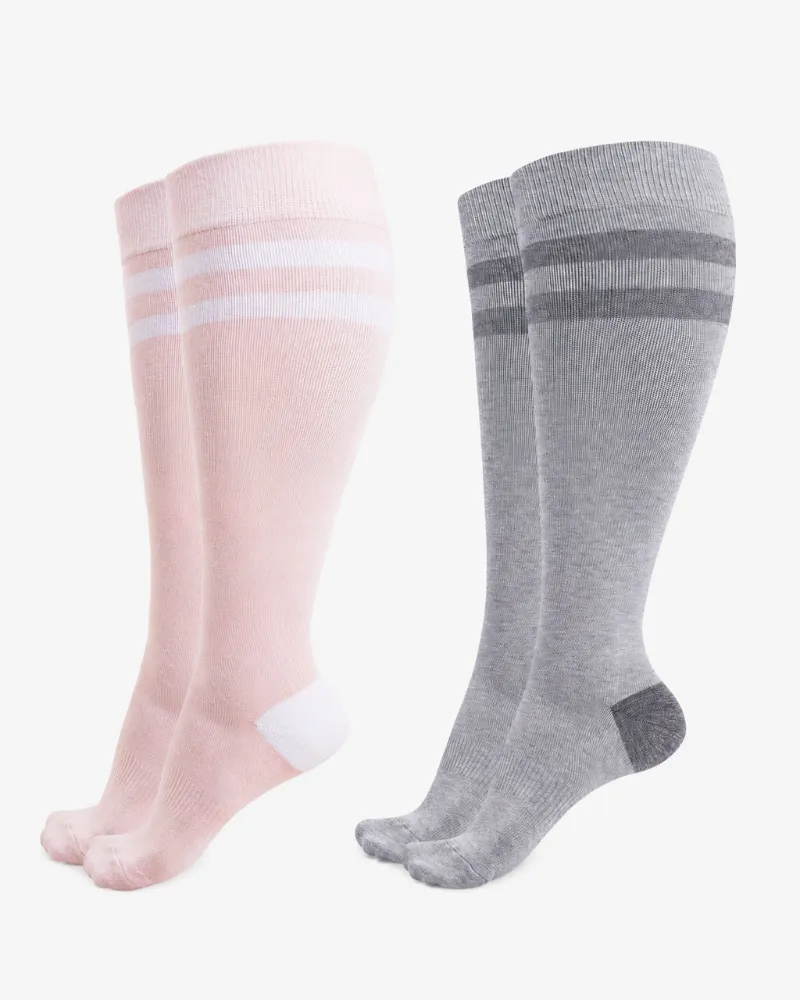
Most circulation socks for pregnancy last around six months of regular wear, or roughly 40 to 60 washes, before the compression fades enough to stop helping. Rotate at least two pairs, wash them gently, and you will usually land closer to the longer end of that range. Here is how we judge when a pair is done, and what actually makes one last.
How Long Circulation Socks for Pregnancy Last, in Real Life
Compression garments are consumable, like running shoes. The fabric does not tear so much as relax. Gradient compression works by pressure that is highest at the ankle and lighter as it climbs the leg, and that pressure lives in elastic fibers that stretch and recover every single time you pull the sock on.
What we see when we track pairs over a pregnancy:
- One pair worn every day: replace around 4 to 6 months
- Two pairs on rotation: each pair typically reaches 6 to 8 months of daily use
- Occasional wear (travel days, long shifts, cold offices): a year or more
- Postpartum wear after swelling settles: the pair usually stops fitting correctly before the fabric wears out
The number that matters is not the calendar, it is how many wash and wear cycles the elastic has survived. A pair worn three days a week is not on the same schedule as one worn from morning to bedtime.
Five Signs It Is Time to Replace Them
The tricky part of compression is that failure is quiet. The sock still looks like a sock, and it still feels snug when you put it on, because your leg fills it. What changes is how much pressure it delivers once it is on.
| What you notice | What it means | What to do |
|---|---|---|
| Cuff slides down or rolls during the day | The top band has lost elasticity | Replace, or try a different size |
| Deep marks or a tourniquet feel at the top | Too tight at the band, often wrong size | Re-measure and resize |
| Fabric looks thin or slightly shiny at heel and toe | Fiber breakdown from friction and washing | Replace |
| You feel no difference after a long day on your feet | Compression has relaxed | Replace |
| Sock twists or bunches at the ankle | Loss of shape memory | Replace |
Two more quiet clues: the sock takes less effort to pull on than it did a month ago, and your old pair suddenly feels "normal" next to a new one. If you compare a fresh pair with a six month old pair back to back, the difference is obvious. That is the honest test.
What Makes a Pair Last: Materials and Construction
Not all compression is built the same, and the cheap pair that dies in eight weeks is not a bargain.
- Nylon and spandex blends hold their recovery better than cotton-heavy knits.
- Graduated compression knit into the fabric outlasts socks where tightness comes mostly from a firm cuff.
- Reinforced heel and toe are where most pairs wear through first.
- Flat seams reduce friction points that thin the fabric.
- Two pairs minimum so each one rests a full day between wears, which lets the elastic recover.
Our circulation socks for pregnancy are the pair we recommend starting with, and buying two is not upselling. It is how you get a full pregnancy out of a single purchase.
Care That Adds Months to Any Pair
Washing is where most people shorten a sock's life without meaning to. Heat is the enemy, and so is anything that coats the fibers.
Do this:
- Wash after every wear, cool water, mild detergent.
- Hand wash, or use a mesh laundry bag on a gentle cycle.
- Roll the sock in a towel to press out water instead of wringing it.
- Air dry flat, away from direct sun and radiators.
Skip this:
- Fabric softener, which leaves a film on elastic fibers
- Bleach and harsh stain treatments
- Tumble drying, even on low
- Draping wet socks over a heater or towel rail, which stretches the cuff out of shape
- Storing them knotted or stretched over a hanger
Hand washing a pair takes about a minute in the sink. If that is not realistic for you at 34 weeks, the mesh bag is the next best thing. Either way, plan on air drying overnight so a wet sock never sits in a hamper for three days.
Fit and Sizing: Why the Wrong Pair Wears Out First
A sock that is too small fails fast. You fight it on, the cuff digs in, and the fabric is under constant strain. A sock that is too big slides, bunches at the ankle and delivers uneven pressure. Either way you replace it sooner than you should.
Measure ankle circumference and the widest part of your calf, and re-measure around 28 weeks. Legs change in pregnancy, and the size that fit at 16 weeks may not be the size that fits at 36. The same principle of fit and comfort applies to anything you wear for hours at a stretch, from a momcozy Wearable Breast Pump flange to a support band. Sizing is not a detail.
For the evening routine, socks plus real sleep support changes how the next morning feels. Our momcozy pregnancy pillow and maternity gym ball are the two pieces we hear the most about from readers pairing compression with better rest and gentle daily movement.
When to Restock: Codes, Registry and Returns
Two moments matter for buying: before the third trimester rush and after you have actually worn a pair for a week or two and know your size is right.
- Registry and gifting: compression socks are an easy add for a baby shower registry, and nobody thinks to buy them for you.
- Sale and clearance: seasonal sales are the right time to add a second pair, not the right time to stockpile four pairs you may not need.
- Shipping and delivery: order early enough that a sizing exchange does not leave you without socks for a week.
- Warranty and returns: check the window before you wear a pair outdoors, since worn garments are usually excluded.
- Discount code terms: read the exclusions so you are not surprised at checkout.
Before you buy, check the latest price and current offer on our store page. If you are bundling socks with bigger gear, grab the code here first and apply it to the whole order rather than adding items one at a time.
One last note on timing: if you wore your socks through labor and the first weeks postpartum, treat that pair as finished once swelling settles. Fluids shift fast, the fit changes, and a sock that was perfect at 38 weeks is often the wrong size by week six.
 Shopping at Momcozy? See today's verified Momcozy discount code
Frequently asked questions
How often should I replace circulation socks for pregnancy?
Plan on a new pair roughly every six months of daily wear, or as soon as the cuff stops holding. If you rotate two pairs, you can usually get through a full pregnancy and into postpartum before either one needs replacing.
Can I put compression socks in the washing machine?
Yes, if you use a mesh laundry bag, cool water and a gentle cycle, then air dry them flat. Skip fabric softener and the dryer, since heat and softener coatings are what kill the elastic.
How do I tell if compression socks have lost their compression?
Compare them with a new pair. If the old one slides down, twists at the ankle or no longer changes how your legs feel after a long day, the elastic has relaxed even though the fabric looks fine.
Should I size up in the third trimester?
Re-measure your ankle and calf around 28 weeks rather than assuming. Many people do need a different size later in pregnancy, and a pair that is too tight at the cuff will not deliver proper gradient pressure.
Can I keep wearing the same pair after delivery?
Often no. Swelling drops quickly after birth, so the size that fit at the end of pregnancy may be loose within a few weeks. Check the fit before you keep wearing them, and treat the labor pair as finished.
Where can I find a Momcozy discount code for compression socks?
Our store page carries the current offer and the terms that go with it. Apply the code to your full cart rather than item by item so it covers everything in the order.