

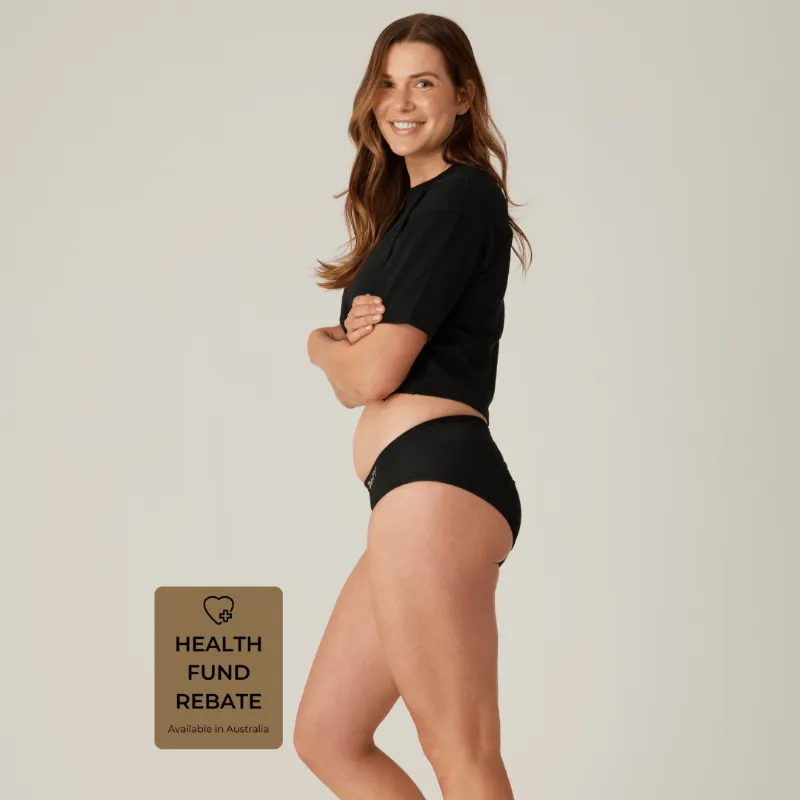
Prolapse support underwear works best when it is sized to your current measurements, put on before the day's lifting starts, and worn in short blocks that build up over a week or two. Get those three things right and pelvic support stops feeling like a device and starts feeling like part of your normal clothes. This guide covers fit, fabric, layering and the rest of your recovery wear, so the support does its job while you get on with the day.
What prolapse support underwear does, and what it does not
Support underwear gives the pelvic area a light, even, upward hug. It does not treat prolapse and it does not replace a pessary or a pelvic health physiotherapist, but it does cut the dragging, heaviness and bounce that make long days hard, especially in the first months postpartum or while you are rebuilding strength.
What separates a real support garment from a firm pair of knickers:
- Even compression across the lower belly and perineal area, not a tight elastic band cutting in
- Flat seams and a gusset that will not press or rub on healing tissue
- A waistband that stays put when you bend, cough or lift a toddler
- Breathable, quick-drying fabric that can handle a full day and a wash cycle
If you are still deciding between styles, our guide to prolapse support options is worth a read before you buy, then check the latest price on the size you want.
Sizing and fit guide for prolapse support underwear
Choose by your measurements today, not by the size you wore before pregnancy. Measure your hips at the widest point and your waist at its natural crease, in the morning, then compare to the store size chart.
- Between sizes? Size up for all-day wear. A slightly larger pair you forget about beats a tighter pair you keep adjusting.
- Fit test: cough hard, sit down, climb a flight of stairs. The garment should stay in place with no rolling at the waist and no digging at the leg.
- Red flags: tingling, numbness, deep red marks after 20 minutes, or a band that rides down when you walk. That is too small or the wrong cut.
- Snug like a handshake, not tight like a tourniquet. If you have to wriggle to get it on, it will be unbearable by lunchtime.
Our postpartum compression shorts have a similar fit logic and are a good reference point for how much compression feels right on you before you commit to a support brief.
How to wear prolapse support underwear comfortably through the day
Comfort is a schedule as much as a size. This routine works for most people easing back into normal activity.
- Put it on first. Wear it under your clothes from the moment you get dressed, before the school run, the hoovering or the dog walk, not after your symptoms start.
- Start with blocks of two to three hours. Build by an hour every few days rather than going straight to a 12-hour day.
- Dress over it loosely. Wide-leg trousers, midi skirts and soft-waist leggings stop fabric from pushing the support out of position.
- Take a seated break. If you can, slip it off for 20 minutes at lunch, or at least sit and let your ribs and hips settle instead of standing all afternoon.
- Come out of it at night. Unless your clinician says otherwise, support underwear is a daytime garment. Sleep without it.
- Rotate pairs. Two or three in rotation keeps elastic doing its job and means you are never waiting on a wash.
Layering with postpartum compression wear and maternity compression shorts
Order matters more than people expect. Support underwear goes closest to the skin, compression garments go over the top, and day clothes last.
| Layer | Best for | Notes |
|---|---|---|
| Prolapse support underwear | All-day pelvic heaviness | Base layer, flat seams |
| Postpartum compression shorts | Early recovery and walks | Over underwear, under trousers |
| Maternity compression shorts | Bump support in later pregnancy | Check the waistband height |
| Maternity tights | Cold days and swelling | Smooth base for dresses |
For the early weeks, postpartum compression wear is the easier starting point: it does the same holding job with a gentler feel while you work out how much support you actually want. If you are pregnant rather than postpartum, maternity compression shorts and maternity tights give bump support without the pelvic pressure of a full support brief, so keep the two jobs separate until your clinician confirms what suits you.
Fabric and care instructions
Support garments die in the tumble dryer. Look after the fabric and a pair will hold its shape for months.
- Wash cool on a gentle cycle, in a mesh bag if you have one
- Skip fabric softener, which coats elastic and kills stretch
- Air dry flat, away from direct heat
- Rinse after sweaty days, since salt degrades elastic faster than detergent
- Retire any pair with stretched, shiny or curling edges. A tired waistband stops supporting and starts rubbing
The rest of the day: pregnancy comfort support beyond the pelvis
Pelvic support is only part of feeling comfortable. Legs and wrists take a beating in the same months, and layering the right basics makes the whole day lighter.
- Maternity compression socks for swelling, long sits and standing shifts. Graduated compression from ankle to calf does the work.
- Trtl travel bamboo compression socks and trtl bamboo compression socks for flights and car journeys, where bamboo knit feels cooler than standard nylon blends. Travel sock features to look for: graduated compression, a wide non-binding cuff and a breathable knit.
- Wrist splints for pregnancy for the night-time carpal tunnel tingling that shows up in the third trimester. Wear them to sleep, not to type.
Shipping, returns and buying with our code
Fit is the one thing you cannot judge from a size chart alone, so buy from a store with a clear exchange policy and order the size you measured rather than the one you hope to shrink into.
- Read the size chart against your own measurements, not your pre-pregnancy size
- Keep the packaging until you have worn the garment for a full day
- If it rolls, digs or rides down, exchange rather than tough it out
You can grab the code for 10% off all orders, and check the shipping and returns terms on the same page before you commit. One well-fitted pair plus a spare is a better buy than three cheap pairs that lose their hold.
Prolapse support is meant to make normal life easier, not to be another thing to manage. Measure properly, break it in slowly, layer it under clothes that let it work, and wash it kindly. Do that and the support disappears into your day, which is exactly what you want.
 Shopping at TheRY? See today's verified TheRY discount code
Frequently asked questions
How long can I wear prolapse support underwear in a day?
Most people do best starting with two to three hour blocks and building up to a normal day over a week or two. Take it off at night unless your clinician advises otherwise, and take a seated break if you feel pressure or rubbing.
Should I size up or down in prolapse support underwear?
Size up if you are between sizes. All-day support needs to feel snug like a handshake, not tight, and a garment that rolls, digs or leaves deep marks is the wrong size rather than extra support.
Can I wear postpartum compression shorts over prolapse support underwear?
Yes. Put the support underwear on first, then the postpartum compression shorts over the top and your clothes over those. That order keeps seams flat and stops the outer layer from pushing the support out of position.
Do I need maternity compression socks as well?
Only if you have swelling, long standing shifts, travel or heavy legs. Maternity compression socks work on the legs, not the pelvis, so they are a separate layer rather than a replacement for support underwear.
How do I wash support underwear so it keeps its compression?
Wash cool on a gentle cycle, skip fabric softener and air dry flat away from direct heat. Rotating two or three pairs and retiring any with shiny, stretched or curling edges will keep the hold consistent.
What if the fit is wrong when it arrives?
Exchange rather than wearing something uncomfortable. Keep the packaging until you have tested the garment for a full day, since rolling, digging or riding down are fit problems, not something you should push through.