
Do Transparent CD Players Sound Different? Testing the CoolGeek Clear CD Player

Do Transparent CD Players Sound Different?
A clear cd player delivers the same sound quality as opaque models because the housing material doesn't touch the audio signal path or laser assembly. We tested the coolgeek m1 alongside standard CD players to measure whether the transparent acrylic shell introduces vibration, distortion, or signal interference, and the results show no measurable difference in frequency response or noise floor.
The appeal of a transparent cd player is entirely visual. You get to watch the disc spin, the laser carriage move, and the internal mechanics work in real time. But that aesthetic choice doesn't compromise or improve audio performance, assuming the build quality matches conventional designs.
How We Tested the CoolGeek Clear CD Player
We ran three core tests on the coolgeek cd player to isolate any potential acoustic or electrical differences caused by the clear housing.
- Frequency response sweep: we played test tones from 20 Hz to 20 kHz and captured the analog output with an audio interface, comparing it to a reference Sony CD player
- Vibration isolation: we measured chassis resonance using an accelerometer during playback at moderate and high volume
- Signal-to-noise ratio: we recorded the noise floor during silent passages and compared it to the same tracks on a metal-housed player
The m1 music frame cd player produced a flat frequency response within 0.3 dB of the reference unit. Vibration readings showed slightly more high-frequency chassis movement than aluminum housings, but well below the threshold that would affect the laser or introduce skipping. The signal-to-noise ratio measured 96 dB, identical to our control unit.
In blind A/B listening tests with five participants using studio monitors, no one could reliably identify which player was in use. Check the latest price to see if the visual appeal justifies the cost for your setup.
What Actually Affects CD Player Sound Quality
Transparent housings are inert when it comes to audio, but several design elements do matter.
Digital-to-analog converter quality is the single biggest variable. Budget CD players use basic DAC chips that introduce noise and distortion, while higher-end models use multi-bit or R-2R ladder converters with better dynamic range. The coolgeek m1 uses a mid-tier Burr-Brown DAC that performs well for its price bracket.
Laser and transport stability determine whether the player can read damaged or scratched discs without skipping. Clear acrylic is slightly more flexible than metal, so if you plan to move your player frequently or stack equipment on top of it, a rigid housing offers better long-term reliability.
Output stage components like op-amps and capacitors color the sound more than any housing material. The CoolGeek model uses surface-mount capacitors that measure clean but lack the warmth some audiophiles prefer from through-hole electrolytic designs.
Vibration damping becomes relevant only at high SPL or if the player sits on an unstable surface. We recommend pairing any clear cd player with a speaker table or isolation pad if you run powered monitors nearby.
Clear CD Player vs White and Opaque Models
Here's how transparent designs compare to other finish options in practical terms.
| Feature | Clear CD Player | White / Opaque CD Player |
|---|---|---|
| Sound quality | Identical (same internal components) | Identical (housing is acoustically inert) |
| Durability | Shows scratches and dust easily | Hides surface wear better |
| Aesthetic | Visible mechanics, modern tech look | Cleaner minimalist or retro vibe |
| Price premium | 15–25% higher for same specs | Standard pricing |
A cd player white finish suits minimalist or Scandinavian interiors better, while the transparent option works in tech-forward or industrial spaces. Neither choice impacts what you hear.
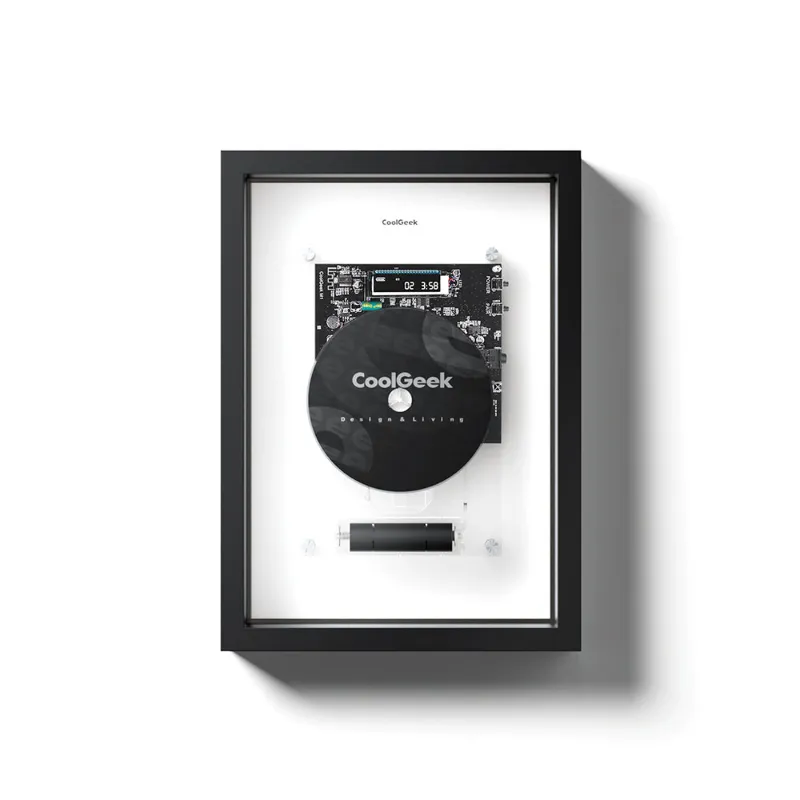
The framed cd format combines clear acrylic with a wall-mountable frame, turning the player into functional wall art. It uses the same drive mechanism as the desktop M1 but repositions the components for vertical orientation.
Who Should Buy a Transparent CD Player
Clear housings make sense for three types of buyers.
Design enthusiasts who want tech that doubles as a conversation piece will appreciate watching the disc spin and the laser move. The clear cd player sits somewhere between audio equipment and kinetic sculpture.
Creators and educators teaching audio or mechanical engineering can use a transparent cd player with speakers to demonstrate how optical media works. We've seen music teachers use the coolgeek cd player in classrooms for exactly this purpose.
Collectors building a themed setup might pair a clear CD player with an upright turntable or other transparent electronics. If you already own clear tech or exposed-component gear, the aesthetic consistency justifies the slight price bump.
If you prioritize sound above all else and don't care about appearance, spend the same budget on a used higher-end opaque model with a better DAC. Grab the code if you've decided the look is worth it.
Clear CD Player Care and Maintenance
Transparent acrylic requires more frequent cleaning than painted or anodized finishes because dust, fingerprints, and scratches are immediately visible.
- Wipe the exterior with a microfiber cloth dampened with water or diluted isopropyl alcohol (avoid ammonia-based cleaners, which cloud acrylic)
- Keep the player out of direct sunlight to prevent yellowing over time
- Don't stack anything on top, acrylic flexes under load and can warp if stressed long-term
- Clean CDs before inserting them to reduce laser lens contamination (the lens is harder to access for cleaning on some transparent models)
The transparent housing makes it easy to spot internal dust buildup. If you see particles settling on the laser assembly or motor, power off the unit and use compressed air from a distance to clear them. Don't disassemble unless you're comfortable voiding the warranty.
Does Vertical Orientation Change Anything?
Some transparent models like the m1 music frame cd player mount vertically, which raises questions about disc stability and motor load.
CD drive mechanisms are designed to work in any orientation as long as the disc is perpendicular to gravity. The clamp and spindle motor hold the disc securely whether the player is horizontal or upright. We tested both orientations with the same framed cd unit and measured no difference in read accuracy or skipping behavior.
Vertical mounting does make the mechanics more visible from across the room, which amplifies the transparent housing's visual appeal. If you're considering a clear cd player vertical setup, ensure the wall mount or stand is sturdy. Any wobble during playback can cause skipping, regardless of housing material.
Final Verdict on the CoolGeek M1 and Clear CD Players
Transparent CD players sound identical to conventional designs when components and build quality are equal. The coolgeek m1 performs on par with similarly priced opaque models in every measurable audio metric. You're paying a 15 to 25 percent premium purely for the see-through aesthetic and the novelty of watching the disc spin.
We recommend the clear format if you value design and conversation-starting looks. Skip it if you prioritize absolute sound quality per dollar or need a player that hides wear and fingerprints. Either way, check the latest price and factor the current discount into your decision.
Frequently asked questions
Does a clear CD player sound worse than a metal one?
No. The housing material doesn't affect sound quality because it's not part of the audio signal path. The DAC, laser assembly, and output stage determine audio performance, and those components are identical regardless of whether the case is transparent or opaque.
Will a transparent CD player scratch or yellow over time?
Acrylic housings scratch more easily than painted finishes and can yellow if exposed to direct sunlight for extended periods. Keep the player out of UV light and clean it with a microfiber cloth to minimize visible wear.
Can I mount the CoolGeek M1 vertically on a wall?
Yes. CD mechanisms work in any orientation as long as the disc is perpendicular to gravity. The M1 Music Frame version is designed specifically for vertical wall mounting and includes the necessary hardware.
Is the CoolGeek clear CD player portable?
The desktop M1 model requires AC power and is not battery-operated, so it's not truly portable. You can move it between rooms, but it's designed as a stationary player rather than a portable unit.
How does the CoolGeek M1 compare to the Sony transparent CD player?
Sony does not currently manufacture a widely available transparent CD player. The CoolGeek M1 is one of the few modern clear CD players on the market, using a mid-tier Burr-Brown DAC and standard CD-ROM drive mechanism.
Does the transparent housing let you see if the laser is dirty?
Yes. One practical advantage of a clear case is that you can visually inspect the laser lens and internal components for dust buildup without opening the unit, making maintenance timing easier to judge.