

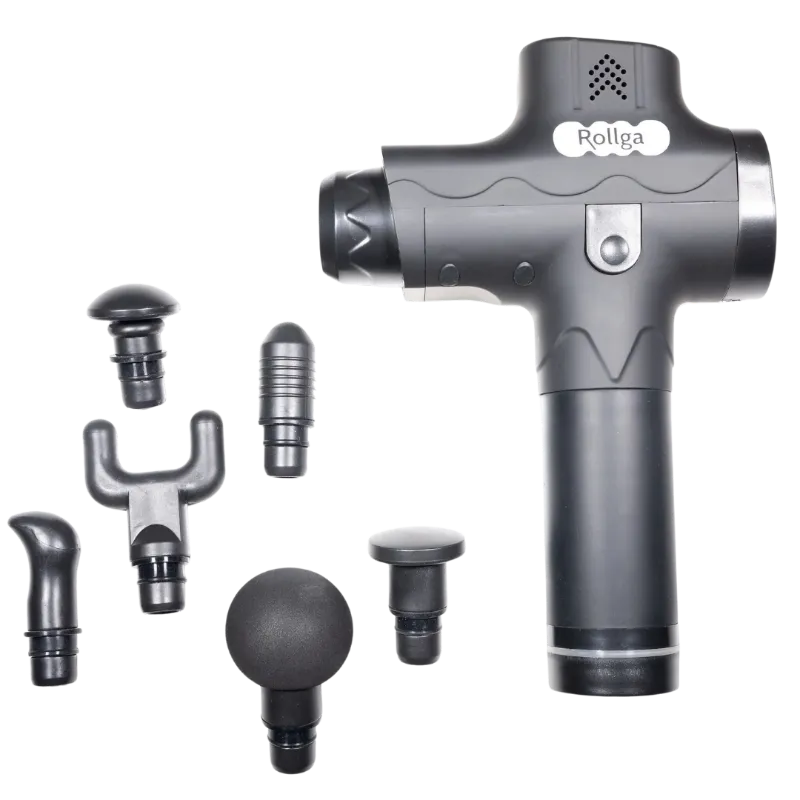
A percussion massage gun helps you recover faster by delivering short, rapid pulses into a muscle so blood flow rises and tight spots let go before they turn into soreness. In our testing, the percussion massage gun is the tool we reach for first after a hard session, and we follow it with a soft foam roller or rolling peanut to smooth out the tissue it just woke up. Below is the routine we actually use, plus the timing, safety rules, and supporting tools that make a percussion massager worth owning.
How a Percussion Massage Gun Helps Muscle Recovery
The head of a percussion massager taps the muscle 20 to 40 times a second depending on the setting. That rapid tapping is what separates it from pressing on a knot with your thumb. The main benefits we notice:
- Faster warm-up. Two minutes on a cold calf or glute beats five minutes of half-hearted stretching.
- Less next-day stiffness. A short session after training seems to take the edge off soreness, especially in the quads and calves.
- Pinpoint access. A gun reaches the upper back, hip crease, and arch of the foot far better than a roller can.
- Less guesswork. You feel the muscle release as you move the head, so you know when to stop.
This is a comfort and circulation tool, not a treatment for an injury. If a spot is sharp, swollen, or bruised, that is a physio conversation, not a gun session.
How to Use a Percussion Massage Gun, Step by Step
- Start on the lowest setting. Turn it on away from your body, then bring the head to the muscle. Most people run the gun too fast and too hard on day one.
- Use the flat head for big muscles, the ball head for curves. A flat attachment sits well on quads and glutes. A rounded one follows the calf and shoulder.
- Work the belly of the muscle only. Stay off bones, joints, the front of the neck, and the spine itself. Glide around the muscle, not across the joint.
- Keep the head moving. Ten to fifteen seconds per spot, 30 to 60 seconds for a whole muscle group. Holding still on one point is how people end up bruised.
- Let the tool do the work. Rest the head on the muscle with light pressure. Pushing hard does not speed anything up.
- Finish by moving. A few slow bodyweight squats or shoulder circles after the gun tells you whether the muscle actually let go.
Total time matters less than consistency. We use the percussion gun for about two minutes per area, once before training and once after, and that is enough for us.
Percussion Massager vs Foam Roller: Order of Operations
The question we get most is which one to use first. We use the gun first for pinpoint work, then the roller for the broad sweep. This is how the tools stack up:
| Tool | Best for | When to use it |
|---|---|---|
| Percussion massager | Calves, glutes, shoulders, upper back | Before and right after training |
| Soft foam roller | Quads, back, hamstrings, whole-leg work | After the gun, or on rest days |
| Rolling peanut | Muscles either side of the spine, hamstrings | When you want two contact points at once |
If you are buying one tool first, the gun covers the most awkward spots. If you already own a gun, the roller is the natural next step. You can check the latest price on both before you decide.
Soft Foam Roller vs Firm Foam Roller
Most recovery pain comes from buying the wrong density, not the wrong technique. A soft foam roller compresses a little under your weight, which makes it far easier to use on the back and on sore legs. A firm roller presses deeper but is unforgiving if you are new to this.
- Choose soft if you are new to foam rolling, if you want to roll your back, or if you plan to roll most days.
- Choose firm if you have rolled for a while and want more pressure on big muscle groups like quads and glutes.
- Buy soft first. Density you can build up to. Bruising kills the habit.
For foam rolling for beginners, and for anyone chasing relief from foam roller for back pain, soft is the safer start. Our Rollga foam roller review covers the contoured shape that makes the soft option easier on bony areas.
Where Balls and Peanuts Fit in Your Recovery Stack
A gun cannot get into everything, which is why the small tools earn their place. Common small yoga ball uses include the arches of the feet, the hip crease, and the space between the shoulder blade and spine. A mini exercise ball is small enough to sit under a glute while you work a trigger point, and mini stability ball exercises double as core work on rest days.
- Small yoga ball: arches, hip crease, chest opening.
- Soft foam rollers: broad sweeps of the legs and back.
- Rolling peanut: two contact points for the hamstrings and the muscles beside the spine.
- Mini stability ball or small fitness ball: low-load core and balance work between sessions.
The rolling peanut is the one people underrate. It sits over the spine without pressing on it, so you get the muscles either side without the discomfort.
Timing, Safety, and Care
- Timing: 30 to 60 seconds per muscle, once or twice a day. More is not better, and a long session on a fresh bruise is a bad idea.
- Skip it on: open skin, varicose veins, acute injuries, and anywhere a doctor has told you to avoid vibration. If you are pregnant or managing a condition, ask first.
- Care: wipe the head with a damp cloth after use, keep the vents clear, and store it charged but not on the charger forever. Dropping it is what ends most percussion massagers early.
For the percussion massager we keep in the gym bag, that wipe-down routine has been the difference between a tool that lasts and one that smells like a locker. If you want the current offer before ordering, grab the code and check the Rollga free shipping policy and Rollga return policy on the same page so there are no surprises.
Start with one muscle group tonight, keep the pressure light, and let the percussion massage gun do the tapping. The recovery habits that work are the boring ones you repeat, not the longest session you ever do.
 Shopping at Rollga? See today's verified Rollga discount code
Frequently asked questions
How long should I use a percussion massage gun on one muscle?
Keep it to 30 to 60 seconds per muscle group, moving the head the whole time. Ten to fifteen seconds on a single tight spot is plenty. Longer sessions do not speed recovery and are more likely to leave you sore.
Should I use a percussion massage gun before or after a workout?
Both work, for different reasons. A short pass before training helps you warm up and find tight spots, and a pass after training helps you wind down. We usually do about two minutes per area each time.
Is a percussion massager better than a soft foam roller?
They do different jobs. A percussion massager gets into calves, glutes, and upper back where a roller cannot reach, while a soft foam roller covers broad areas like the quads and back. Most people get the best result using the gun first, then the roller.
Can I use a percussion massage gun on my back?
Yes, on the muscles either side of the spine, never directly on the spine itself or on the front of the neck. If you want to work the area beside the spine with two contact points, a rolling peanut is often more comfortable.
Do small yoga balls and mini stability balls help recovery too?
They do. A small yoga ball works the arches and hip crease, and a mini stability ball is useful for glute release and low-load core work on rest days. They are cheap additions that cover the spots a gun and roller miss.
Where can I find the current Rollga discount code?
The code and current offer live on our Rollga discount page, along with the shipping and return details. Check that page before you order so you get the code applied at checkout.