
How to Choose the Best USA Map Puzzle for Kids Learning Geography

How to Choose the Best USA Map Puzzle for Kids Learning Geography
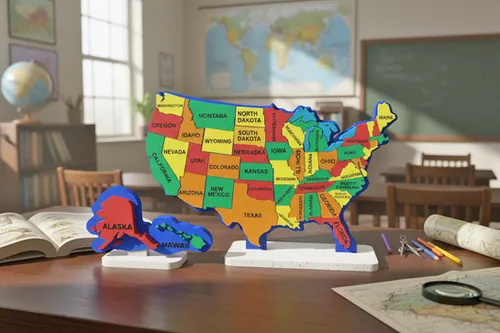
A map puzzle usa helps children master American geography by turning abstract shapes into tangible pieces they can touch, move, and connect. We've tested dozens of geography puzzles to identify what actually supports learning versus what just clutters the playroom, and the right choice depends on your child's age, fine motor skills, and whether you want a quick game or a deep dive into state facts.
Choosing between a map puzzle usa and a united states map puzzle game comes down to format: standalone puzzles work well for independent play and Montessori-style repetition, while game versions add competitive elements and digital integration that some families prefer. Both teach the same core geography, but the experience differs significantly.
Match Piece Count and Complexity to Your Child's Age
Puzzle difficulty matters more than marketing age ranges, because a frustrated six-year-old will abandon a 50-state puzzle while a motivated four-year-old might surprise you with a regional version.
Toddlers and preschoolers (ages 3-5) need:
- Chunky wooden pieces with knobs for gripping
- 10-15 large regions instead of individual states
- Bright colors that differentiate sections clearly
- Pieces thick enough to stand brief chewing incidents
Early elementary (ages 5-8) handle:
- Full 50-state puzzles with moderate-sized pieces
- Foam or thick cardboard that forgives rough handling
- State capitals printed on or under pieces
- Self-correcting edges that only fit the right neighbors
Older kids and adults benefit from:
- Smaller, more detailed pieces that require spatial reasoning
- Topographical features, landmarks, or historical facts
- 100+ piece versions that include territories and waterways
- Challenges like assembling without the frame
We recommend starting one complexity level below what you think your child can handle. A usa map puzzle for adults can frustrate a bright eight-year-old if the pieces are too small or uniform in color.
Wood vs. Foam vs. Cardboard: Material Trade-Offs
Material determines durability, storage, and how the puzzle feels during repeated use. We've repaired or replaced enough puzzles to know which materials earn their price tags.
| Material | Best For | Durability | Price Range |
|---|---|---|---|
| Wood | Montessori classrooms, heirloom quality | 5+ years with care | Higher |
| Foam | Bathtime geography, outdoor play | 2-3 years, resists water | Mid |
| Cardboard | Budget-conscious families, variety | 1-2 years, prone to bending | Lower |
Wooden puzzles like traditional Montessori Puzzle Map of the United States designs offer precision-cut pieces that fit smoothly and teach through tactile feedback. The weight and solidity help younger children understand that each state occupies real space. Edges stay crisp through hundreds of assemblies, making them worth the investment for homeschoolers or families with multiple children.
Foam puzzles survive spills, baths, and outdoor learning sessions that would destroy cardboard. A map toy in foam format works beautifully for kinesthetic learners who need to move while studying. The material is lightweight enough for travel but thick enough that pieces don't blow away during porch lessons.
Cardboard puzzles provide the most variety at accessible prices. You can own a basic state-shape version, a capitals version, and a landmarks version for less than one premium wooden puzzle costs. The trade-off is longevity—expect bent corners and weakened piece tabs within a year of regular use.
Educational Features That Actually Teach Geography
Graphics and labels determine whether a puzzle becomes a genuine learning tool or just a shape-matching activity. The best geography puzzles layer information without overwhelming the learner.
Look for puzzles that include:
- State names printed on each piece so children associate the word with the shape
- Capital cities marked clearly with a star or dot and label
- Color-coding by region (Northeast, Southeast, Midwest, Southwest, West) to build mental frameworks
- Bordering states in complementary colors that make boundaries obvious
- Landmarks or state symbols that create memory hooks beyond just location
A geography kit often pairs the puzzle with flashcards, a blank map for testing, and activity guides that extend learning beyond assembly. These bundles work well for structured homeschool curricula or for parents who want a complete system rather than inventing lessons.
Some families prefer the USA Geography Puzzle digital format for instant feedback and progress tracking, though we find physical puzzles create stronger spatial memory for most learners. The tactile act of rotating a piece, testing a fit, and feeling it click into place engages more neural pathways than dragging on a screen.
Where to Buy and How to Save on Quality Geography Puzzles
Fun House Toys stocks several usa map puzzle game options and related geography tools at prices that beat big-box retailers. Before you buy, check the latest price and grab our current 10% off sitewide code—it applies to puzzles, learning games, and bundled educational kits.
We recommend comparing a standalone map puzzle usa with the united states map puzzle game version to see which format suits your child's learning style. The game version adds competitive scoring and timed challenges that motivate some kids but distract others from pure geography mastery.
Budget strategy for multiple children: Buy one high-quality wooden puzzle for foundational learning, then add foam or cardboard variations that focus on capitals, landmarks, or time zones. The variety prevents boredom without sacrificing the core investment in a durable primary puzzle.
Storage tip: Puzzles left scattered lose pieces within days. Store flat in a drawer, in the original box, or on a dedicated puzzle board that lets you slide the in-progress assembly under a bed or behind a couch. Vertical storage in a bin invites pieces to slip between layers and disappear.
Extending Geography Learning Beyond the Puzzle
A map puzzle teaches location, but context makes that knowledge stick. Pair puzzle sessions with activities that bring states to life.
Connect to family geography: Each time your child places a state, share a fact—"Grandma lives in Ohio," "We drove through Pennsylvania last summer," or "Your favorite apples come from Washington." Personal connections transform abstract shapes into meaningful places.
Combine with complementary learning tools: A pangea puzzle kit teaches continental drift and deep time, giving context for why our modern map looks the way it does. Letter tiles for spelling let younger children practice state names after they've learned to recognize the shapes.
Create challenges: Time how fast your child can complete the puzzle, then challenge them to beat their record. Or assemble it upside down so only the shape matters, not the printed labels. Remove the frame and sort pieces by region before building each section independently.
Use discount opportunities: Save with our code when buying puzzles as gifts—geography tools make excellent birthday and holiday presents that parents actually appreciate receiving, unlike the plastic clutter that usually arrives.
The best usa map puzzle for your family is the one your child will touch, manipulate, and repeat until state locations become automatic knowledge. Start with age-appropriate complexity, choose materials that match your lifestyle, and focus on educational features that layer learning without creating visual chaos.
Frequently asked questions
What age is best for a child to start using a map puzzle usa?
Most children can start with regional map puzzles around age 3 using chunky wooden pieces with knobs, then progress to full 50-state puzzles between ages 5 and 7 depending on fine motor skills and interest in geography.
Are wooden map puzzles worth the higher price compared to cardboard?
Wooden puzzles last 5+ years through hundreds of uses and work well for multiple children or classroom settings, making them cost-effective long-term. Cardboard works fine for casual use but typically needs replacement within 1-2 years.
Can adults benefit from usa map puzzle games?
Adults often find detailed map puzzles with 100+ pieces, topographical features, or timed challenges genuinely engaging for improving geography knowledge or as stress-relief activities. Many families enjoy assembling them together.
How do I keep puzzle pieces from getting lost?
Store puzzles flat in their original box, in a dedicated drawer, or on a puzzle board that slides under furniture. Avoid vertical storage in bins where pieces can slip between layers and disappear.
What features make a geography puzzle educational versus just entertainment?
Educational puzzles print state names on pieces, mark capital cities clearly, use color-coding by region, and include landmarks or symbols that create memory associations beyond just matching shapes.
Do foam map puzzles work for outdoor or bath time learning?
Foam puzzles resist water and survive outdoor conditions that would destroy cardboard, making them excellent for kinesthetic learners who need to move while studying or for families who want flexible learning locations.