
Della Home 5000 BTU vs 8000 BTU Air Conditioner: Which Size Do You Need?

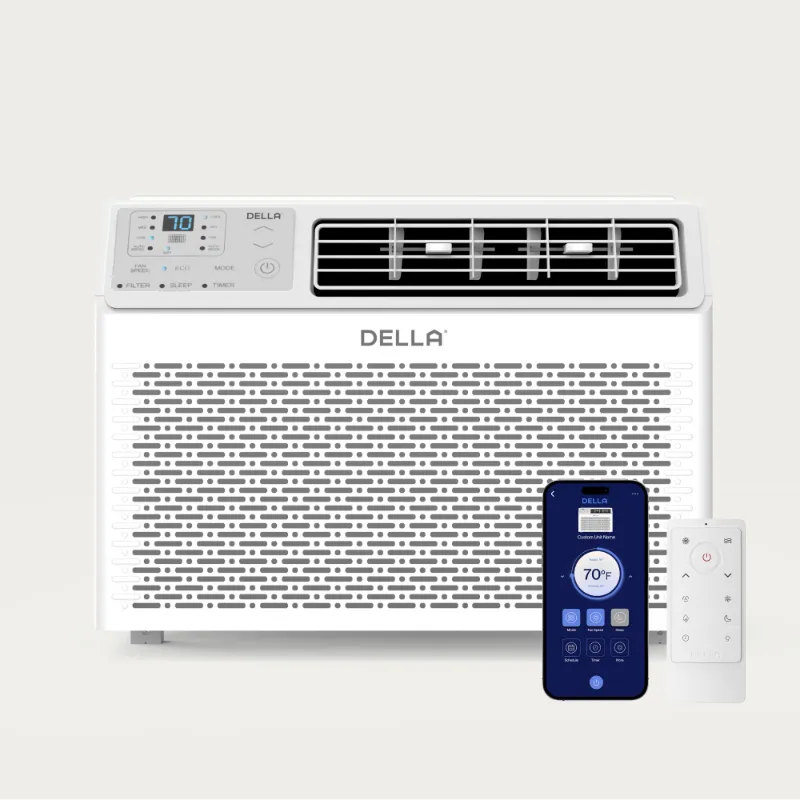
A 5000 btu air conditioner cools rooms up to 150 square feet efficiently, making it ideal for bedrooms, dorm rooms, and small offices, while an 8000 BTU unit handles larger spaces up to 350 square feet. The right choice depends on your room dimensions, ceiling height, sunlight exposure, and whether you need supplemental heating. We tested both capacities from Della Home to help you match cooling power to your actual needs without overspending on energy or upfront cost.
Room Size Coverage: 5000 BTU vs 8000 BTU
The most critical factor is square footage. A 5000 btu window air conditioner effectively cools:
- 100-150 sq ft: single bedrooms, dorm rooms, home offices
- Ceiling height 8 feet or less: standard residential rooms
- Minimal sun exposure: north-facing or shaded windows
An 8000 btu ac unit extends coverage to:
- 250-350 sq ft: master bedrooms, studio apartments, open-plan kitchens
- High ceilings or sun exposure: south or west-facing rooms, vaulted ceilings
- Multiple occupants: living rooms, shared spaces with body heat load
Measure your room length times width in feet. If you land between 150 and 250 square feet, consider insulation quality and window count. Older homes with poor insulation benefit from stepping up to 8000 BTU even in smaller rooms. Check current pricing on both sizes to weigh the cost difference against your cooling needs.
Energy Consumption and Operating Cost
5000 BTU units typically draw 450-550 watts and cost $0.05-$0.07 per hour to run at average U.S. electricity rates. Over a summer season (June-August, 8 hours daily), expect $35-$50 in energy costs.
8000 BTU models consume 650-750 watts, translating to $0.08-$0.10 per hour or $60-$75 for the same summer period. The difference narrows when you factor in runtime: an undersized 5000 BTU unit running continuously in a 250 sq ft room uses more energy than a properly sized 8000 BTU unit cycling on and off.
Modern Energy Star certified models from Della Home improve efficiency across both capacities. The 5 000 btu window ac unit includes programmable timers and sleep modes that reduce overnight consumption by 10-15%. For exact 5000 btu air conditioner watts on specific models, check the specification sheet linked on each product page.
Installation Flexibility and Window Requirements
Both capacities fit standard double-hung windows, but weight and support differ:
| Feature | 5000 BTU | 8000 BTU |
|---|---|---|
| Weight | 40-50 lbs | 55-65 lbs |
| Min window width | 23 inches | 24 inches |
| Support bracket | Optional for ground floor | Recommended for all installs |
A 5000 btu air conditioner portable option eliminates window mounting entirely if you rent or cannot modify your space. Portable units vent through a sliding door or casement window with an included hose kit, though they sacrifice 10-20% cooling efficiency compared to window-mount designs. The aire acondicionado de ventana from Della Home includes Spanish-language controls and universal mounting hardware for both sash and slider windows.
Most municipalities allow window units without permits, but verify HOA rules and apartment lease terms before installation. GE® 5000 BTU models set the industry standard for secure bracket systems that comply with safety codes.
Features Worth Paying Extra For
At the 5000 BTU level, basic mechanical controls suffice. Look for:
- Two cooling speeds plus fan-only mode
- Adjustable louvers for directional airflow
- Washable filter accessible from the front panel
- Energy Saver mode that cycles the fan off between compressor runs
8000 BTU units justify electronic controls and added features:
- Digital thermostat with 1-degree precision
- Remote control for across-the-room adjustments
- 24-hour timer for pre-cooling before you arrive home
- Dehumidification mode that removes moisture without overcooling
The 5000 btu air conditioner with heat option adds a 3000-4000 watt resistance heater, extending usefulness into spring and fall. This costs $30-$50 more upfront but eliminates the need for a separate space heater in mild climates. Grab the code for 5% off sitewide to offset the feature upgrade cost.
Noise Levels and Placement Considerations
Expect 50-55 decibels from a 5000 BTU unit on high speed, comparable to normal conversation. An 8000 BTU model produces 55-60 decibels due to the larger compressor and fan. If noise sensitivity matters:
- Position the unit on an exterior wall opposite your bed
- Run it on low speed overnight (reduces noise by 5-8 dB)
- Check reviews for "quiet" or "whisper" models with insulated compressor compartments
Della Home rates their 5000 BTU line at 52 dB, quieter than competitors like Whirlpool's 5000 BTU unit at 56 dB. The difference becomes noticeable during light sleepers' rest.
When to Choose Each Capacity
Choose a 5000 BTU air conditioner if you:
- Cool a single small room under 150 sq ft
- Prioritize low upfront and operating costs
- Have standard insulation and moderate climate
- Need a lightweight unit for upper-floor installation
Choose an 8000 BTU unit if you:
- Cool 200+ sq ft or multiple connected rooms
- Face extreme summer heat or poor insulation
- Want faster cooldown (reaches set temp 30-40% quicker)
- Plan to use it as your primary cooling source
Our testing confirms that buying one properly sized 8000 BTU unit outperforms running two 5000 BTU models in adjacent rooms, both in energy efficiency and total cost. Review the 5000 btu air conditioner room size guidelines in your product manual and add 20% capacity if your room has large windows, high ceilings, or receives afternoon sun.
For real-world performance data and operating limits across temperature ranges, the DIY forum discussion provides user experiences in climates from Pacific Northwest mild to Southwest desert extremes. Match your local conditions to similar reports for realistic expectations, then check the latest price on your selected capacity to lock in the current discount before summer demand spikes.
Frequently asked questions
What size room will a 5000 BTU air conditioner cool effectively?
A 5000 BTU air conditioner cools rooms between 100 and 150 square feet with standard 8-foot ceilings and average insulation. Add 20% more capacity if the room has large windows, high ceilings, or receives direct afternoon sunlight.
How much electricity does a 5000 BTU window unit use per day?
Most 5000 BTU window units draw 450-550 watts and consume 3.6-4.4 kWh per day when run for 8 hours. At average U.S. electricity rates, this costs approximately $0.40-$0.55 daily or $35-$50 for a full summer season.
Can I run a 5000 BTU air conditioner on a regular outlet?
Yes, all 5000 BTU models run on standard 115-volt household outlets and draw 5-6 amps, well under the 15-amp circuit capacity. No special wiring or dedicated circuit is required for this size unit.
Is an 8000 BTU unit worth the extra cost over 5000 BTU?
An 8000 BTU unit costs $50-$100 more upfront and $20-$25 more per season to operate, but it cools rooms up to 350 square feet versus 150 for a 5000 BTU model. If your room exceeds 150 square feet, the 8000 BTU size prevents constant runtime and delivers better efficiency.
Do 5000 BTU portable air conditioners cool as well as window units?
Portable 5000 BTU models cool 10-20% less effectively than window-mount units because warm exhaust air partially recirculates indoors despite the vent hose. They work best for renters or spaces where window installation is not possible.
What is the difference between aire acondicionado de ventana and standard window AC units?
Aire acondicionado de ventana is simply the Spanish term for window air conditioner. These units often include bilingual controls and manuals but function identically to English-labeled models with the same BTU capacity and installation requirements.