

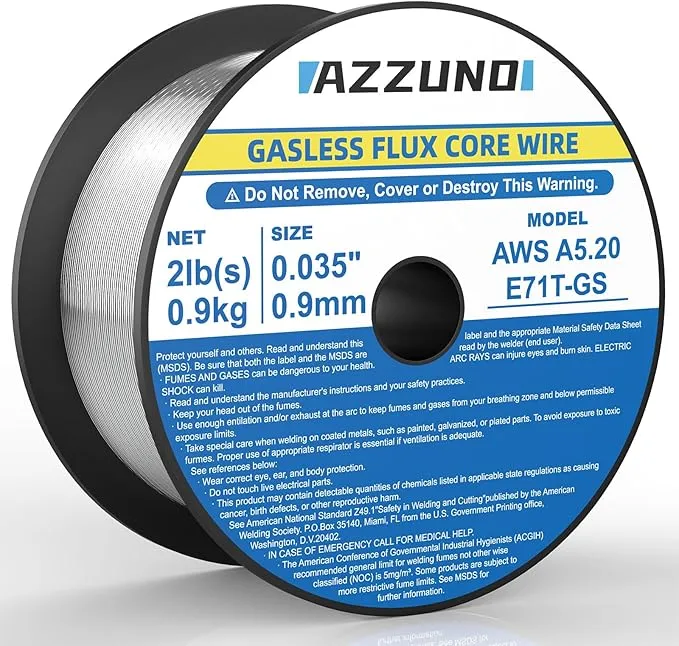
Birdnesting, the tangled knot of wire that forms at your drive rolls or contact tip, almost always comes down to too much drive tension, a worn or wrong-size contact tip, or wire feeding against resistance. The good news: if you are running e71t-gs flux cored wire on a machine like a 200 amp mig, every one of those causes is fixable in minutes without buying anything new. Here is how to diagnose the tangle, prevent it, and get back to clean beads.
Why E71T-GS Flux Cored Wire Birds Nest in the First Place
Birdnesting happens when the drive rolls push wire faster than the wire can exit the gun. The wire buckles and coils up behind the tip, usually right at the drive rolls where the least resistance exists. With e71t-gs flux cored wire specifically, a few things make this more likely than with solid wire:
- It is softer than solid MIG wire. Flux cored wire has a hollow, flux-filled tube that deforms easier under excessive drive roll pressure. Crush it slightly and it feeds erratically or jams.
- Gasless setups run hotter spatter near the tip. Spatter buildup in the contact tip adds exit resistance, and the rolls keep feeding into it.
- No gas bottle means no excuse. If you chose flux core to skip the gas bottle, you still need the same feed discipline as a mig welder with gas, just with knurled drive rolls instead of smooth ones.
Diagnosis tip: pull the trigger with the gun pointed away from you. If the wire stops coming out but the rolls keep spinning and the wire bunches up at the rolls, the problem is exit resistance (tip, liner, or spatter). If the rolls slip and grind the wire, the problem is tension set too low. If the rolls grip hard and the wire still tangles, the wire is being crushed or the tip is wrong size.
Fix the Drive Roll Tension and Set It Correctly
Over-tensioned drive rolls are the number one cause we see, especially on multi-process machines like the bilt hard aluminum 250a 6-in-1 igbt mig welder, where roll pressure often gets set during initial setup and never revisited.
- Feed the wire out a few inches and clamp a pair of pliers lightly on it about a foot from the rolls.
- Trigger the feed. If the rolls slip slightly and stop feeding, your tension is roughly right. If they keep churning the wire without slipping, back the tension off.
- Use the knurled groove for flux cored wire and the smooth or U-groove for solid wire. Running e71t-gs flux cored wire in a smooth V-groove made for solid wire causes slipping and inconsistent feeding.
- Match the groove to your wire diameter. Most hobby machines run 0.030 or 0.035 inch flux core; check the roll markings and swap the roll if needed.
Check the Contact Tip Size and Clean Out Spatter
The contact tip is the other half of the equation. A tip even slightly oversized or clogged turns your gun exit into a bottleneck.
- Match the tip to the wire exactly: 0.035 inch wire needs a 0.035 inch tip for flux core. Do not size up like some people do with solid wire, because the softer flux cored wire will wander and jam.
- Trim the wire back past any spattered section before refeeding. Feeding through a contaminated tip just pushes the jam deeper.
- Keep a tip cleaner or a dedicated reamer in your cart and ream the tip every few minutes of welding. Cheap insurance.
- Replace tips that are bell-mouthed or caked with spatter. They cost pennies and cause hours of frustration.
Clear a Jammed or Crimped Liner Without Replacing It
Resistance inside the liner builds up from flux dust, wire shavings, and general grime. When the wire has to fight the liner, the path of least resistance is coiling up at the rolls.
- Blow the liner out with compressed air from the gun end every time you change a spool. Most birdnest complaints disappear after this one step alone.
- Trim the wire flush at the drive rolls, release the tension arm, and pull the wire back out through the gun by hand. If it comes out with visible shavings and black grit, clean the liner before running new wire.
- Cut the wire end at a clean 90 degree angle every time you rethread. A angled or burred end catches the liner the moment you pull the trigger.
- If the liner is kinked near the gun neck, usually from laying the gun in a tight coil on the bench, straighten the lead and retest. Repeated birdnesting at the same spot in the lead means the liner is permanently kinked and needs replacing.
Store and Feed Flux Cored Wire the Right Way
Flux cored wire is more sensitive to storage conditions than solid wire because the flux core can absorb moisture and the wire surface can pick up rust fast. Rusty or gritty wire sheds debris into the liner, and that debris becomes tomorrow's jam.
- Keep spools in a sealed bag or bin with the original packaging until use, not loose in a drawer.
- Discard the first few feet of wire from any spool that has sat unwrapped for months; it is often rusted or contaminated.
- Wipe the wire with a clean rag as you rethread. It takes five seconds.
- If you burn through spools quickly, a quality spool like e71t-gs flux cored wire with consistent winding will feed noticeably smoother than cheap no-name wire, which is often loosely wound and tangles off the spool itself.
Flux Core vs Gas-Shielded MIG: When Each Setup Makes Sense
Birdnesting is not a reason to abandon flux core, but it is worth knowing where each process fits so you are not fighting the wrong tool:
| Flux core (e71t-gs) | Gas-shielded MIG | |
|---|---|---|
| Best for | Outdoor work, thicker steel, windy job sites | Clean shop work, sheet metal, auto body |
| Spatter | More spatter, more tip cleaning | Minimal with correct settings |
| Feed issues | More sensitive to roll pressure and liner grit | Generally smoother feeding |
| Setup cost | No bottle or regulator needed | Requires gas and regulator |
If you mostly weld outdoors or on rusty, thick stock, stay with flux core and just maintain the gun. If you are moving to thin panels or want cleaner beads indoors, a machine like the bilt hard aluminum 250a 6-in-1 igbt mig welder or a dedicated mig welder with gas gives you both processes on one power source. Whichever route you pick, check the latest price and grab the code on our Azzuno Tools discount page before you buy, since we keep the current 5% off offer updated there.
Quick Prevention Checklist Before Every Session
Run through this list in about two minutes and birdnesting becomes rare:
- Correct drive roll groove and size for your wire diameter
- Tension set by the pliers-slip test, not by feel
- Clean, correctly sized contact tip, reamed of spatter
- Wire trimmed square and fed past any contaminated section
- Liner blown out at every spool change
- Spool stored sealed and the first foot discarded if stale
Most tangles come from one of three things: too much roll pressure, a clogged tip, or a dirty liner. Fix those and your e71t-gs flux cored wire will feed as smoothly as solid wire. If your machine itself is feeding inconsistently even after all this, it may be time to upgrade; our azzuno welder picks and the current discount on the Azzuno Tools discount page make that an easier call.
 Shopping at Azzuno Tools? See today's verified Azzuno Tools discount code
Frequently asked questions
Why does my e71t-gs flux cored wire keep birdnesting at the drive rolls?
It is usually too much drive roll tension, a clogged or oversized contact tip, or resistance in the liner. The rolls keep pushing while the wire cannot exit, so it coils up at the drive rolls.
What drive roll groove should I use for flux core wire?
Flux cored wire needs the knurled groove and should match your wire diameter, typically 0.030 or 0.035 inch. Using the smooth V-groove meant for solid wire causes slipping and erratic feeding.
Can I use a slightly bigger contact tip with flux cored wire?
Yes, for gasless flux core a tip even slightly oversized lets the softer wire wander and jam. Match the tip size exactly to the wire, unlike solid MIG wire where a slightly large tip is sometimes tolerated.
How do I stop flux core wire from rusting and jamming the liner?
Blow it out with compressed air at every spool change, trim the wire square before rethreading, and discard the first foot of any spool that has been stored unwrapped. Rust and grit from stale wire is a major jam source.
Will a multi-process welder like the Bilt Hard 250A 6-in-1 run flux core well?
Yes, machines like a 200 amp mig or a 6-in-1 multi-process unit run flux core fine, but check that the drive rolls have a knurled groove and are set to the right groove and tension for your wire diameter.
Is flux core or gas-shielded MIG better for beginners?
Flux core is better for outdoor and thicker, dirty steel; gas-shielded MIG gives cleaner beads on thin material with far less spatter. Many multi-process machines do both, so you can switch as the job demands.