

# Gas vs. Gasless: Choosing Between a MIG Welder with Gas and an E71T-GS Flux Core Setup
If you're shopping for a new welding setup, one of the first decisions you'll face is whether to go with a mig welder with gas or a gasless flux core rig running E71T-GS wire. Both approaches can produce strong, clean welds — but they suit different projects, budgets, and working conditions. In this guide, we'll break down the pros and cons of each so you can pick the right machine for your shop, garage, or job site.
*(Quick note: if you're buying from Azzuno Tools, don't forget to grab the current offer — 5% OFF All Orders — via the Azzuno Tools discount code page before checkout.)*
How Gas-Shielded MIG Welding Works
A traditional MIG setup feeds a solid wire electrode while a bottle of shielding gas (typically 75/25 argon/CO2) flows around the weld pool, keeping oxygen, nitrogen, and hydrogen out of the bead. The result is a clean, spatter-light weld with an excellent appearance — which is why gas-shielded MIG is the go-to choice for automotive panels, furniture, and anything where looks matter.
A dedicated gas setup like the mig welder with gas gives you precise control over voltage and wire feed, making it easier to dial in thin sheet metal without burn-through. If you're restoring a car or building clean structural joints, this is the route most hobbyists and pros gravitate toward.
Pros of gas-shielded MIG:
- Cleaner welds with minimal spatter and post-weld cleanup
- Better for thin materials and sheet metal
- Smoother arc and easier slag-free welds
- Easier to learn good technique on
Cons:
- You need to buy, transport, and refill gas cylinders
- Wind blows shielding gas away — not ideal for outdoor work
- Slightly higher running costs
How Gasless Flux Core (E71T-GS) Works
A gasless setup uses self-shielded flux cored wire — most commonly e71t-gs flux cored wire — which contains a flux core that vaporizes when welded, generating its own protective gas cloud around the puddle. That means no bottle, no regulator, and no trips to the gas supplier.
Flux core is the practical choice for outdoor fabrication, fence repair, trailer work, and thicker steel. The tradeoff is more spatter and a slag layer you'll need to chip and brush off after each pass.
Pros of E71T-GS flux core:
- No gas bottle — simpler and cheaper to get started
- Works in wind and outdoor conditions
- Deeper penetration on thicker steel
- Easy to swap — most dual-purpose machines run both
Cons:
- More spatter and slag cleanup
- Bead appearance isn't as pretty as gas-shielded MIG
- E71T-GS is best suited to mild steel, single-pass welds
Best of Both Worlds: Dual-Purpose MIG Machines
Here's the good news: you don't have to choose. Many modern machines are gas/gasless dual-purpose, meaning you can run solid wire with shielding gas one day and flip to flux core the next. A versatile unit like the bilt hard aluminum 250a 6-in-1 igbt mig welder handles MIG, flux core, and more in a single package, making it ideal if your projects vary from thin aluminum to heavy steel plate.
If you want a capable mid-range option, a 200 amp mig gives you plenty of headroom for both gas-shielded and flux core work on most hobby and light-fabrication projects.
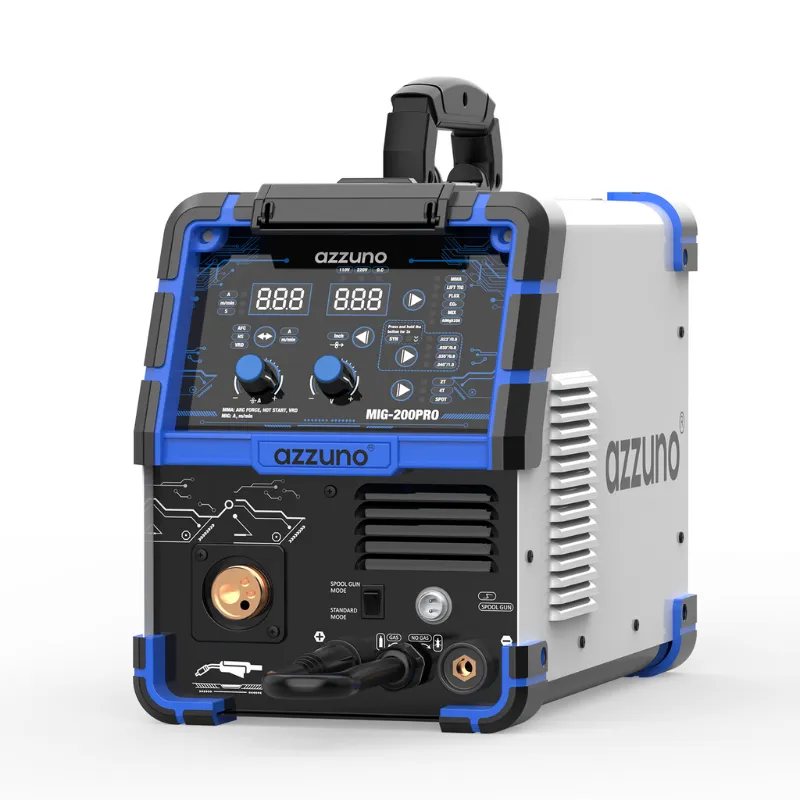
And when it's time to commit to a brand, the azzuno welder line balances price and performance well — check the discount code page for the current 5% off deal.
Quick Comparison
| Factor | Gas MIG | E71T-GS Flux Core |
|---|---|---|
| Weld appearance | Excellent | Good (needs cleanup) |
| Spatter | Minimal | Moderate to high |
| Outdoor use | Poor | Excellent |
| Thin sheet metal | Excellent | Fair |
| Thick steel | Good | Very good |
| Startup cost | Higher (bottle + regulator) | Lower |
| Ongoing cost | Gas refills | Wire only |
A Note on TIG
If your work involves aluminum, stainless, or precision joints, MIG may not be the only answer. An ac dc tig welder opens up AC TIG for aluminum and DC TIG for steel and stainless, with a level of control MIG can't match. And a sharp tungsten is half the battle in TIG — a quality tungsten grinder keeps your points consistent and your arcs stable.
Which Should You Choose?
- Mostly indoor, thin material, appearance-focused work? Go with a mig welder with gas and 75/25 mix.
- Outdoor repairs, thick steel, no gas supply nearby? Run e71t-gs flux cored wire gasless.
- A mix of everything? Get a dual-purpose machine like the bilt hard aluminum 250a 6-in-1 igbt mig welder or a 200 amp mig and keep a roll of each wire on hand.
Whatever you decide, buy once and buy right — and stack the Azzuno Tools 5% off discount on top to make your budget stretch further.
FAQ
Can I run E71T-GS wire with gas? No. E71T-GS is a self-shielded wire designed to work without gas. If you want to run gas-shielded flux core (like E71T-1), that's a different wire that requires a shielding gas bottle.
Is gasless MIG welding as strong as gas MIG? Yes — properly made E71T-GS welds are strong. Strength differences come more from technique and penetration than from the shielding method itself.
Do I need to reverse polarity for flux core wire? In most machines, yes. E71T-GS typically runs on DC straight polarity (electrode negative), while gas MIG runs electrode positive. Always check the wire manufacturer's recommendations and your machine's manual.
Can one machine do both gas MIG and flux core? Yes. Most dual-purpose MIG welders — including the bilt hard aluminum 250a 6-in-1 igbt mig welder — let you switch between solid wire with gas and flux core with a polarity change and wire swap.
What gas should I use for MIG welding steel? A 75% argon / 25% CO2 mix (C25) is the most popular choice for mild steel, offering a good balance of arc stability and penetration. 100% CO2 works too but produces more spatter.
Is MIG or flux core better for beginners? Flux core is easier to start because there's no gas setup, but a mig welder with gas produces cleaner welds that are more forgiving on thin metal. Many beginners start gasless and switch to gas later.
 Shopping at Azzuno Tools? See today's verified Azzuno Tools discount code
Frequently asked questions
Can I run E71T-GS wire with gas?
No. E71T-GS is a self-shielded wire designed to work without gas. If you want to run gas-shielded flux core (like E71T-1), that's a different wire that requires a shielding gas bottle.
Is gasless MIG welding as strong as gas MIG?
Yes — properly made E71T-GS welds are strong. Strength differences come more from technique and penetration than from the shielding method itself.
Do I need to reverse polarity for flux core wire?
In most machines, yes. E71T-GS typically runs on DC straight polarity (electrode negative), while gas MIG runs electrode positive. Always check the wire manufacturer's recommendations and your machine's manual.
Can one machine do both gas MIG and flux core?
Yes. Most dual-purpose MIG welders — including the bilt hard aluminum 250a 6-in-1 IGBT MIG welder — let you switch between solid wire with gas and flux core with a polarity change and wire swap.
What gas should I use for MIG welding steel?
A 75% argon / 25% CO2 mix (C25) is the most popular choice for mild steel, offering a good balance of arc stability and penetration. 100% CO2 works too but produces more spatter.
Is MIG or flux core better for beginners?
Flux core is easier to start because there's no gas setup, but a mig welder with gas produces cleaner welds that are more forgiving on thin metal. Many beginners start gasless and switch to gas later.