

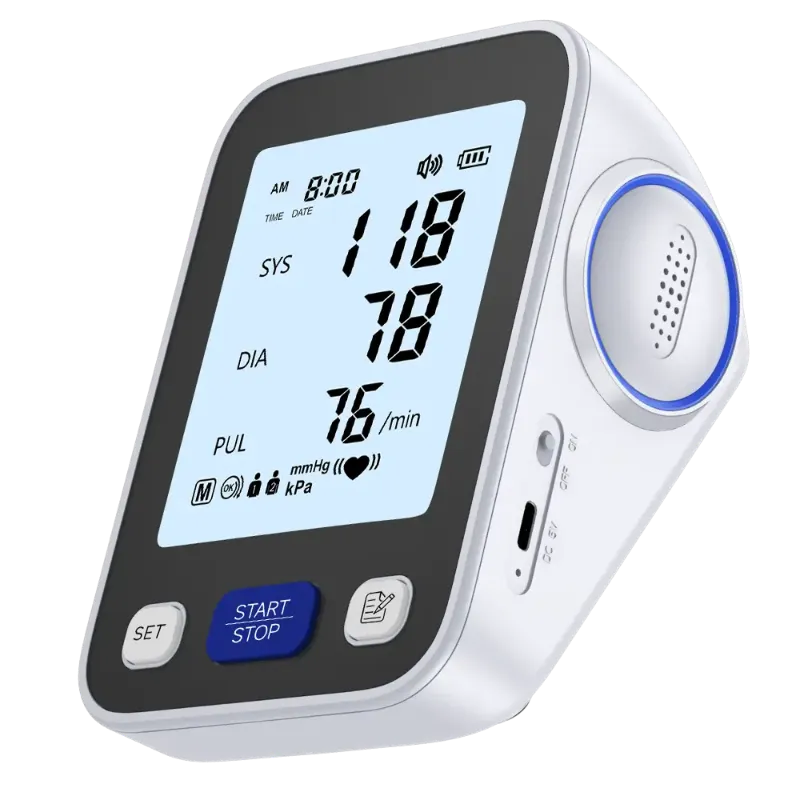
Cuff placement is the most common reason a leader blood pressure monitor returns a number you do not trust, and the BP 205 is no different. The cuff goes on bare upper-arm skin, roughly an inch above the elbow crease, wrapped snug enough to stay put but loose enough for one fingertip to slide under the top edge, with your arm supported at heart height. Nail those three things and most of your "weird" readings stop happening.
Below is the routine we use when testing the bp 205 at home, plus how to sanity-check the results and where blood pressure tracking fits alongside the rest of the RunStar range.
Why Cuff Placement Decides What Your Leader Blood Pressure Monitor Reports
Oscillometric monitors, which is what almost every home unit is, do not listen for sounds. They watch tiny pressure pulses in the cuff as it deflates and calculate systolic and diastolic numbers from those pulses. If the cuff is in the wrong place or at the wrong tension, the sensor is reading a different artery or a weaker pulse, so the maths runs on bad input.
The errors we see most often:
- Cuff a size too small or too large. A tight cuff overestimates, a loose one underestimates or fails to inflate properly. Measure your upper arm circumference before you buy anything, including the BP 205.
- Sleeve fabric under the cuff. Even thin cotton dampens the pulse signal. Roll the sleeve up properly or take the arm out of it.
- Arm hanging at your side. Below heart level can push numbers up noticeably. Rest the forearm on a table at roughly chest height.
- Talking, feet uncrossed, or a full bladder. Each of these nudges readings upward. Sit still and quiet for a few minutes first.
- Cold hands and a cold arm. Peripheral vessels constrict and the pulse signal weakens. Warm up before you start.
Fitting the BP 205 Cuff: A Repeatable Six-Step Routine
Do the same thing in the same order every time. Consistency matters more than perfection, because a comparable trend beats a single tidy number.
- Sit and rest for five minutes. No phone, no conversation, feet flat on the floor, back against the chair.
- Bare the upper arm. Push the sleeve up or remove the arm from it entirely.
- Wrap the cuff on the left arm unless your clinician told you otherwise, with the tube running down the inside of the arm toward the hand.
- Check the fit. The bottom edge sits about an inch above the elbow crease, the marker lines the middle of the arm, and one fingertip fits under the top edge.
- Rest the forearm on a table so the cuff is level with your heart. Do not hold the arm up in the air.
- Press start, stay silent, and take a second reading a minute later. Note both, not just the nicer one.
Write the two readings down with the date and time. That log is what makes home monitoring useful, and it is what your clinician will actually want to see.
Positioning, Timing and Battery and Power Basics
Take readings at the same two times each day, usually morning before medication and again in the evening. Avoid caffeine, cigarettes and exercise for half an hour beforehand, and do not measure over a full bladder.
Keep an eye on battery and power. A weak battery can make the pump inflate sluggishly, which shows up as an incomplete or failed reading rather than an obviously wrong one. If the pump sounds tired or the display dims mid-measurement, replace the cells before you blame your arteries. Store the unit with the cuff unstressed, not folded tightly around the tube, and keep it away from radiators and direct sun.
Troubleshooting Table
| Symptom | Likely cause | Fix |
|---|---|---|
| Error message or no reading | Cuff too loose, tube kinked, or low battery | Re-wrap the cuff, check the tube, replace batteries |
| Numbers jump around between readings | Talking, movement, wrong arm height | Rest, stay silent, support the arm on a table |
| Reading much higher than usual | Cuff over a sleeve, cuff too small, cold arm | Bare skin, correct cuff size, warm up first |
| Reading much lower than usual | Cuff too large, arm above heart level | Re-check arm circumference, lower the forearm |
If a reading looks impossible, do not re-pump five times in a row. Wait a few minutes, reset your posture and take one clean measurement.
Where This Leader Blood Pressure Monitor Fits in the RunStar Lineup
RunStar is not only a blood pressure brand, so it helps to see the whole picture before you order. Here is how the pieces sit together in a product lineup comparison.
| Product | What it measures | Who it suits |
|---|---|---|
| bp 205 | Blood pressure and pulse at home | Anyone monitoring a single user day to day |
| leader blood pressure monitor | Blood pressure and pulse with a step-up cuff and memory setup | Households that want stored readings and easier fitting |
| runstar 8e smartscan pro | Weight plus body composition metrics, synced to your phone | People tracking heart and metabolic trends together |
| star4 | Weight and core body metrics, simple daily use | Straightforward weigh-ins without a phone |
| good body fat scale | Body fat, weight and related metrics | Anyone building a fuller health picture |
Neither device replaces a clinician, and neither one is a weight-loss or diagnosis tool. What they give you is a pair of independent trends you can compare over weeks.
Tracking Blood Pressure Alongside Body Composition Metrics
Weight and blood pressure move for different reasons, which is exactly why tracking both is useful. RunStar scale accuracy is strongest when you weigh under the same conditions: same time, hard floor, bare feet, no carpet.
A few practical points for the smarter end of the range:
- Smart app setup takes a few minutes on the runstar smart scale. Install the app, pair over Bluetooth, then set your profile before the first weigh-in.
- Phone compatibility is worth checking before you buy if you are on an older handset or a tablet-only household.
- Multiple user profiles matter in a shared bathroom. Without separate profiles, your body composition metrics get blended with everyone else's and the trend line becomes meaningless.
- Auto-sync habits. Step on, let the reading settle and transfer, then log your blood pressure in the same session so the two records line up by date.
For a simple daily scale that does not need a phone at all, the run star scale and runstar scale both cover basic weigh-ins. If you want the best-supported numeric tracking, the most accurate weighing machine category is where we would start, with a hard, level floor and consistent timing doing more for accuracy than any feature list.
Buying, Shipping and Support
Cuff size is the one thing to get right before checkout. Measure your upper arm at the midpoint, check the cuff range on the product page, and if you are between sizes, ask support rather than guessing. Check the latest price on the store page and grab the code if you are ready to order, since the current sitewide offer is applied there rather than at the product link.
Before you buy, read the shipping and returns window so you know how long you have to test the fit, and note what warranty and support covers, especially on the cuff and tube, which are the parts that wear. Keep the box for the first couple of weeks while you confirm the cuff fits comfortably at rest.
Then settle into the routine: rest, bare arm, cuff at heart height, two readings, one log. Do that and your monitor stops being a source of anxiety and starts being a source of information. See the BP 205 and current offer.
 Shopping at RunStar? See today's verified RunStar discount code
Frequently asked questions
How do I know if the BP 205 cuff is the right size for my arm?
Measure your upper arm circumference at the midpoint and compare it with the cuff range listed on the product page before ordering. If your measurement sits at the very top of the range, size up so the cuff is not over-tightened during inflation.
Can I take a reading with the cuff over a shirt sleeve?
No. Fabric between the cuff and your skin dampens the pulse signal the monitor is measuring, and can bias the result. Roll the sleeve up properly or take your arm out of it so the cuff sits on bare skin.
Why does my leader blood pressure monitor give different numbers a minute apart?
Small variation is normal and expected, which is why two readings a minute apart and an average are more useful than a single number. Larger swings usually point to talking, movement, arm position or a loose cuff rather than the device itself.
Should I replace the batteries before I assume the monitor is faulty?
Yes. A weak battery can make the pump inflate slowly and produce a failed or incomplete reading without any error message you would recognise. Swap the cells and re-test before troubleshooting anything else.
Can I use a RunStar smart scale as well as a blood pressure monitor?
Absolutely, and the two complement each other. The monitor tracks blood pressure and pulse, while a scale such as the runstar 8e smartscan pro tracks weight and body composition metrics, so you can compare both trends on the same dates.
Do I need the app to use a RunStar scale?
Not for basic weigh-ins. Scales like the run star scale display weight on the unit itself, and the app is only needed for syncing body composition metrics, setting up multiple user profiles and keeping a history.