

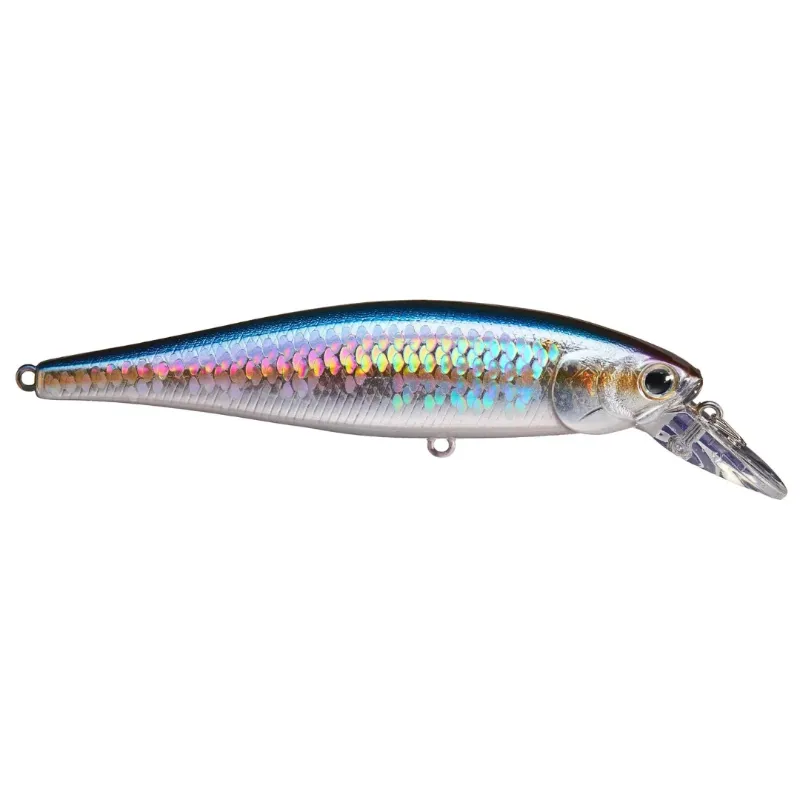
A lucky craft jerkbait is our first pick in cold, coloured water because its tight rolling action and long glide give bass a target they can track without spending energy chasing it. The bait does not need bright light or a fast retrieve to work, it needs a long pause and a steady hand. Here is how we fish it, what we hang it off, and where to buy the gear with our discount in the UK and Ireland.
Why the lucky craft jerkbait suits cold, coloured water
Cold water slows a bass down. Its strike window shrinks, it holds tighter to cover, and it stops chasing baits that cross too fast. A jerkbait fixes all three problems at once.
- It hangs in the strike zone on the pause, so a fish only has to move a few inches to eat it.
- Most models in the Lucky Craft line are built to sit fairly still between twitches, which is exactly the behaviour you want when a fish is reviewing the bait rather than smashing it.
- The profile reads clearly even at low visibility, and a side flash off the flank helps a fish find it in tea-stained water.
- It fishes well on a straight, unhurried retrieve, so you cover water without relying on speed or vibration.
The lucky craft jerkbait is the centre of this whole approach. Everything below is about making it easier for a slow, cold fish to commit.
Reading the water before you choose a bait
Colour and temperature decide your cadence more than the bait does. We check three things before the first cast.
- Visibility. Stained water with 30 to 60 cm of visibility still fishes well on a jerkbait with flash. Chocolate-coloured flood water does not, that is a tube or a big glide bait day.
- Temperature trend. Falling water after a cold front means longer pauses and smaller baits. Rising or stable water after a warm spell lets you shorten the pause and speed up.
- Structure. Cold fish sit on the steep, hard edges, the dam wall, a rocky point, bridge pilings. Fish the jerkbait parallel to those edges so the bait stays in the productive band for longer.
If the water is up and dirty, move up the bank and fish shallow wood and grass edges. If it is low and clear, back off and cast longer.
Cadence: the pause does the work
The single biggest mistake we see is working a jerkbait too quickly in cold water. Slow the whole sequence down and count the pause out loud.
- Cast past the target and let the bait settle to the depth you want, usually a short count on a sinking or slow-suspending model.
- Work it with two or three sharp downward taps of the rod tip, not sideways sweeps. Downward taps make the bait dart nose-down and roll, which is the look fish react to.
- Stop. Count. Start at three seconds in cold water and build to five, seven, even ten until a fish reacts.
- Take up a little slack on the pause and watch the line, not the bait. Most bites come as a tick or a line that suddenly moves sideways.
- On the next sequence, vary the count. If two fish came on a six count, stay there. If nothing has touched it, go longer before you change baits.
Wind and current will drag the bait off the pause. In that situation, position the boat so you are casting with the drift rather than across it, or swap to a slightly heavier model.
Rod, reel and line for slow jerkbait work
You want a rod with a soft enough tip to load on the cast but a stiff enough mid-section to snap the bait. We use a medium or medium-heavy casting rod in the 6 ft 6 in to 7 ft range and match it to a low-profile reel with a smooth, controllable drag.
| Setup | Best for | What we notice |
|---|---|---|
| daiwa tatula sv tws | Light jerkbaits, precise short casts | The SV spool gets moving with very little effort, which helps when you are lobbing a light bait into wind |
| shimano curado mgl 150 | All-round jerkbait and crankbait duty | Light frame, comfortable for a full day of twitching, and forgiving on the cast |
| Curado DC 200 | Windy banks and longer casts | The digital braking takes the thumb out of the equation when you are casting into a crosswind |
For rods, dobyns fishing rods give you a genuinely useful spread of powers, so you can pick a medium for smaller jerkbaits and a medium-heavy when you are fishing around rock. The daiwa tatula x is the other rod we reach for, and it pairs neatly with either Daiwa or Shimano reels.
Line choice matters as much as the rod. We run fluorocarbon for feel and sink rate in clear, cold water, and a copolymer or braid-to-fluorocarbon leader when we want a bit more stretch and forgiveness on the strike. Keep the leader short and check it every few fish, cold-water fish are often hooked just inside the lip and a scuffed leader loses them.
Colour and size: jerkbait and crankbait selection
Colour in coloured water is simpler than most anglers make it.
- Stained water: chartreuse, gold, orange belly, or a bait with a strong side flash. You want contrast against a brown background.
- Cold and clear: natural perch, ghost minnow, matte shad. Subtle works when visibility is good.
- Bright, high sky: a bait with a darker back and a flash on the flank reads better than a fully translucent one.
- Muddy and cold: skip finesse. Go bigger and louder, or switch lure family entirely.
Size down before you give up. A smaller jerkbait with a longer pause will often produce when the standard size gets followed but not eaten.
If you want a second opinion on the same water, a crankbait fished slow along hard edges covers the same fish and confirms whether they are active. If the crankbait gets bumps and the jerkbait gets nothing, the fish are there and you just need to slow down further.
When to leave the jerkbait in the box
No bait is a universal answer. We switch when the water goes past stained into muddy, or when the fish are pinned to heavy cover.
- A strike king coffee tube is our cold, dirty water fallback. It is slow, it stays in front of a fish, and it works when nothing is chasing.
- A jackall kaera frog comes out when the water warms a few degrees and fish move onto shallow cover, particularly on a flat, bright afternoon.
- A spro kgb chad shad 180 is the big-fish option. Slow glides on long pauses suit really cold, really clear water where the jerkbait is getting looked at but not eaten.
Our rough rule: jerkbait first, tube if the water is dirty, glide bait if the fish are big and lazy, frog when there is surface activity.
Buying genuine tackle in the UK and Ireland
Cold-water jerkbait fishing falls apart if the reel is not smooth or the line is old stock, so buy from a shop that ships genuine tackle with a proper paper trail.
- Genuine tackle authenticity. Ask for the box, the paperwork and the retailer's own stock guarantee. Grey imports and marketplace clones are common on popular Daiwa and Shimano reels.
- Discount code redemption steps. Add the item to your basket, paste the code at checkout, confirm the discount has applied before you pay.
- Shipping to UK and Ireland. Check the delivery window against your next trip rather than ordering the week you plan to fish.
- Order tracking and delivery updates. Keep the tracking email, it is the fastest way to resolve a missed delivery.
- Returns and refunds policy. Read it before you spool a reel, because a used, spooled reel is usually not returnable.
You can grab the 10% off code here before you check out, and check the latest price on anything in the jerkbait and reel ranges. For a full winter kit, the store page is also the quickest place to confirm what is currently in stock for UK and Ireland delivery.
Putting it together
Fish the jerkbait slow, on a count, parallel to hard edges, and let the pause sell it. Match the rod and reel to the weight of the bait rather than the size of the fish, keep your leader fresh, and change colour before you change lure family. Most cold, coloured water sessions are won by the angler who pauses longest, not the one who casts furthest.
 Shopping at Banff UK & Ireland? See today's verified Banff UK & Ireland discount code
Frequently asked questions
What makes a lucky craft jerkbait better than a generic one in cold water?
The combination of a tight rolling action and a pause that holds the bait in the strike zone. In cold water a fish does not want to chase, so a bait that sits still and then darts a short distance is far easier to commit to.
How long should I pause a jerkbait in coloured water?
Start with three seconds and work up to five, seven or longer until you get a reaction. Falling water temperature and heavier colour both call for a longer pause.
Which reel suits a jerkbait best, the Daiwa Tatula SV TWS or a Curado?
Both work well. The Daiwa Tatula SV TWS is easier to get moving with a light jerkbait and rewards accurate short casts, while the Shimano Curado MGL 150 is a comfortable all-rounder for a full day of twitching. The Curado DC 200 is the one we pick on windy banks.
Do I need a dedicated jerkbait rod?
Not strictly, but a medium or medium-heavy casting rod with a soft tip and a stiff mid-section makes the bait snap properly. A general-purpose rod will fish a jerkbait, it just loses some of the action.
When should I stop fishing a jerkbait and switch lures?
When the water goes past stained into genuinely muddy, or when fish are pinned tight to heavy cover. A tube bait fished slow is the better cold, dirty water choice, and a glide bait suits big, lazy fish in clear water.
Can I get a discount on a lucky craft jerkbait and reels from the store?
Yes. Add the items to your basket, apply the current 10% off code at checkout and confirm the discount has applied before paying. The code page also lists shipping and returns details for UK and Ireland orders.