
How to Choose Between Night Vision Goggles, Binoculars, and Monoculars

Night vision binoculars are the right pick when you need both hands free and want a comfortable, two-eyed view of wildlife at distance, while monoculars win on weight and price, and goggles win when you are moving through the dark. In short: binoculars for stationary watching, a monocular for scanning and hiking, goggles for navigation. Here is how we sort it out after testing these formats side by side, and how to match one to your actual use.
Quick Comparison: Which Format Fits Your Use?
| Format | Best for | Main trade-off |
|---|---|---|
| Binoculars | Wildlife watching, security checks, long observation sessions | Heavier and bulkier in the hand |
| Monocular | Hiking, scanning, one-handed use, budgets | Single-eye view, less immersive |
| Goggles | Walking, driving-adjacent tasks, hands-free work | Usually lower magnification |
If you already know you want the two-tube experience, start with a dedicated model like binoculars with night vision, then use the sections below to fine-tune the details.
Binoculars With Night Vision: The Wildlife Watcher's Choice
Two-eyed viewing matters more than most buyers expect. Your brain fuses the two images into a single, more natural picture with better depth perception, which makes it much easier to judge how far a fox or deer actually is. Long sessions also cause less eye strain than squinting into one barrel.
When we evaluate binoculars with night vision, we look at:
- Magnification and detection range. Higher is not automatically better. Anything above 7x on a digital unit gets shaky without a tripod, so mid-range magnification with a strong infrared illuminator often beats a big number on a weak light.
- IR illuminator quality. The built-in infrared torch is what actually paints the scene. A stronger, adjustable IR means usable detail at longer distances and less washout on close objects.
- Recording. Photo and video capture with an SD card slot has become standard, and it is genuinely useful for wildlife logs and property checks.
- Battery type. Swappable cells beat a sealed battery on a long night out.
For a deeper dive into how current models compare across budgets, this roundup of the best night vision binoculars is a solid independent read. If wildlife observation is your main goal, check the latest price and our code before you buy, because the difference between two similar models often comes down to IR strength rather than magnification.
Monoculars: One Hand Free, Half the Weight
A night-vision monocular is the format we recommend most for people who hike, scout, or move between fixed positions. You keep one eye dark-adapted, you can hold a walking stick or a gate latch with the other hand, and the whole unit slips into a jacket pocket.
The main compromise is immersion. You lose the fused two-eyed view and the depth cues that come with it, and long observation sessions fatigue one eye. But for the job most people actually do, spotting, scanning, confirming, then moving on, a compact night-vision monocular is the better daily tool than a bigger binocular.
Two monocular variants are worth knowing:
- Digital units work in near-total darkness using an infrared illuminator, record video, and are safe to use in any light. This is the sensible default for most buyers.
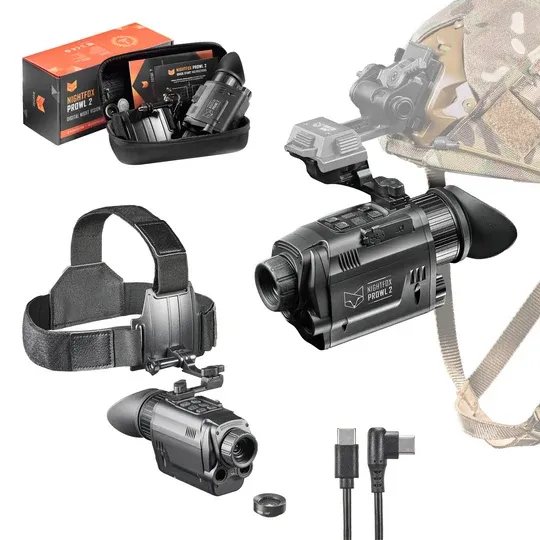
- Thermal units detect heat instead of light, so they see through light fog and reveal animals hidden in brush. A thermal vision monocular is the premium option, and a thermal monocular for helmet mount makes sense for hands-free scanning around a property or campsite. Thermal also costs considerably more, so buy it only when heat detection is the job.
Digital Night Vision Goggles: When You Are Moving in the Dark
Goggles strap to your head, which changes what the device is for. Magnification drops and image quality becomes secondary to comfort, weight, and a wide field of view. The payoff is total hands-free operation: setting up a blind, walking a fence line, loading gear, or working around camp after dark.
Budget digital models use a single tube with dual eyepieces rather than true binocular tubes, which keeps prices accessible. Expect the view to be usable rather than beautiful, and prioritize:
- Adjustable head strap and balanced weight
- Wide field of view over magnification
- Decent IR range for walking, not detailed observation
- Long runtime or USB-C power
A pair of infrared goggles in this category is a genuinely useful second device even if you already own binoculars, and a digital night vision goggles unit is often the cheapest way to get a working night vision setup at all. The military and professional world runs on head-mounted units for exactly this reason; browse what dedicated night vision specialists offer for goggles and binos to see where the format's ceiling is.
Digital vs Thermal: Do Not Buy the Wrong Tech
This is the most common expensive mistake, so here is the plain version:
- Digital night vision amplifies existing light and adds its own IR light. You see a green or black-and-white image with real detail: faces, branches, animal shapes. It needs some IR support in total darkness.
- Thermal vision reads heat signatures. You see glowing blobs of warmth, not detail. It cuts through light fog and finds hidden animals, but you cannot identify a face or read a sign.
If you want to watch and identify wildlife, buy digital. If you want to detect heat at range regardless of conditions, buy thermal. Some buyers eventually own both, and "binoculars with night vision and thermal" combinations do exist, but they are heavy, expensive, and usually overkill for a first purchase.
What to Check Before You Buy
- Realistic range claims. Manufacturers quote detection range with the IR on under ideal conditions. Assume you will get meaningful detail at roughly half the quoted figure.
- IR illuminator control. Adjustable power matters more than raw IR brightness, because close subjects wash out otherwise.
- Battery logistics. Rechargeable built-in packs are fine for short outings; swappable cells or USB-C power are better for long nights.
- Tripod thread. Any observation device benefits from a mount, and it instantly makes higher magnification usable.
- Weather resistance. At minimum, expect light rain tolerance for anything you plan to carry outside.
One last practical tip: whatever format you choose, add a separate infrared torch to your kit. A handheld IR light lets you boost range on demand without draining the device's own illuminator, and it fixes the most common complaint buyers have, which is not enough reach on close-range settings.
Our Bottom Line
Buy a monocular if you move, binoculars if you watch, and goggles if you work with your hands after dark. Start digital, add thermal later if heat detection becomes a real need, and always weigh IR quality over magnification. Before you order, grab the current 5% off sitewide code so you are not paying full price, then match the format to the job and you will not regret the purchase.
Frequently asked questions
Are digital binoculars with night vision better than thermal ones?
Digital units amplify light (with an IR illuminator for total darkness) and show detail like animal shapes and faces. Thermal detects heat signatures, so it spots animals hidden in brush or fog but shows little detail. Choose digital for watching wildlife and thermal for detection at range.
Can I use night vision devices during the day?
No. Digital night vision devices amplify both light and infrared, so bright daylight can wash out or damage the sensor unless the unit has a daylight-safe filter. Digital models are generally safe in daylight, but always check the manual.
Which is better for wildlife watching: a monocular or night vision binoculars?
A monocular is lighter, cheaper, and leaves one hand free, which suits hiking and quick scanning. Binoculars give a two-eyed view with better depth perception and less eye strain, which suits long, stationary wildlife watching sessions.
Do night vision goggles work like real binoculars?
Digital night vision goggles are usually single-tube units with dual eyepieces, while true night vision binoculars use two separate optical channels. Binoculars offer better depth perception; goggles prioritize hands-free use and a wide field of view over magnification.
How far can budget night vision binoculars actually see?
Range claims assume ideal conditions with the IR illuminator on. Plan for meaningful detail at roughly half the advertised number, and prioritize a strong, adjustable IR illuminator over high magnification if range matters to you.
Should I buy an infrared torch separately?
Add a separate infrared torch if you want extra reach without draining your device's built-in illuminator, and use a tripod or mount for anything above 7x magnification to steady the image.