
Infrared Torch vs. IR Illuminator: What Your Night Vision Setup Actually Needs

# Infrared Torch vs. IR Illuminator: What Your Night Vision Setup Actually Needs
If you've spent any time shopping for nightvision gear, you've probably noticed that "infrared torch" and "IR illuminator" get used almost interchangeably. Walk into any forum or product listing and the terms blur together — but they're not actually the same thing, and choosing the wrong one can leave you with a monocular night vision setup that underperforms exactly when you need it most.
In this guide, we'll break down what each term really means, when you need one versus the other, and how to build a complete dark-hours setup around them.
First, a Quick Primer: How Night Vision Sees in the Dark
Digital and image-intensified night vision devices — whether you're using a handheld night-vision monocular, a pair of infrared goggles, or full binoculars with night vision — don't create light. They amplify it. On a night with a bright moon and clear skies, that's no problem. But on a heavily overcast night, in dense woodland, or inside a barn or building, there's simply no ambient light to amplify.
That's where infrared illumination comes in. An IR source projects light in a wavelength the device can see but (mostly) the human eye cannot — letting you see clearly in what's effectively total darkness.
So What's the Difference Between an IR Torch and an IR Illuminator?
The IR Illuminator: Built Into the Device
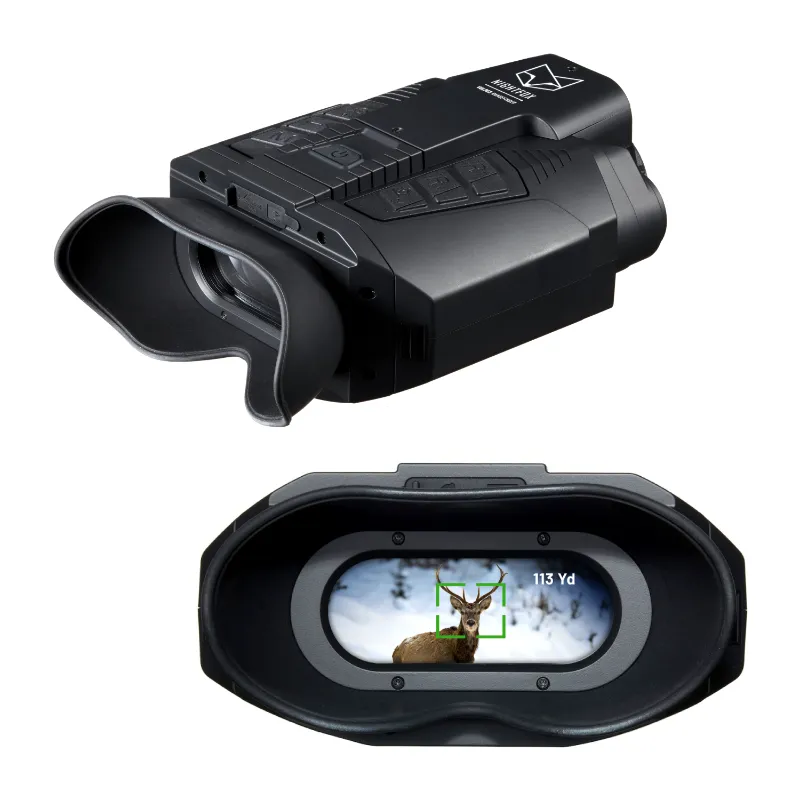
An IR illuminator is the small integrated emitter that comes built into many consumer devices — especially digital night vision units. If you own a meaning prowl or other compact digital night vision goggles, there's almost certainly a small IR LED on the front housing you can switch on or off.
Pros:
- Zero extra weight or bulk — it's already there
- Perfectly aligned with the device's field of view
- Simple one-button operation
Cons:
- Limited range, often 50–150 meters depending on the unit
- Fixed beam pattern, usually a wide flood
- Drains the device's internal battery faster
- Can create a visible red glow that spooks game or reveals your position
The Infrared Torch: A Separate, Dedicated Light
An infrared torch (sometimes called an IR flashlight or IR spotlight) is a standalone device with its own housing, battery, and optics. You mount it to your rail, helmet, or rifle and use it to flood a target area with infrared light that your monocular night vision device amplifies.
Pros:
- Much greater range — quality torches can reach 200–500+ meters
- Adjustable focus (spot to flood) and adjustable power levels
- Separate battery, so it doesn't eat your night vision device's runtime
- Detachable — leave it home when moonlight is strong
Cons:
- Extra weight, cost, and gear to manage
- Requires mounting hardware and aim alignment
- Can overexpose nearby objects if run at full power at close range
Which One Does YOUR Setup Actually Need?
The honest answer: it depends on your device and your use case. Here's a quick decision framework.
You're Fine With the Built-In Illuminator If...
- You're mostly scouting or observing at distances under 100 meters
- Your device is a compact digital unit — browse digital night vision goggles and you'll see how capable modern onboard illuminators have become
- You prioritize a lightweight, minimal kit — this pairs beautifully with a night vision monocular with head mount for hands-free use
You Need a Dedicated Infrared Torch If...
- You're spotting, hunting, or doing pest control at 150+ meters
- You use a device with a weak or no onboard illuminator — many analog or tube-based units, including some listed among the Best Night Vision Monoculars - Top 5 Staff Picks, rely entirely on external IR
- You want adjustable range and beam control for different scenarios
- You run a thermal vision monocular as your primary detection tool and keep night vision for identification — a torch makes your ID device dramatically more useful in pitch black
Pro Tip: Pair a Torch With a Head-Mounted Monocular
The most versatile budget-friendly setup for serious users is a monocular night vision device mounted on a head mount or helmet rig, paired with a rail-mounted infrared torch. This gives you:
- Hands-free navigation — the monocular handles movement and close-range work
- On-demand reach — flick on the torch when you need to reach across a field
- Modularity — swap the torch for a thermal monocular for helmet when you need detection rather than magnified identification
If you're weighing one device against another, our full nightvision range covers everything from entry-level monoculars to dedicated binoculares, and this guide to The Best Night Vision Monoculars for Scouting After Dark is a solid independent reference for comparing popular models.
For a deeper look at mil-spec style units and tube-based options, the roundup of Monoculars (PVS-14, Tanto, RVM-14, MH-14) shows what the monocular night vision device military standard looks like — note that these analog units generally *require* an external IR torch for use in true zero-light environments.
Wavelength Matters: 850nm vs. 940nm
When choosing a torch or comparing illuminators, you'll see two common wavelengths:
- 850nm — brighter effective output, longer range, but produces a faint visible red dot at the emitter. The standard choice for hunting and general use.
- 940nm — completely covert to the naked eye, but noticeably shorter range and dimmer through the device. Best for security, wildlife observation of light-sensitive animals, or any situation where total invisibility matters.
Most digital night vision devices — including every unit in our night vision pro selection — respond well to 850nm, while some analog tubes and specialty cameras favor 940nm. Check your device spec sheet before buying a torch.
The Verdict
Don't think of it as infrared torch vs. IR illuminator — think of it as a layered system:
- Built-in illuminator = your baseline, always available, good to ~100m
- Dedicated infrared torch = your reach extender, for when the target is far, the night is pitch black, or you need precise beam control
Start with a solid night vision monocular, learn what its onboard illuminator can genuinely do, and add a binoculars with night vision or a standalone torch as your needs expand. And if you're ready to upgrade, don't forget to grab our 5% OFF sitewide code on the Nightfox discount code page before you check out.
Frequently Asked Questions
Can I use an infrared torch with any night vision device?
Almost all digital night vision devices will detect 850nm IR from an external torch, and most handle 940nm too. Older analog image tubes vary, so check your device's specifications. If your unit is a modern digital model — like the ones in our meaning prowl and monocular night vision ranges — you're almost certainly compatible.
Does an IR illuminator spook animals?
Infrared light is invisible to humans, but many animals — particularly deer and some predators — can detect the faint red glow of an 850nm emitter at close range. A 940nm source is far more covert. Keeping the torch angled downrange and avoiding direct sweeps toward animals also helps.
Is a monocular or binocular night vision device better with a torch?
A monocular keeps one eye adapted to darkness and pairs more naturally with a rail- or helmet-mounted torch. If you want maximum comfort for long static observation instead, binoculars with night vision are the better choice, and a torch on a separate mount works just as well.
How far can a good infrared torch reach?
Quality 850nm torches with adjustable focus typically project usable illumination from 200 to 500 meters through a night vision device, with the device's own magnification and sensor quality as the limiting factor. Onboard illuminators generally max out at 50–150 meters.
Do I need night vision goggles if I already have a monocular?
Not necessarily. A night vision monocular with head mount delivers most of the hands-free benefit of infrared goggles at a lower cost, which is why many users consider a head-mounted monocular the best monocular night vision value for both tactical and hunting applications. Full goggles make sense primarily for extended all-night wear or dual-eye depth perception needs.
Frequently asked questions
Can I use an infrared torch with any night vision device?
Almost all digital night vision devices detect 850nm IR from an external torch, and most handle 940nm too. Older analog image tubes vary, so check your device's specifications before buying.
Does an IR illuminator spook animals?
Infrared light is invisible to humans, but many animals can detect the faint red glow of an 850nm emitter at close range. A 940nm source is far more covert, and avoiding direct sweeps toward animals also helps.
Is a monocular or binocular night vision device better with a torch?
A monocular keeps one eye adapted to darkness and pairs more naturally with a rail- or helmet-mounted torch. Binoculars offer more comfort for long static observation, and a separate torch mount works with either.
How far can a good infrared torch reach?
Quality 850nm torches with adjustable focus typically project usable illumination from 200 to 500 meters through a night vision device, while onboard illuminators generally max out at 50-150 meters.
Do I need night vision goggles if I already have a monocular?
Not necessarily. A head-mounted monocular delivers most of the hands-free benefit of goggles at a lower cost. Full goggles make sense primarily for extended all-night wear or dual-eye depth perception.