
Complete Guide to Setting Up a Commercial-Grade Home Gym

Why Complete Setting Up a Commercial Grade Home Gym
To complete setting up a commercial grade home gym, you need equipment built for daily punishment, proper space allocation, and a layout that supports serious strength training. We've tested dozens of setups and found that the right foundation pieces from GMWD Fitness deliver the durability and functionality you'd expect in a pro facility, without the monthly membership drain.
The difference between commercial and consumer equipment comes down to frame thickness, weight capacity, and bearing quality. Commercial gear uses 11-gauge steel or thicker, handles 1,000+ lb loads, and features sealed bearings that survive years of heavy use. Consumer models bend, wobble, or fail within months under the same workload.
Essential Equipment to Complete Setting Up a Commercial Grade Space
Your foundation starts with four core pieces that support 90% of strength movements.
The anchor: power cage A power cage with 3x3-inch uprights and spotter arms rated for 1,000 lbs gives you the safety and versatility to squat, bench, and overhead press without a spotter. Look for numbered hole spacing every inch in the bench zone and every two inches elsewhere. We prefer cages with pull-up bars welded into the top frame rather than bolt-on accessories.
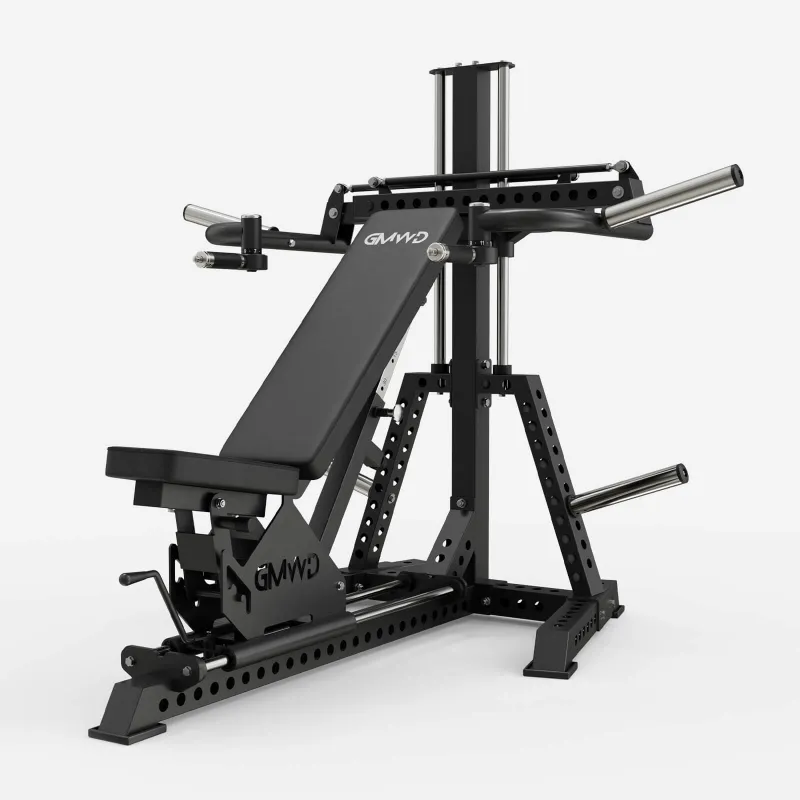
Pressing station: incline bench press machine An incline bench press machine with adjustable angles (flat, 30°, 45°, 60°) and a 1,500 lb weight capacity handles both dumbbell and barbell work. Commercial benches use vinyl over high-density foam that resists tearing and holds shape. The gap between pad sections should be no wider than 2 inches to support your spine properly.
Lower body power: hack squat leg press machine A hack squat leg press machine combines two movements into one footprint. Plate-loaded models give you more control over resistance progression and never need a power source. Check that the sled rides on linear bearings or precision rails, not plastic bushings that bind under load.
Upper body depth: lat machine and back row equipment A lat machine with a 2:1 or 4:1 cable ratio and a separate back row equipment station cover all vertical and horizontal pulling. Sealed pulleys with shielded ball bearings run quieter and last five times longer than cheap nylon wheels.
Pair these with a dip machine if your cage doesn't include dip handles, and add a stretching machine or leather stretching station for mobility work between sets. Check the latest pricing and grab our code to bring the total cost down.
Space Planning and Layout for Commercial Equipment
Commercial equipment needs breathing room. Budget 100 square feet minimum per major piece, plus walkways.
Minimum dimensions
- Power cage: 8 ft × 8 ft (includes bar clearance and spotter arm swing)
- Hack squat: 7 ft × 6 ft (sled travel path)
- Lat pulldown: 6 ft × 6 ft (cable arc and seat clearance)
- Bench press area: 10 ft × 8 ft (bar loaded to 7 ft, dismount space)
Flooring requirements Commercial rubber tiles at ¾ inch thick or stall mats absorb impact and protect your foundation. Avoid foam puzzle mats; they compress under plate-loaded machines and create an unstable surface. Secure seams with double-sided tape or adhesive to prevent shifting during deadlifts.
Ceiling height Eight-foot ceilings work for most movements if you skip overhead pressing inside the cage. Ten feet gives you full clearance for jerks, snatches, and tall lifters doing pull-ups.
Complete Setting Up a Commercial Grade Gym on a Realistic Budget
Expect to invest between $5,000 and $12,000 for a four-piece foundation setup with commercial specs. Here's how the categories break down.
| Equipment Category | Budget Tier | Mid Tier | Premium Tier |
|---|---|---|---|
| Power cage | $800–$1,200 | $1,500–$2,500 | $3,000+ |
| Bench press machine | $400–$700 | $800–$1,200 | $1,500+ |
| Leg press / hack squat | $1,200–$1,800 | $2,000–$3,500 | $4,500+ |
| Cable stations (lat + row) | $1,500–$2,500 | $3,000–$4,500 | $6,000+ |
Where to save without sacrificing quality Buy plate-loaded machines instead of selectorized stacks. You'll spend $1,500 on Olympic plates versus $2,000+ for a weight stack retrofit. Plate-loaded gear also weighs less, ships cheaper, and never needs cable replacement.
Skip chrome and powder-coated colors. Raw steel with a clear coat costs 20% less and performs identically. Surface rust on plates and frames has zero impact on function.
When to spend more Bearings, pulleys, and upholstery separate commercial from prosumer. Sealed cartridge bearings cost $15 each versus $3 for sleeve bearings, but they spin true for a decade. Marine-grade vinyl survives sweat and chalk; economy vinyl cracks within two years.
Visit our discount page to see current offers on multi-piece bundles.
Assembly, Anchoring, and Safety Setup
Commercial machines ship in crates weighing 200 to 600 lbs. Budget four to six hours per piece for two-person assembly.
Anchoring to your floor Bolt power cages, hack squats, and any plate-loaded machine taller than five feet to the floor. Use ½-inch lag bolts into floor joists (wood subfloor) or ½-inch concrete anchors (slab). Unanchored equipment tips forward when you rack weight high or during explosive movements.
Spotter arm positioning Set spotter arms one hole below your full range of motion. For bench press, that's one inch below chest touch. For squats, one inch below your deepest squat depth. Test with an empty bar before loading plates.
Cable and pulley inspection Check all cable terminations for fraying before first use. Replace any cable with broken strands. Lubricate pulley bearings every six months with white lithium grease or the manufacturer's recommendation.
Maintenance Schedule for Commercial Equipment Longevity
Heavy use demands consistent upkeep. Follow this cycle to keep gear running smoothly.
Weekly
- Wipe down all vinyl surfaces with mild soap and water
- Check all bolts and fasteners for looseness (vibration works them free)
- Inspect cables for kinks or wear
- Sweep under equipment to prevent dust buildup in linear rails
Monthly
- Lubricate all linear bearings and guide rods with silicone spray
- Tighten any frame bolts that rattled loose
- Vacuum inside upholstered pads if covers are removable
Quarterly
- Remove weight horns and check welds for cracks
- Grease pulley axles on cable machines
- Re-torque all floor anchor bolts
Annually
- Replace any worn cables (budget $30 per cable)
- Swap out damaged upholstery sections (commercial vinyl can be re-stitched)
- Inspect all welds and powder coating for rust
A Dyson V8 handheld vacuum makes quick work of chalk dust and rubber crumbs around plate storage and under benches.
Who Should Invest in Commercial Equipment at Home
This tier of equipment makes sense for specific training profiles and long-term goals.
Serious strength athletes Powerlifters, strongman competitors, and Olympic lifters training six days a week need equipment that handles 500+ lb squats and 300+ lb bench presses without flex or failure. Commercial frames and bearings survive this load cycle indefinitely.
Home gym owners replacing consumer gear If you've already bent a consumer power cage or cracked a bench frame, step up to commercial now. The total cost of replacing consumer equipment every two years exceeds buying commercial once.
Multi-user households Families or training partners sharing equipment put twice the wear on every piece. Commercial upholstery resists tearing, and heavier frames stay stable when users vary in height and strength by 100+ lbs.
Resale value planning Commercial equipment holds 60–70% of its original value after five years of use. Consumer gear drops to 30–40%. If you might move or downsize, commercial iron recovers more of your investment.
We don't recommend commercial setups for casual lifters training two days a week or beginners still learning movement patterns. Consumer equipment serves those needs at half the cost, and you can upgrade individual pieces later as your program intensifies.
Frequently asked questions
How much space do I need to complete setting up a commercial grade home gym?
Plan for at least 400 square feet to fit a power cage, bench, leg press, and cable station with proper clearances. A two-car garage (400–500 sq ft) works well for a four-piece commercial setup.
Can I use a power cage on a second floor without reinforcement?
Most second floors handle a 500 lb cage plus 500 lbs of plates if you spread the load across joists and bolt the cage down. Consult a structural engineer if your total equipment weight exceeds 1,500 lbs in one area.
What's the difference between a hack squat leg press machine and a standard leg press?
A hack squat positions you at a 45-degree angle with the weight on your shoulders, targeting quads more directly. A leg press seats you horizontally and lets you move heavier loads with less spinal compression. Combo units give you both movement patterns.
Do I need to anchor every piece of commercial equipment?
Anchor anything taller than five feet or any plate-loaded machine where weight stacks above your center of mass. Free-standing benches and dip machines under 400 lbs typically don't require anchoring.
How often should I replace cables on a lat machine?
Inspect cables monthly for fraying. Most commercial cables last 3–5 years under heavy daily use. Replace immediately if you see any broken strands, regardless of age.
Is GMWD Fitness equipment considered true commercial grade?
GMWD Fitness builds equipment to light commercial specs, meaning it uses 11-gauge steel frames, sealed bearings, and 1,000+ lb capacities that meet the durability standards for small studio gyms and serious home setups.