
The Complete Guide to Setting Up a Conference Table for Your Team

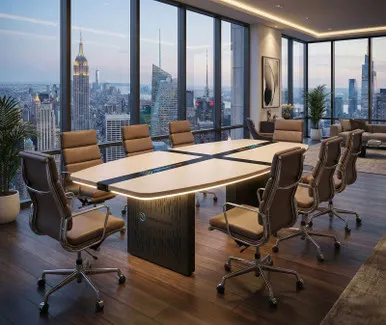
The Right Conference Table Starts With Your Room, Not the Catalog
A good conference table setup comes down to three things: the right size for your room and headcount, built-in power at every seat, and enough clearance around the table so people can pull chairs out without a tetanus shot of chair legs into the wall. Get those three right and everything else, from finishes to cable management, falls into place.
We've set up and tested enough meeting rooms to know that most teams overbuy size and underbuy power. Here's how to do it the other way around.
How to Pick the Right Conference Table Size for Your Headcount
The most common mistake is matching the table to the room instead of the team. A large conference table that looks great in an empty room becomes a liability when eight people need to share papers and a laptop screen.
Use this as your starting point:
- 4 to 6 people: a small conference table in the 6 to 8 foot range works well
- 6 to 8 people: plan on an 8 to 10 foot table
- 10 to 14 people: you're into large conference table territory, usually 12 feet or more, and often better served by two tables pushed together or a U-shape
Then check clearances. You want at least 3 feet between the table edge and the nearest wall for chair movement, and 4 feet or more if people walk behind seated colleagues. If your room can't support that, drop a size, not the clearance.
If you're browsing options, our conference table page shows the full range of sizes and finishes. For comparison shopping across brands, this roundup of Office Conference Tables & Meeting Tables gives you a sense of what the broader market offers at different price points.
Modern Conference Table With Power: Why Built-In Outlets Matter
A modern conference table with power is no longer a nice-to-have. Between laptops, phones, and the occasional projector or speakerphone puck, a meeting where half the team is hunting for an outlet is a meeting that runs long.
When you evaluate tables, look for:
- Integrated power modules or grommets so cords drop through the surface instead of snaking across it
- Data pass-throughs for ethernet or HDMI if you run hybrid calls
- Removable or flip-up panels so you can reconfigure ports without disassembling the table
If your room doubles as a solo focus space between meetings, a hidden monitor desk is worth a look, since it tucks the display away when the table needs to look clean. And for anyone presenting from a laptop, a laptop wall mount keeps the presenter's screen visible to the room without a bulky cart.
Wood Conference Table vs. Laminate: Choosing the Right Material
A wood conference table signals permanence and wears better over decades, but it costs more and can be heavier to move. Laminate is lighter, cheaper, and more resistant to coffee rings and marker ink, which matters if your team actually uses the table.
| Factor | Wood Conference Table | Laminate Conference Table |
|---|---|---|
| Durability | Refinishable, ages well | Resists stains, harder to repair |
| Weight | Heavy, harder to rearrange | Lighter, easier to relocate |
| Look | Warm, executive feel | Clean, modern feel |
| Best for | Boardrooms, client-facing rooms | Huddle rooms, everyday team use |
Either way, check the edge profile. A soft, rounded edge is kinder to forearms during long working sessions than a hard square edge.
Conference Table IKEA Alternatives: What to Consider Beyond Big-Box
A lot of teams search for a conference table IKEA option because it's the fastest thing they know to look up. Big-box tables can work for scrappy startups, but they usually compromise on legroom, power integration, and long-term durability. When you buy from a specialist, you typically get modular sizing, better weight ratings, and surfaces rated for daily heavy use.
We'd also point you toward this independent collection of Conference Tables if you want to see how specialist dealers spec things like modesty panels, wireways, and sit-stand options. For visual inspiration, browsing 26 Conference Tables ideas in 2026 is a genuinely useful way to see how different shapes and finishes look in real rooms.
If your budget is tight, a second option is to mix furniture types: a school desk style setup works for training rooms, while a drawing desk table or drafting table can double as a whiteboard-adjacent planning surface in creative studios. None of these replaces a real conference table for client meetings, but they stretch a small office further.
Sit-Stand Meetings: Where an Electric Standing Desk Fits In
Short stand-up meetings are healthier and, honestly, shorter. If your team meets for 15 minutes a few times a day, a dedicated electric standing desk positioned beside the main table lets people shift posture without committing the whole room to a height-adjustable table, which gets expensive fast at large sizes.
Some teams do the opposite: a sit-stand table as the main surface, with fixed chairs pulled in for longer working sessions. Either works. What matters is that at least one surface in the room adjusts.
Care, Setup, and Final Checklist
Once your table arrives:
- Assemble it in the room, not in a hallway. Large conference tables don't navigate doorways well.
- Route all cables through grommets before the first meeting, not after someone trips.
- Wipe surfaces with a damp microfiber cloth; skip harsh cleaners on wood.
- Re-torque leg bolts after the first month.
Before you order, measure the room, count the chairs, and confirm where the nearest outlets are. Then check the current offer on our VersaTables coupon code page, where you can grab the code and see today's pricing before you commit. If you're comparing finishes or sizes, the same coupon code applies across the full catalog.
A well-chosen conference table pays for itself in fewer rescheduled meetings and less cable chaos. Measure twice, power everything, and buy for the team you'll have in two years, not the one you have today.
Frequently asked questions
What size conference table do I need for 6 people?
For 6 people, a small conference table in the 6 to 8 foot range is usually comfortable. Make sure you also have at least 3 feet of clearance between the table edge and the nearest wall so chairs can move freely.
Do conference tables come with built-in power outlets?
Many do. Look for a modern conference table with power modules or grommets that let cords drop through the surface, and data pass-throughs if you run hybrid calls. Power integration is the feature teams most often wish they had prioritized.
Is a wood conference table better than laminate?
Wood looks warmer and can be refinished, making it better for boardrooms and client-facing spaces. Laminate is lighter, cheaper, and more stain-resistant, which suits everyday team huddle rooms. The right pick depends on how hard the table gets used.
Can I use regular desks instead of a conference table?
You can push desks together for casual meetings, but a purpose-built conference table gives you better legroom, cable management, and a shared work surface. For short stand-ups, an electric standing desk placed beside the main table is a useful supplement.
How much clearance do I need around a conference table?
Plan on at least 3 feet between the table edge and any wall so chairs can pull out, and 4 feet or more if people need to walk behind seated colleagues. If the room can't support that, choose a smaller table rather than sacrificing clearance.
Where can I find a discount code for a VersaTables conference table?
Our VersaTables coupon code page lists the current offer, and the code applies across the full catalog including conference tables and standing desks. Always check the store page for the latest price before ordering.