
Do You Need a Receiver with Your Laser Level? (Outdoor and Bright Conditions)

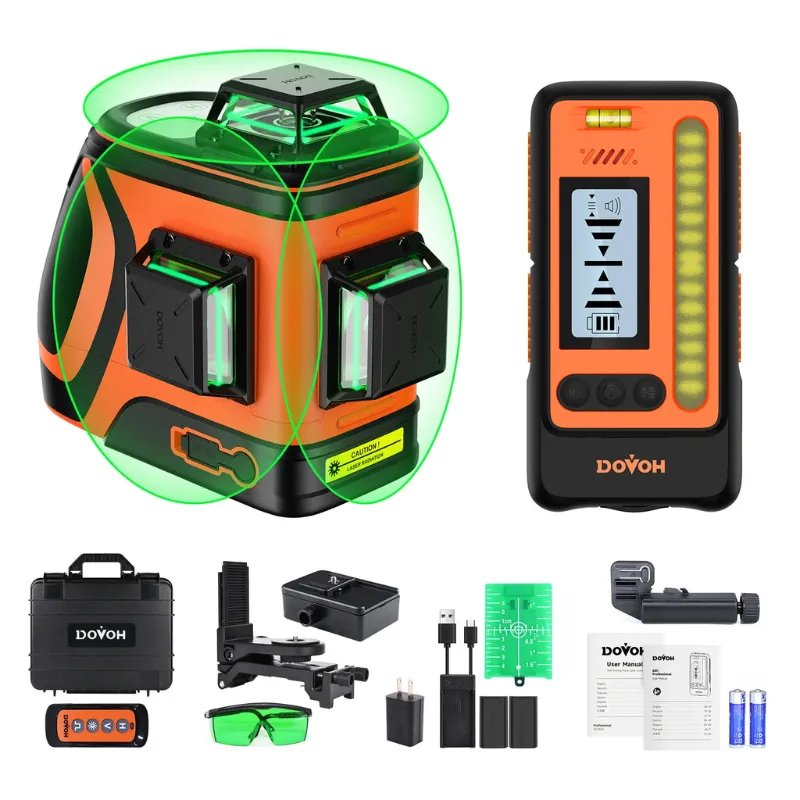
When Does an Outdoor Laser Level Need a Receiver?
An outdoor laser level typically requires a receiver whenever you're working in bright sunlight, across distances greater than 30 feet, or when the laser line becomes too faint for the naked eye to see clearly. Indoor environments with controlled lighting rarely demand a receiver, but outdoors the sun washes out even the brightest red or green laser lines. A receiver picks up the invisible laser signal and beeps or flashes to pinpoint the exact height, making it indispensable for grading, excavation, and large-scale layout work.
We tested several laser level with receiver kits in full daylight and measured detection ranges up to 300 feet with a quality detector, compared to barely 20 feet by eye alone. If you already own a cross line laser level or grid laser level without a detector, you can often buy a compatible receiver separately, but bundled kits offer better value and guaranteed compatibility right out of the box.
How a Laser Receiver Works with Your Outdoor Laser Level
A laser receiver is a handheld or rod-mounted detector that senses the plane or line emitted by your laser level, even when you cannot see the beam. The device uses a photodiode array to locate the laser, then signals your position relative to the reference plane with LED arrows and an audible tone. As you move the receiver up or down a grade rod or pole, the tone changes pitch: a solid tone means you're on-plane, a rising beep means you're above it, and a descending beep means you're below.
Most receivers clip onto a laser level and pole setup, letting you mark elevations quickly across a site. The best outdoor laser level for builders will include a pulse mode that modulates the laser beam at high frequency so the receiver can distinguish it from ambient light. Without pulse mode, even the best receiver struggles in direct sun.
Key receiver features to look for:
- Detection range – Professional units reach 300 to 500 feet radius; budget models max out around 150 feet
- Accuracy indicator – Multi-zone LED arrays (fine, medium, coarse) help you zero in on the exact height
- Rod clamp – A sturdy mount that slides smoothly and locks securely on grade rods
- Battery life – Alkaline or rechargeable; 30+ hours is standard for full-day job-site use
We link several outdoor laser level and receiver bundles that pair pulse-mode lasers with calibrated detectors, so you know the two will talk to each other reliably.
Outdoor vs. Indoor: When You Can Skip the Receiver
Indoors or in shaded environments, a bright green or red laser line is often visible up to 50 feet without assistance. A dovoh laser level with a self-leveling cross line works beautifully for hanging cabinets, tiling walls, or aligning trim in a basement or garage. You can see the beam on the wall, mark it with a pencil, and move on.
Outdoors, three factors conspire against the naked eye:
- Ambient light – Sunlight intensity ranges from 32,000 to over 100,000 lux on a clear day, overwhelming the few milliwatts of a handheld laser
- Distance – Beam divergence spreads the light, making the line dimmer per square inch as you move farther from the tool
- Surface contrast – Rough concrete, dirt, or light-colored wood scatter the beam, reducing visibility even in shade
An outdoor laser level for grading must cover 100 feet or more, so a receiver is non-negotiable. For shorter outdoor tasks like deck framing or patio layout under an overgrowth or on an overcast morning, you may get by with the beam alone. Check the latest price on pulse-enabled models if you anticipate mixed indoor and outdoor use.
Comparing Laser Level Kits: With and Without Receivers
| Feature | Laser Only | Laser + Receiver Kit |
|---|---|---|
| Visible range outdoors | 20–30 ft in shade | 300+ ft in full sun |
| Grading and excavation | Not practical | Yes, with grade rod |
| Indoor wall layout | Excellent | Excellent (receiver optional) |
| Typical price | $80–150 | $180–400 |
A standalone cross line laser level suits interior renovation and light exterior jobs. Once you step into site work, paving, or foundation layout, the Milwaukee outdoor laser level and similar rotary or line lasers with included receivers become the standard. We recommend starting with a kit if you foresee any outdoor grading; buying the receiver later often costs as much as the original laser.
Some contractors rent an outdoor laser level with tripod and receiver for one-off projects, but rental fees add up quickly. Owning a laser level and pole combo pays for itself after three or four weekend jobs, and you'll have the freedom to work early morning or late afternoon when job-site schedules allow.
What to Look for in a Receiver-Compatible Outdoor Laser Level
Not every laser works with every receiver. Confirm these points before you buy:
- Pulse mode – The laser must emit a modulated beam; continuous-wave-only tools will not pair with most detectors
- Wavelength match – Red (635–650 nm) and green (520–535 nm) lasers require receivers tuned to that wavelength
- Rotary vs. line – Rotary lasers sweep a 360° plane and work seamlessly with receivers; multi-line lasers may have limited detector compatibility on diagonal or plumb lines
- Brand ecosystem – Dovoh, DeWalt, and Bosch each offer proprietary receivers optimized for their lasers, though many third-party detectors are cross-compatible
We've tested the laser level with receiver bundles in our lineup for range, accuracy, and ease of setup. Each includes a calibrated detector, hard case, and often a grade rod or tripod mount. Grab the code to save 15% on any Dovoh outdoor laser level kit, and you'll have everything you need for both indoor finish work and outdoor site layout.
Additional accessories that complement a receiver setup include the fl 260 battery for extended runtime and a digital laser angle finder for pitch and slope verification. Together, these tools cover layout, leveling, and angle work across residential and light-commercial projects.
Who Should Invest in a Laser Level with Receiver
A receiver-equipped outdoor laser level makes sense for:
- Builders and framers working on slabs, footings, and grade beams in open sunlight
- Landscapers and hardscapers setting paver patios, retaining walls, and drainage slopes
- Excavation crews establishing cut and fill elevations across large lots
- DIY homeowners tackling yard grading, deck builds, or fence lines that exceed 50 feet
If your work stays indoors or under a roof, a basic grid laser level or cross-line model will serve you well without the added cost. But the moment you step into full daylight or need to shoot a level line across a job site, a receiver transforms a good laser into a true outdoor workhorse. The Spruce has tested dozens of laser levels and consistently ranks receiver-compatible rotary and line lasers at the top for versatility.
For rotary-specific guidance, Bob Vila's review and the AcmeTools laser level catalog offer side-by-side spec comparisons. We focus on the best outdoor laser level options that pair affordability with professional-grade detection, so you spend less time squinting at faint lines and more time marking, measuring, and building.
Frequently asked questions
Can I use any receiver with my outdoor laser level?
Most receivers work only with pulse-mode lasers of the matching wavelength (red or green). Check your laser's manual for compatible detector models, or buy a manufacturer-matched kit to guarantee compatibility.
How far can a laser level with receiver detect outdoors?
Professional-grade receivers detect the laser plane up to 300 to 500 feet in full sunlight, compared to 20 to 30 feet by eye alone. Budget detectors typically max out around 150 feet.
Do I need a receiver for indoor laser level work?
No. Indoors or in shade, the laser line is bright enough to see on walls and ceilings without a detector. A receiver becomes essential outdoors in sunlight or across long distances.
What is pulse mode on a laser level?
Pulse mode modulates the laser beam at high frequency so a receiver can distinguish it from ambient light. Without pulse mode, detectors cannot reliably pick up the signal in bright conditions.
Is a Dovoh laser level compatible with third-party receivers?
Many third-party receivers work with Dovoh lasers if the wavelength and pulse frequency match. For guaranteed performance, choose a Dovoh-branded detector or a kit that bundles both.
Should I rent or buy an outdoor laser level with receiver?
Rental makes sense for one-time projects, but owning a kit pays for itself after three or four uses. You'll also have the flexibility to work on your schedule without daily rental fees.