

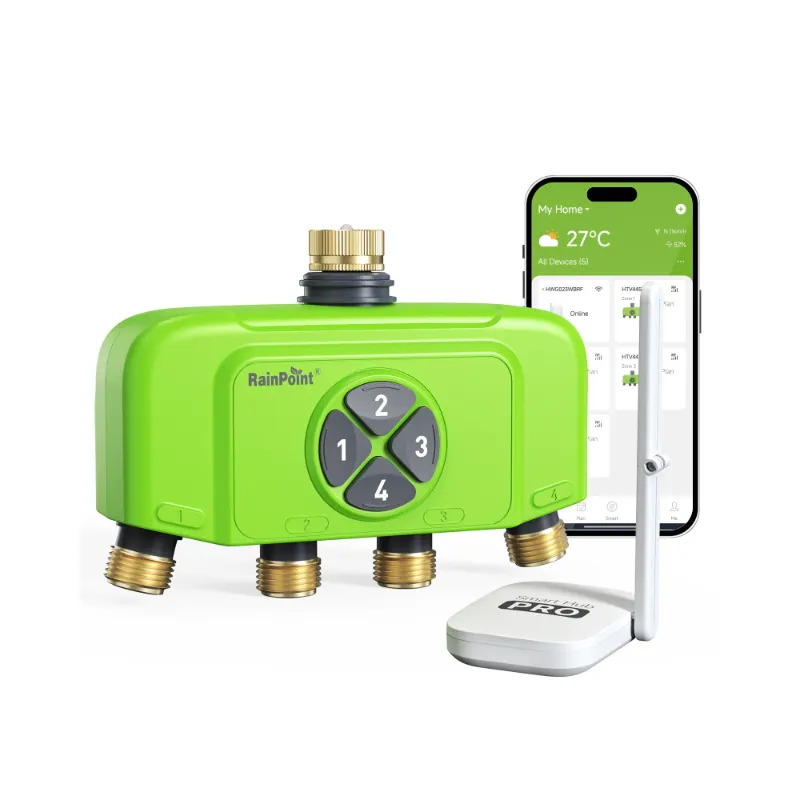
A smart sprinkler timer automates watering with Wi-Fi control and real-time adjustments, while traditional timers run on fixed schedules. Understanding the differences helps you choose the system that fits your garden size, budget, and lifestyle.
Smart Sprinkler Timer vs. Traditional: The Core Difference
Traditional timers deliver what they promise: simple, mechanical or battery-powered scheduling. You set it once, and it waters on the days and times you choose. A smart sprinkler timer adds remote access, weather awareness, and soil sensing to that basic model. The rainpoint wifi water timer represents this shift—it connects to your smartphone, learns your garden's moisture needs, and adjusts automatically so you're never watering during rain or through a dry spell unnecessarily.
The payoff is precision. Traditional timers can't know if it rained last night or if the forecast calls for a downpour tomorrow. A smart device does, and it responds by skipping watering cycles or shortening them. For renters, frequent travelers, or anyone tired of guessing, that's a game-changer.
How Automation and Control Work Differently
Traditional timers require you to be present or to remember to adjust them manually. If you're away for two weeks in spring and your garden gets cool nights, you're still watering on the schedule you set in March. You return to either dry plants or wasted water.
Smart timers let you adjust from anywhere. Stuck at work? Open the app and water now. Unexpected heat wave? Extend the cycle by 10 minutes. Real-time control means your garden watering system responds to conditions, not just your initial setup. Many smart models also integrate weather data, skipping schedules when rain is predicted or has recently fallen.
Water Savings: Where Smart Timers Shine
Water waste is a real cost, especially in drought-prone regions. Traditional timers water on a fixed schedule regardless of soil moisture or rainfall. Over a season, that adds up—sometimes 30-50% more water than plants actually need.
Pairing a smart timer with a soil moisture sensor changes the equation. The sensor measures water in the soil in real time. When moisture is adequate, the timer skips the scheduled cycle. You water only when the soil dries out, which cuts waste and often lowers your water bill. A rainpoint wifi water timer syncs with soil sensors to create a closed loop: measure, decide, water. Traditional timers have no feedback loop at all.
Ease of Setup and Use
| Feature | Traditional Timer | Smart Sprinkler Timer |
|---|---|---|
| Setup | Manual dial or buttons on device | App-based, WiFi pairing |
| Adjustments | Physical access required | Remote from phone, anywhere |
| Weather data | None | Integrated, real-time |
| Soil sensing | Manual checking only | Automatic via soil moisture sensor |
| Learning curve | 5 minutes | 15-30 minutes (app setup) |
Traditional timers win on immediate simplicity. You don't need Wi-Fi or batteries in multiple devices. But once you step away from your property, you're stuck. Smart timers require a bit more setup—pairing the device to your network, connecting the app, possibly adding sensors—but that upfront investment pays off in hands-off management.
Which Works Best for Different Garden Setups
If you have a small garden irrigation setup or a few raised beds, a traditional water timer may be all you need. You're nearby most days and can tweak things as needed. For larger properties, rental situations, or if you want to optimize water use, smart technology justifies the cost.
A garden drip irrigation system with a smart timer is ideal for precision watering. Drip systems deliver water slowly to soil level, reducing evaporation. Add a soil moisture probe and a smart timer, and your water reaches plant roots without waste. For indoor plant watering system setups—often smaller and more sensitive to overwatering—a smart timer paired with a soil humidity sensor keeps moisture in the optimal range without guesswork.
The Cost Factor
Traditional timers cost $15-50. Smart timers start around $50-100, and adding sensors (like a soil moisture detector) raises the total to $100-200. For a homeowner watering lawns and a few garden beds, that extra cost may not pay back in reduced water bills for several seasons. For a larger garden watering system or a customer in a region with high water costs, the payback is faster—often within a year.
Factor in your time value too. If you're watering manually or making daily adjustments, a smart timer buys you evenings and weekends back. For people who travel seasonally or maintain multiple garden zones, that convenience has real value beyond the water savings.
Making the Right Choice
Choose a traditional timer if you garden close to home, your climate is stable, and you prefer simplicity and lower upfront cost. Choose a smart sprinkler timer if you travel, want water savings, manage multiple zones, or enjoy gardening efficiency. The rainpoint wifi water timer bridges both worlds—it's straightforward to use but packed with smart features.
Not sure if now's the time? Grab the code for 10% off to trial a smart setup at lower cost. Start with a basic smart timer and sprinkler hose setup, then add sensors as you see how much water you save. Many gardeners find that once they switch to a smart sprinkler timer, they never go back to manual adjustment.
 Shopping at RainPoint US? See today's verified RainPoint US discount code
Frequently asked questions
Can a smart sprinkler timer work with my existing hose setup?
Yes, most smart timers attach between your faucet and hose just like traditional timers. A [sprinkler hose](/go/p/13988) or standard hose works fine. Some setups benefit from pairing with a [garden drip irrigation system](/go/p/13985) for better control, but it's not required.
Do I really save money with a smart sprinkler timer?
Yes, especially if paired with sensors. A [soil moisture sensor](/go/p/13986) tells the timer when soil is wet enough, preventing overwatering. Most users report 20-40% water savings once the system learns their garden's rhythm.
What happens to my smart sprinkler timer if the Wi-Fi goes down?
Most smart timers fall back to a manual or default schedule if the connection drops. They'll resume smart adjustments once Wi-Fi is restored. Check your specific model's documentation to be sure.
Do I need multiple soil sensors for a large garden?
For best results, place one [soil humidity sensor](/go/p/13992) or [soil moisture probe](/go/p/13991) in each garden zone that has different watering needs. A single sensor works for small or uniform gardens.
Is a smart sprinkler timer worth it for an indoor plant watering system?
Yes. Indoor plants are sensitive to overwatering, and an [indoor plant watering system](/go/p/13994) with smart controls and a [moisture sensor](/go/p/13990) prevents soggy soil. It's especially valuable if you travel or forget to check soil regularly.
How does a smart timer handle rainfall?
Smart timers use real-time weather data to skip or shorten watering after rain. [Check the latest price](/store/rainpoint-us-discount-code/) on the RainPoint smart timer to see which models include this feature.