

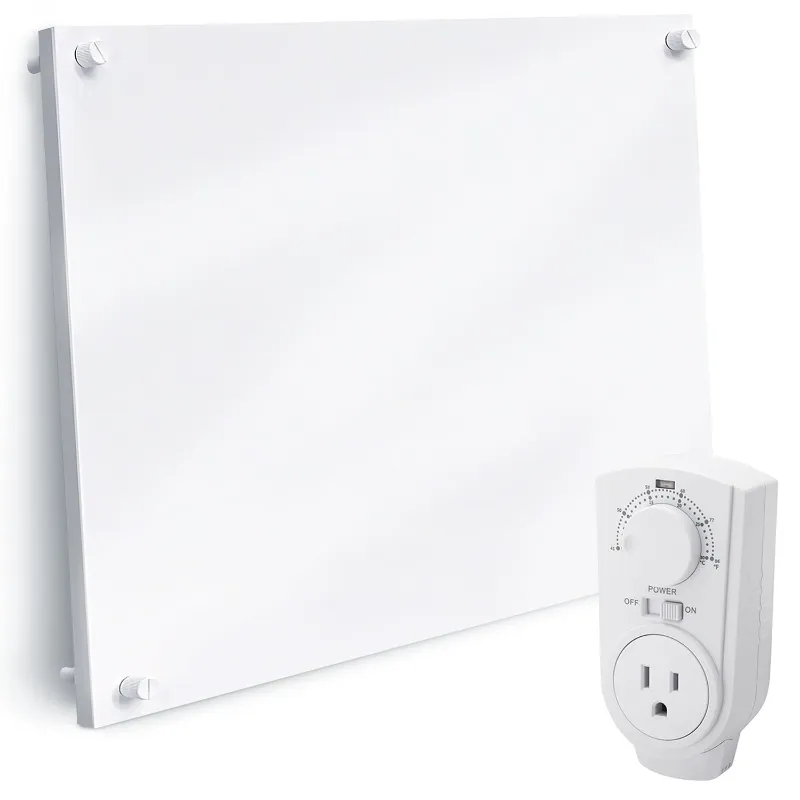
Wall mounted heaters often require a dedicated circuit, and understanding exactly when that rule applies keeps your installation safe, code-compliant, and efficient. Most 240-volt models always need one, while lower-wattage 120-volt units may share a circuit only under specific conditions. This guide walks through the electrical requirements, the nuances for bathroom installations, and how EconoHome's lineup fits into the picture.
Why Wall Mounted Heaters and Dedicated Circuits Go Together
A dedicated circuit is a single branch circuit that powers only one appliance, with no other outlets or fixtures drawing from it. Electric heaters are classified as a continuous load by the National Electrical Code (NEC) because they can run for three hours or more at a stretch. The NEC requires that a continuous load not exceed 80 percent of a circuit's rated ampacity.
Here is what that means in practice:
- A 1,500-watt heater on 120V draws about 12.5 amps continuously.
- An 80-percent rule means that heater needs at least a 15-amp circuit on its own, with no other load sharing it.
- Any heater rated above 1,440 watts on 120V essentially must be on a dedicated 15-amp circuit; heavier units at 240V need a dedicated 20-, 30-, or 40-amp circuit depending on wattage.
Wall mounted heaters in EconoHome's range are designed with these electrical realities in mind. Always check the product spec sheet for the exact wattage and voltage before scheduling an electrician.
Bathroom Heater Rules Are Stricter
Bathrooms add a second layer of requirements on top of standard heater rules. The NEC (Article 210.11(C)(3)) requires that bathrooms have at least one dedicated 20-amp circuit. That circuit can supply multiple bathroom outlets in the same home, but it cannot feed any other rooms.
Where bathroom heaters fit in:
- If the heater is hardwired: Most electricians install a separate dedicated circuit for it, completely independent of the bathroom outlet circuit.
- If it plugs into an outlet: It must use a GFCI-protected outlet, and you still need to ensure the continuous load stays within 80 percent of the circuit rating.
- A bathroom wall heater hardwired at 240V always gets its own circuit, full stop.
GFCI protection is non-negotiable in bathrooms. Any heater within six feet of a water source must be on a GFCI-protected circuit. Skipping this step is both a code violation and a genuine safety risk.
Radiant vs. Convection: Does Heater Type Change the Rule?
The type of heating element does not change the dedicated-circuit requirement, but it does affect how you size the circuit because of how each type draws power.
| Heater Type | Load Behavior | Typical Voltage | Dedicated Circuit? |
|---|---|---|---|
| Radiant wall heaters | Steady, continuous draw | 120V or 240V | Almost always yes |
| Convection wall heaters | Cycles on and off | 120V or 240V | Yes for 240V; often yes for 120V |
| Fan-forced wall heaters | Steady with motor load | 120V or 240V | Yes for high wattage |
Radiant wall heaters produce infrared heat that warms objects and people directly rather than cycling air. Because they tend to run at a steady wattage for long periods, they hit the continuous-load threshold quickly and almost universally need a dedicated circuit.
How to Size the Circuit for Your Heater
Follow these steps before calling an electrician:
- Find the wattage on the heater's label or spec sheet.
- Divide watts by volts to get amps (e.g., 2,000W ÷ 240V = 8.3A).
- Apply the 80-percent rule: divide the continuous amps by 0.8 to find the minimum circuit rating (8.3 ÷ 0.8 = 10.4A, so a 15-amp 240V circuit is the minimum).
- Choose the wire gauge: 15A = 14 AWG, 20A = 12 AWG, 30A = 10 AWG.
- Confirm with your local code: some jurisdictions are stricter than the NEC baseline.
If you are unsure whether your existing wiring can support an upgrade, a licensed electrician can run a load calculation in under an hour. That cost is small compared to a panel replacement or a fire damage claim.
Pairing Good Insulation With Your Heater
A properly wired heater is only half the equation. Poor insulation forces any heater to run longer and harder, which puts more sustained load on that dedicated circuit and drives up your energy bill. Adding reflective insulation to exterior walls or an attic before you install a heater is one of the highest-ROI steps you can take. A foil insulation roll is a practical option for crawl spaces, garage walls, or the wall cavity behind a bathroom installation, cutting radiant heat loss before your new heater even turns on.
Bathroom heater energy efficiency improves noticeably when drafts are sealed and wall cavities are insulated, which also means the heater cycles less and the circuit runs cooler.
Choosing the Right EconoHome Heater for Your Space
EconoHome offers several options worth comparing side by side depending on room size and installation preference:
| Product | Best For | Installation |
|---|---|---|
| Wall mounted heaters | Living rooms, bedrooms, hallways | Hardwired or plug-in |
| Bathroom wall heater | Bathrooms, wet areas | Hardwired with GFCI |
| Radiant wall heaters | Spot heating, draughty rooms | Wall-mount, hardwired |
| Bathroom heaters | Small bathrooms, en suites | Plug-in GFCI or hardwired |
For current pricing and to grab the EconoHome discount code for 10% off, check the store page before you buy. EconoHome free shipping eligibility and return policy details are also listed there.
What to Tell Your Electrician
Walk your electrician through these four points so the installation goes smoothly:
- The heater's wattage and voltage (from the spec sheet).
- Whether it is hardwired or plug-in so they know if a new outlet is needed.
- The bathroom location if applicable, so they plan for GFCI and the separate bathroom circuit.
- Any insulation upgrades you are planning, so conduit routing accounts for wall work.
A clear brief means fewer return visits and a cleaner final install. Once the circuit is in, check the latest price on EconoHome's heater range to lock in your discount before ordering.
 Shopping at EconoHome? See today's verified EconoHome discount code
Frequently asked questions
Do all wall mounted heaters need a dedicated circuit?
Most do, especially any model rated above 1,440 watts or wired at 240V. Lower-wattage 120V models may technically share a circuit, but the NEC's 80-percent continuous-load rule means they almost always occupy one on their own in practice.
Does a bathroom wall heater need GFCI protection?
Yes. Any heater installed in a bathroom, particularly within six feet of a water source, must be connected to a GFCI-protected circuit. This is an NEC requirement and is enforced by local building inspectors.
Can I plug a bathroom heater into an existing bathroom outlet?
Only if the outlet is GFCI-protected and the circuit is not already loaded close to its rated capacity. Hardwiring on a separate dedicated circuit is the safer and more code-friendly approach for permanent installations.
What wire gauge do I need for a 240V wall heater?
That depends on the circuit's amperage rating. A 15-amp 240V circuit uses 14 AWG wire, a 20-amp circuit uses 12 AWG, and a 30-amp circuit uses 10 AWG. Always have a licensed electrician confirm the gauge based on your specific load calculation.
Will adding reflective insulation improve my heater's efficiency?
Yes. Installing reflective insulation or a foil insulation roll in the walls or attic reduces heat loss, which means your heater runs for shorter periods, draws less sustained load on the circuit, and uses less energy overall.
How do I find the EconoHome discount code for their heater range?
Visit the EconoHome coupon page on this site for the current code and any active offers like free shipping. The discount applies across EconoHome's full product range including their wall heater models.