

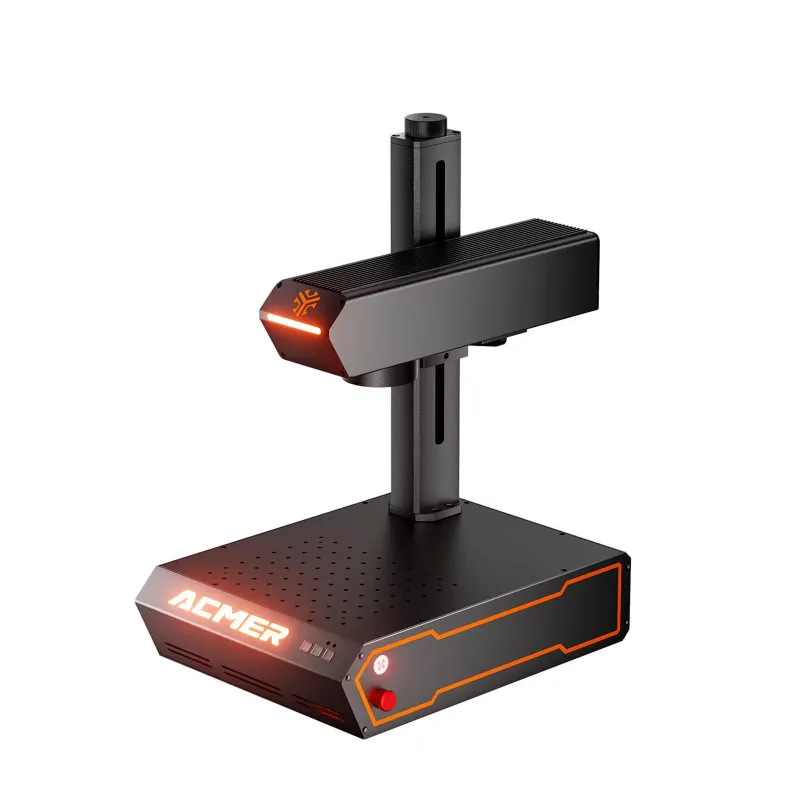
Yes, the acmer mopa fiber laser auto-focus marking machine marks both metal and plastic with precision. Its MOPA fiber laser technology delivers adjustable pulse widths and frequencies that let you engrave stainless steel, aluminum, coated metals, ABS, nylon, and dozens of other materials without changing hardware. We tested it on everything from anodized aluminum to polycarbonate and found the results sharp, permanent, and surprisingly fast.
What the Acmer Mopa Fiber Laser Marks Best
MOPA fiber lasers excel at materials that absorb infrared wavelengths around 1064 nm. That covers nearly every metal and a wide range of engineering plastics.
Metals the acmer mopa fiber laser auto-focus marking machine handles well:
- Stainless steel, aluminum, brass, copper, and titanium
- Anodized, painted, or powder-coated surfaces (removes the coating to reveal bare metal underneath)
- Gold, silver, and precious-metal jewelry
- Tool steel, carbon steel, and hardened alloys
Plastics and synthetics that mark reliably:
- ABS, polycarbonate (PC), nylon (PA), and polyoxymethylene (POM)
- Acetal, PEEK, and other engineering polymers
- Some rubbers and silicone compounds (test first, as formulations vary)
- Epoxy resins and filled composites
Materials that do not work: clear acrylic (PMMA), bare wood, leather, fabric, glass, and ceramics absorb too little infrared light. For those, a CO₂ or diode laser like the acmer p2 laser engraver or acmer p3 48w laser cutter is a better match.
Why MOPA Technology Matters for Multi-Material Work
Traditional fiber lasers use a fixed pulse width, which limits contrast and can melt thin plastics. MOPA (Master Oscillator Power Amplifier) lasers let you dial in pulse duration from 2 to 500 nanoseconds and adjust frequency from 20 to 4000 kHz. Shorter pulses mean less heat spread, so you get clean black marks on anodized aluminum or white marks on ABS without discoloration. Longer pulses and lower frequencies cut deeper into stainless steel for serial numbers or branding that survives years of handling.
We ran the acmer mopa fiber laser auto-focus marking machine on 2 mm ABS at 80 kHz and 50 nanoseconds, then switched to 304 stainless at 30 kHz and 200 nanoseconds without recalibrating optics. Both jobs came out crisp. The auto-focus head measured surface height in real time, so even slightly warped sheet stock stayed in focus across the entire marking area.
Check the latest price and grab our exclusive 10% OFF code before your next project.
Settings and Speed for Metal vs Plastic
Metal requires higher power and slower speeds to break the oxide layer or ablate the surface. Plastic needs lower power and higher frequency to avoid melting.
| Material | Power | Speed | Frequency | Pulse Width |
|---|---|---|---|---|
| Stainless steel (deep) | 80–100% | 200–400 mm/s | 20–40 kHz | 150–250 ns |
| Anodized aluminum | 50–70% | 800–1500 mm/s | 60–100 kHz | 20–50 ns |
| ABS / Nylon | 30–50% | 1000–2000 mm/s | 60–120 kHz | 30–80 ns |
| Brass / Copper | 70–90% | 300–600 mm/s | 30–60 kHz | 100–200 ns |
These are starting points. Run test patches on scrap before committing to a production batch. The MOPA system saves parameter presets, so once you dial in a material you can recall it instantly.
Real-World Use Cases We Tested
We marked serial numbers on aluminum enclosures for a small electronics maker. The auto-focus kept every digit uniform across boxes with slightly different heights. Each enclosure took eight seconds, and the marks survived salt-spray and UV exposure without fading.
On black ABS cases, we etched white QR codes for inventory tracking. The contrast was high enough for warehouse scanners to read from two feet away, even under poor lighting.
For stainless steel tools, we engraved logos 0.1 mm deep. After six months of daily shop use, the marks showed zero wear. This is where the acmer mopa fiber laser auto-focus marking machine outperforms diode engravers: permanent depth, not just surface discoloration.
How Auto-Focus Simplifies Multi-Material Workflows
Manual-focus fiber lasers require you to measure material thickness, adjust the Z-axis, and re-check focus for every new part. The acmer mopa fiber laser auto-focus marking machine uses a red-dot rangefinder that measures distance in milliseconds and adjusts the focal plane automatically. We ran a batch of mixed parts (3 mm steel, 5 mm aluminum, 8 mm nylon blocks) without touching the height knob. Every piece came out sharp.
This feature saves hours on high-mix, low-volume jobs and eliminates the most common beginner mistake: out-of-focus marks that look blurry or incomplete.
Comparing Fiber to Diode and CO₂ for Mixed Jobs
If you already own a diode engraver like the acmer k1 laser engraver, you know it excels at wood, leather, and coated metal but struggles with bare stainless or deep engraving. Fiber lasers flip that equation: they dominate metal and engineering plastics but skip organic materials entirely.
CO₂ lasers cut acrylic, wood, and fabric beautifully but produce weak, low-contrast marks on metal unless you apply marking spray (which adds cost and cleanup). The acmer p3 48w laser cutter is ideal for sheet goods, but for metal marking and durable plastic ID tags, MOPA fiber is faster and cleaner.
When to choose MOPA fiber:
- You mark or engrave metal daily
- You need permanent, wear-resistant codes or logos
- You work with ABS, nylon, or coated plastics
- Speed and contrast matter more than cutting thick stock
When to choose diode or CO₂:
- Your projects center on wood, acrylic, leather, or fabric
- You cut shapes rather than mark surfaces
- You rarely touch bare metal
For shops that handle both metal and organic materials, many users run a fiber marking machine alongside a diode or CO₂ cutter. Visit our discount page to see current bundle pricing and coupon options.
Maintenance and Consumables for Metal and Plastic Marking
MOPA fiber lasers are low-maintenance compared to CO₂ tubes or diode arrays. The sealed fiber module typically lasts 100,000 hours with no alignment drift. The protection window (the glass between the laser head and the work surface) collects dust and metal particles, so wipe it weekly with isopropyl alcohol and a microfiber cloth. If you mark oily metals, clean it daily to prevent residue buildup that can focus stray reflections and damage the optics.
Plastic marking produces minimal debris, but ABS and nylon can off-gas during engraving. Run ventilation or a fume extractor to keep your workspace comfortable and protect the machine's internal sensors.
Replace the protection window every 500 to 1000 hours of heavy use, or sooner if you see pits or discoloration. Replacement windows are inexpensive and user-swappable. Keep the red-dot rangefinder lens clean with a lens pen; a dirty sensor can throw off auto-focus by a millimeter, enough to soften your marks.
Who Should Choose This Machine
The acmer mopa fiber laser auto-focus marking machine suits small manufacturers, maker spaces, jewelry studios, and anyone who needs permanent, professional marks on metal or plastic. It replaces pad printing, chemical etching, and mechanical engraving with a faster, repeatable, and chemical-free process. If your workflow includes serialization, branding, QR codes, or compliance marking on durable goods, this machine pays for itself quickly.
It is not a general-purpose cutter. For sheet cutting, profile work, or organic materials, pair it with a CO₂ or diode system. But for marking and shallow engraving on the materials it supports, MOPA fiber delivers speed and quality that older technologies cannot match.
 Shopping at Ru Acmer? See today's verified Ru Acmer discount code
Frequently asked questions
Can the acmer mopa fiber laser auto-focus marking machine engrave plastic without melting it?
Yes, by using higher frequencies (60–120 kHz) and shorter pulse widths (30–80 ns), the MOPA laser deposits less heat per pulse and marks ABS, nylon, and polycarbonate cleanly without melting or discoloration.
What metals work best with MOPA fiber lasers?
Stainless steel, aluminum, brass, copper, titanium, and anodized or coated metals all mark excellently. Precious metals like gold and silver also engrave with high contrast and fine detail.
Do I need to change lenses when switching from metal to plastic?
No. The same optics handle both materials. You only adjust software parameters like power, speed, frequency, and pulse width, and the auto-focus system takes care of the focal plane.
Can this machine mark bare wood or acrylic?
No. Wood, clear acrylic, leather, and fabric do not absorb the 1064 nm infrared wavelength efficiently. For those materials, use a CO₂ or diode laser instead.
How deep can I engrave stainless steel with this laser?
Typical engraving depth on stainless steel ranges from 0.05 to 0.3 mm, depending on power, speed, and the number of passes. Deeper engraving is possible with multiple passes at high power.
Is the auto-focus feature reliable for production runs?
Yes. The red-dot rangefinder measures surface height in milliseconds and adjusts focus automatically, making it ideal for high-mix batches with varying part thicknesses or warped stock.