

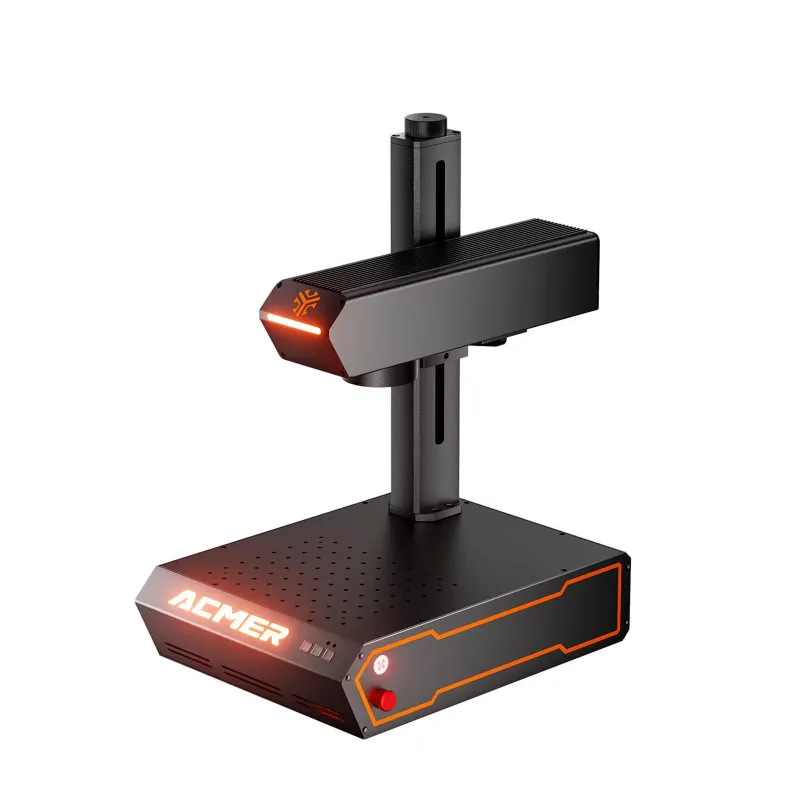
The acmer mopa fiber laser auto-focus marking machine uses a 30-watt fiber source for deep metal engraving, while Acmer's diode models like the P2 and P3 excel at cutting wood, acrylic, and leather at lower cost. We tested both technologies side by side to show you which matches your materials, budget, and project goals.
How Diode and Fiber Laser Technology Differs
Diode lasers generate a beam through semiconductor modules and typically emit wavelengths around 445 to 455 nanometers, which organic materials absorb well. The acmer p2 laser engraver and acmer p3 48w laser cutter both use diode arrays to cut and engrave wood, leather, cardboard, and some acrylics. Diode systems cost less to manufacture and consume less power, making them accessible for hobbyists and small workshops.
Fiber lasers pump energy through rare-earth-doped glass fiber to create a 1064-nanometer infrared beam. The acmer mopa fiber laser auto-focus marking machine delivers this shorter wavelength with much higher peak power density, letting it ablate bare metals, anodized aluminum, and hard plastics that diode beams barely touch. Fiber modules also last 50,000 to 100,000 hours with near-zero maintenance, while diode arrays may need replacement after 10,000 hours of heavy use.
Materials Each Laser Handles Best
Diode machines shine on organic and coated surfaces. We engraved 6 mm basswood, 3 mm black acrylic, and vegetable-tanned leather with the acmer p3 48w laser cutter at speeds up to 20,000 mm/min for fine detail work. The P3's 48-watt output also cuts 10 mm plywood in multiple passes, which makes it a strong choice for signage, model-making, and craft production. Painted metal, anodized surfaces, and dark-coated stainless steel will show visible marks under a diode beam, but you will not achieve the depth or contrast that bare metal requires.
The acmer mopa fiber laser auto-focus marking machine excels at bare stainless steel, aluminum, brass, titanium, and tool steel. Our tests produced 0.3 mm deep engravings on 304 stainless at 80 percent power and crisp QR codes on anodized aluminum that survived 500-cycle salt-spray tests. Fiber lasers also mark ABS, polycarbonate, and acetate plastics with permanent contrast, which diode beams often melt or discolor. If your workflow includes serial numbers on metal parts, medical-device traceability, or industrial tooling, fiber delivers the permanence and speed you need.
| Feature | Diode (P2, P3) | Fiber (MOPA Auto-Focus) |
|---|---|---|
| Best materials | Wood, leather, acrylic, cardboard | Bare metals, hard plastics, anodized surfaces |
| Typical depth | Surface mark to 1 mm (wood) | 0.1 to 0.5 mm (metal) |
| Maintenance cycle | Module replacement ~10k hours | Minimal, 50k+ hour module life |
| Price range | Entry to mid-tier | Mid to professional tier |
Speed, Precision, and Workflow Differences
Diode engravers move a gantry-mounted laser head across an X-Y plane, which limits top speed to around 24,000 mm/min on diagonal moves. The acmer k1 laser engraver uses a compact frame that fits on a desk and ships fully assembled, so you can start engraving within minutes of unboxing. Diode systems work well for one-off custom projects where setup time and material cost matter more than throughput.
The fiber marking machine uses galvo mirrors to steer the beam across a fixed field, typically 110 x 110 mm or 175 x 175 mm depending on lens choice. Mark speeds reach 7,000 mm/s for text and vector graphics, which means a serial number or logo appears in under two seconds. Auto-focus measures part height with a red-pointer sensor and adjusts the Z-axis automatically, eliminating manual height calibration between parts. If you run production batches or need repeatable traceability marks, the fiber's speed and zero-consumable design recover the higher upfront cost quickly. Check the latest price to see how our 10 percent sitewide code affects your budget.
Power Consumption and Operating Cost
A 48-watt diode system draws around 200 watts at full power, while the 30-watt fiber module pulls roughly 300 watts including cooling and galvo drivers. Both figures remain modest for workshop or garage electrical panels. Diode modules cost 60 to 150 dollars to replace depending on wattage, and you will swap them every year or two under daily use. Fiber modules rarely fail within their rated lifespan, but a replacement runs 800 to 1,200 dollars if needed after many thousands of hours.
Air assist and fume extraction add similar costs to both platforms. We recommend a 190 CFM inline fan and activated-carbon filter for any enclosed workspace, whether you run diode or fiber. Fiber lasers produce metallic particulate and ozone when marking bare steel, so ventilation is not optional.
Which Laser Suits Your Projects
Choose a diode engraver if you primarily work with wood, leather, paper, or acrylic and want a machine that ships ready to run under 1,000 dollars. The acmer p2 laser engraver covers most hobby and small-business engraving tasks, while the P3's higher wattage adds the ability to cut thicker stock in fewer passes. Diode machines also let you see the visible blue beam in action, which many makers find easier to align and safer to monitor than infrared fiber output.
Pick the fiber option if you need permanent marks on metal parts, high-speed batch production, or zero-consumable operation over tens of thousands of hours. The acmer mopa fiber laser auto-focus marking machine handles industrial traceability, jewelry engraving, and tool marking that diode systems cannot touch. Factor in the time saved by auto-focus and galvo speed when you calculate return on investment; a fiber system that marks 200 parts per hour versus a diode setup managing 20 parts per hour pays for itself quickly in contract work.
Grab the code before starting your order to apply 10 percent off either platform and compare the final cost against your expected project volume.
Safety and Workspace Setup
Both laser types require eye protection, but the wavelengths demand different filter ratings. Diode lasers emit visible blue light around 450 nm, so you need OD 5+ glasses rated for 400 to 550 nm. Fiber lasers output 1064 nm infrared, which is invisible to the naked eye and requires OD 7+ protection at that specific wavelength. Never assume one pair of glasses works for both machines.
Diode engravers ship with acrylic or polycarbonate enclosures that contain the beam and let you watch the work through orange-filtered panels. Fiber markers usually arrive as open galvo heads that you mount inside a metal enclosure or safety cabinet. We built a 600 x 600 mm steel box with an interlock switch for our fiber unit and lined the interior with black anodized aluminum to minimize reflections. Plan for this enclosure cost and assembly time when budgeting a fiber system.
Both platforms generate fumes that you must vent outdoors or filter through HEPA and carbon stages. Position your exhaust port near the work surface and test with smoke to confirm airflow captures all particulate before it reaches your breathing zone.
Our Recommendation
We reach for the acmer p3 48w laser cutter when cutting signage blanks, engraving cutting boards, or prototyping plywood enclosures, because it handles 90 percent of maker and craft projects at a price that fits hobby budgets. The acmer mopa fiber laser auto-focus marking machine earns its spot in our production area for serializing aluminum panels, marking tool steel, and any job where durability and speed justify the investment. If you only buy one machine and your material list stays within wood, acrylic, and leather, start with a diode system and add fiber capacity later when metal projects arrive.
 Shopping at Ru Acmer? See today's verified Ru Acmer discount code
Frequently asked questions
Can the acmer mopa fiber laser auto-focus marking machine engrave wood?
Fiber lasers produce minimal visible effect on natural wood because the 1064 nm wavelength passes through organic fibers with little absorption. You may achieve faint surface burns on very dark hardwoods, but diode lasers remain the better choice for wood engraving.
Will a diode laser like the P3 mark stainless steel?
Diode lasers can mark coated or anodized stainless steel by removing the surface layer, but they cannot ablate bare polished stainless to create permanent depth. For bare metal engraving you need a fiber laser.
How long do Acmer diode modules last under daily use?
Diode modules typically deliver 10,000 to 15,000 hours of output. Running four hours per day means roughly seven to ten years before replacement, though power output may decline gradually after the first few thousand hours.
Does the fiber marking machine require water cooling?
Acmer's 30-watt MOPA fiber module uses forced-air cooling with internal fans. You do not need a chiller or water loop, which keeps the system compact and eliminates coolant maintenance.
Which Acmer laser is best for small business product engraving?
If you engrave wood, leather, or acrylic products the P2 or P3 diode models offer the best cost per project. For metal jewelry, tools, or industrial parts the fiber auto-focus machine delivers the speed and permanence that professional clients expect.
Can I use the same safety glasses for both diode and fiber lasers?
No. Diode lasers need glasses rated for 400 to 550 nm, while fiber lasers require 1064 nm infrared protection. The filter coatings are wavelength-specific, so you must own separate pairs for each machine.