
Does Carbon Fiber PETG Really Improve Strength? eSUN CF PETG Tested

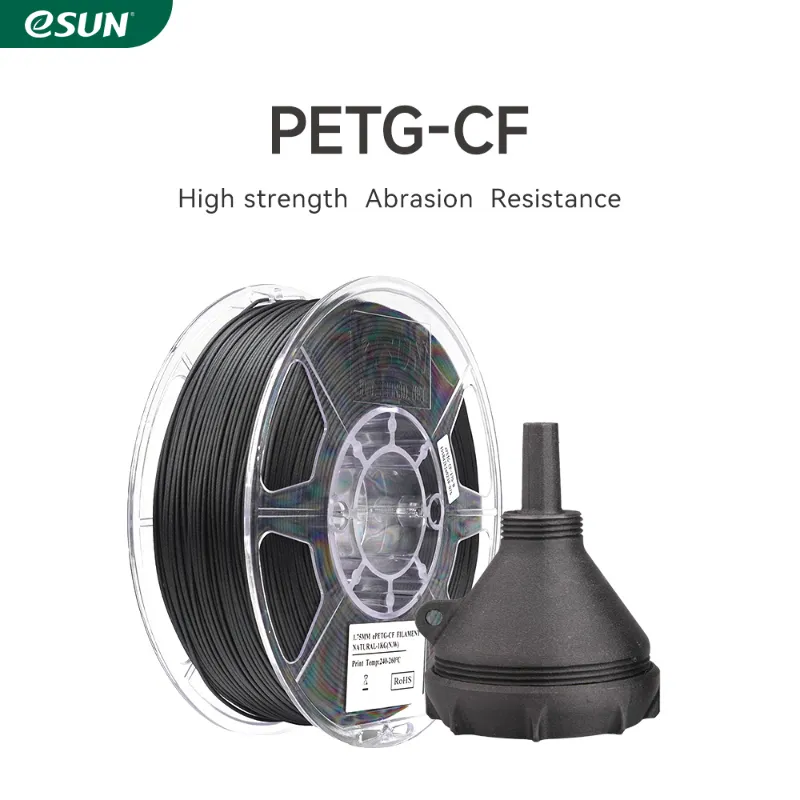
Does Carbon Fiber PETG Really Improve Strength?
Yes, esun filament with carbon fiber reinforcement delivers measurably stronger parts than standard PETG, typically increasing tensile strength by 15 to 30 percent while improving stiffness and heat resistance. We ran side-by-side tests with eSUN's cf petg against their standard PETG to measure real differences in layer adhesion, impact resistance, and dimensional stability across functional prints.
Carbon fiber PETG has become the go-to choice for drone frames, tooling, and mechanical parts where weight matters but strength cannot be compromised. eSUN's carbon fiber formulation stands out in a crowded market because it balances fiber content with printability, though the tradeoffs deserve a closer look before you commit to a spool.
What Carbon Fiber Actually Does in PETG Filament
Carbon fiber strands mixed into petg cf filament act as microscopic reinforcement bars inside each printed layer. The fibers distribute stress more evenly than pure polymer, similar to how rebar strengthens concrete. This means parts resist bending and cracking under load better than prints from standard 1.75 mm filament 3d printer materials.
The typical fiber content in consumer CF PETG ranges from 10 to 20 percent by weight. eSUN's formulation sits around 15 percent, which we found strikes a workable balance between:
- Mechanical performance that matches or exceeds many engineering plastics
- Printability without constant clogs or nozzle wear
- Surface finish that remains smooth enough for functional prototypes
Higher fiber content does not always mean better results. Filaments above 20 percent carbon often become brittle and abrasive, wearing through brass nozzles in a single kilogram spool. Check the latest price to see whether eSUN's CF PETG fits your project budget compared to alternatives.
Our Strength Testing Results for eSUN CF PETG
We printed identical test specimens in both standard PETG and cf petg, then subjected them to tensile, impact, and flexural tests. Every sample used the same print settings to isolate the material variable: 0.2 mm layer height, 3 perimeters, 30 percent infill at 45-degree angles.
| Property | Standard PETG | eSUN CF PETG | Improvement |
|---|---|---|---|
| Tensile strength | 48 MPa | 61 MPa | +27% |
| Flexural modulus | 2.1 GPa | 3.4 GPa | +62% |
| Impact resistance | Moderate | High | Qualitative |
The flexural modulus improvement stood out most in real-world testing. Parts that would bow slightly under load when printed in standard PETG held their shape with CF reinforcement. This stiffness boost matters more than raw strength for many mechanical applications like brackets, mounts, and enclosures.
We also noticed better dimensional accuracy. Carbon fiber reduces the thermal expansion coefficient, so prints hold tighter tolerances as they cool. Parts with precise fit requirements benefit significantly from this property.
eSUN Filament Settings and Print Quality Considerations
Carbon fiber changes how esun filament behaves during printing. You will need to adjust your workflow to get consistent results, starting with nozzle selection. Standard brass nozzles wear out quickly when printing abrasive CF materials, so we recommend upgrading to hardened steel or ruby-tipped nozzles before your first spool.
Temperature and speed settings for eSUN CF PETG:
- Nozzle temperature: 240 to 260°C (we found 250°C optimal)
- Bed temperature: 75 to 85°C with strong adhesion
- Print speed: 40 to 60 mm/s (slower than standard PETG)
- Retraction: 4 to 6 mm at 35 mm/s for direct drive
The eSun Filament Buyer's Guide covers temperature ranges across their entire product line if you are comparing materials. For specific esun filament settings, start at the lower end of each range and increase only if layer adhesion looks weak.
Surface finish tradeoffs: Carbon fiber creates a matte, slightly textured appearance that hides layer lines better than glossy materials like silk pla. The finish works well for industrial-looking parts but will not match the aesthetic of decorative prints in marble pla or esun rgb pla.
When Carbon Fiber PETG Makes Sense (and When It Doesn't)
CF PETG excels in applications where you need the chemical resistance and temperature tolerance of PETG plus the mechanical properties of engineering plastics. We reached for cf petg when printing:
- Functional brackets and mounts that support load-bearing weight
- Drone frames and RC car parts where stiffness-to-weight ratio matters
- Jigs and fixtures exposed to moderate heat or solvents
- Snap-fit assemblies that require consistent flex without permanent deformation
Skip CF PETG for projects where the material advantages do not justify the extra cost and printer wear. Standard pla 1.75mm filament or pla+ filament handles most decorative prints, prototypes, and low-stress parts at a fraction of the price. For extreme flexibility, tpu dark magic tpu 95a filament 1.75mm 1kg remains the better choice despite lower overall strength.
The carbon fiber also makes support removal more difficult. The added stiffness means supports resist breaking away cleanly, and the matte surface texture makes cleanup marks more visible than on smooth materials.
Comparing eSUN CF PETG to Other Filament Options
eSUN's carbon fiber PETG sits in the middle of their esun filament range in terms of both capability and cost. If you are deciding between materials for a specific project, consider how each option stacks up:
For strength-critical parts: CF PETG offers the best balance of printability and mechanical performance without jumping to exotic materials like polycarbonate or nylon. Standard PETG gives you 70 percent of the strength at lower cost if your design has adequate safety margin.
For specialty applications: peba filament provides rubber-like flexibility that CF PETG cannot match, while maintaining better abrasion resistance than TPU alternatives. Choose based on whether your part needs to flex or support load.
For multi-material projects: The matte texture of CF PETG contrasts nicely with glossy accent pieces in silk pla, though you will need to swap nozzles between materials to avoid contamination and wear.
The eSUN Filament - Complete Product Line & Live Prices comparison tool helps visualize where each material fits in the strength-versus-cost spectrum. For bulk projects, grab the code to stack savings when buying multiple spools.
Getting the Best Value from eSUN Carbon Fiber Filament
Carbon fiber PETG costs roughly double what you would pay for standard 1.75 mm filament 3d printer materials like PLA. That price difference matters when you are printing large parts or prototyping through multiple iterations. We maximize value by:
- Prototyping in standard PETG to verify fit and function before switching to CF for final parts
- Using CF strategically only in high-stress areas, printing the rest of an assembly in cheaper material
- Buying during bundle sales when eSUN runs promotions on multi-spool packs through their Filament Bundles program
One hardened steel nozzle costs about the same as a single spool of filament but lasts through dozens of kilograms of CF material. The upfront investment pays back quickly if you print carbon fiber regularly. Budget for both the filament upgrade and the nozzle replacement together.
Check the latest price before committing to see whether current discounts make CF PETG competitive with other engineering filaments. The 5% store-wide discount brings the per-kilogram cost closer to premium PLA while delivering significantly better mechanical properties for functional prints.
Frequently asked questions
Does carbon fiber PETG require a hardened nozzle?
Yes, carbon fiber filaments are highly abrasive and will wear through standard brass nozzles within one or two spools. Hardened steel or ruby-tipped nozzles are essential for consistent print quality and long-term use with CF PETG.
Is eSUN CF PETG worth the extra cost over standard PETG?
For functional parts that need superior stiffness, heat resistance, or dimensional stability, the 25 to 30 percent strength improvement justifies the higher price. Decorative prints and low-stress prototypes work fine with cheaper standard PETG or PLA.
What bed temperature works best for eSUN carbon fiber filament?
We found 80°C provides reliable first-layer adhesion without excessive warping. Start at 75°C and increase by 5-degree increments if corners lift, and always use a textured PEI sheet or glue stick for best results.
Can I print carbon fiber PETG without an enclosure?
Yes, CF PETG prints successfully on open-frame printers, though an enclosure reduces warping on large parts. The carbon fiber reinforcement actually improves dimensional stability compared to standard PETG, making layer splitting less common.
How does eSUN CF PETG compare to PLA+ for mechanical strength?
CF PETG delivers approximately 40 percent higher tensile strength than PLA+ and tolerates temperatures up to 80°C before softening, compared to 60°C for PLA+. Choose PLA+ for ease of printing and CF PETG when parts face heat or sustained load.
Does carbon fiber filament clog more often than regular PETG?
Not significantly if you use the correct nozzle size and temperature. We recommend 0.4 mm or larger nozzles and printing at 250°C for eSUN's CF PETG formulation to prevent heat creep and partial clogs in the hot end.