
What Is PEBA Filament and When Should You Use It Over TPU?

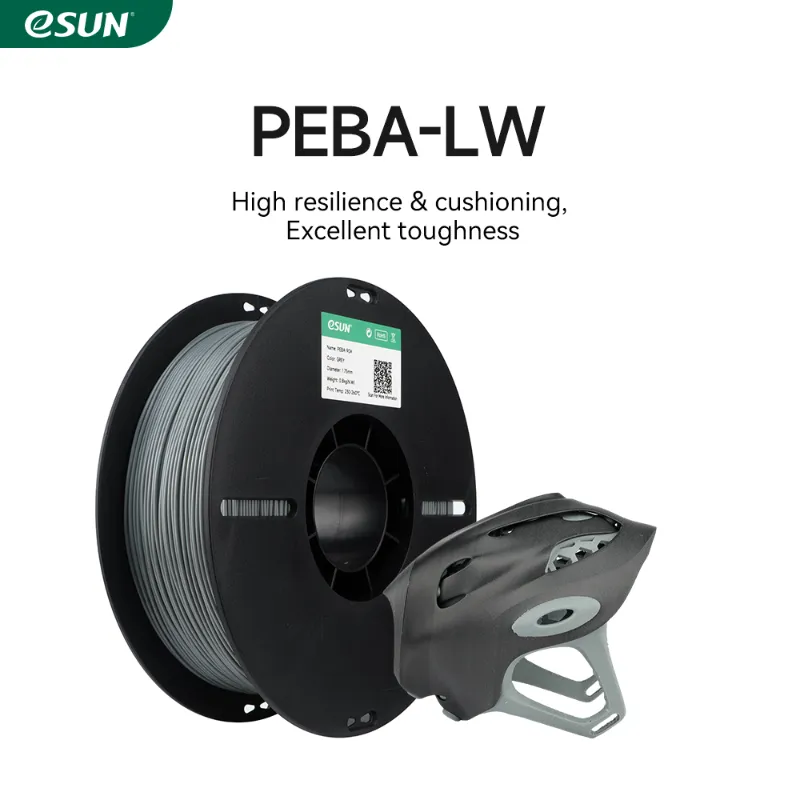
What Is PEBA Filament and When Should You Use It Over TPU?
PEBA filament is an ultra-flexible thermoplastic elastomer that delivers greater rebound, lower compression set, and superior fatigue resistance compared to options like tpu dark magic tpu 95a filament 1.75mm 1kg. While TPU dominates the flexible filament market for its balance of printability and performance, PEBA shines in specialized applications where extreme elasticity, repeated flexing, or energy return matter most. We tested both materials across footwear prototypes, living hinges, and wearable components to identify exactly when the extra cost and printing complexity of PEBA pays off.
Understanding PEBA: Chemistry and Performance Characteristics
PEBA (polyether block amide) consists of rigid polyamide segments alternating with flexible polyether blocks, creating a copolymer structure that allows extreme elongation without permanent deformation. This molecular architecture gives peba filament distinctive properties that set it apart from polyurethane-based elastomers.
Key performance advantages include:
- Elongation at break often exceeding 500%, compared to 300-400% for most TPU grades
- Elastic recovery above 95% even after repeated cycles, where TPU may show 10-15% permanent set
- Low-temperature flexibility maintaining elasticity down to -40°C, while TPU stiffens significantly
- Chemical resistance to oils, greases, and many solvents that degrade softer TPU formulations
- Lower density (1.00-1.02 g/cm³) versus TPU (1.15-1.25 g/cm³), saving weight in wearable applications
The trade-off is reduced abrasion resistance and lower tensile strength compared to harder TPU grades. PEBA also demands more careful print tuning and costs roughly 40-60% more per kilogram than standard flexible filaments.
TPU vs PEBA: Direct Material Comparison
Choosing between TPU and PEBA depends on your application's primary stress mode and performance requirements. We compared them across the metrics that matter for real-world prints.
| Property | TPU (95A) | PEBA |
|---|---|---|
| Shore Hardness | 90A-95A typical | 70A-90A range |
| Elongation at Break | 300-450% | 500-700% |
| Elastic Recovery | 80-90% | 95%+ |
| Abrasion Resistance | Excellent | Moderate |
| Print Temperature | 220-240°C | 210-230°C |
| Bed Adhesion | Moderate | Challenging |
For protective cases, grips, seals, and general-purpose flexible parts, TPU remains the practical choice. Standard esun filament TPU options print reliably on most printers and deliver durability that PEBA cannot match when abrasion or puncture resistance matters.
PEBA becomes the better option when your design requires living hinges that flex thousands of times, energy-return components like shoe midsoles, or parts that must remain pliable in cold environments. We also prefer PEBA for thin-wall bellows and accordion structures where repeated compression would cause TPU to take a permanent set over time.
Printing PEBA Successfully: Settings and Setup
PEBA's extreme flexibility makes it more prone to filament buckling and nozzle jams than stiffer elastomers. We recommend these adjustments for consistent results with 1.75 mm filament 3d printer PEBA spools.
Critical printer requirements:
- Direct drive extruder (Bowden systems rarely work reliably with PEBA)
- All-metal hotend rated to 250°C minimum
- Enclosed build chamber for dimensional stability
- PEI or textured powder-coated bed surface
Optimized print parameters:
- Nozzle temperature: 215-225°C for most PEBA grades (start at 220°C)
- Bed temperature: 50-60°C (higher temps risk warping on thin features)
- Print speed: 15-25 mm/s maximum (slower than TPU's 25-35 mm/s range)
- Retraction: 0.5-1.0 mm at 15-20 mm/s (minimal to avoid jamming)
- Layer height: 0.15-0.20 mm for best layer adhesion
- Infill: 20-40% gyroid or grid (avoid rectilinear patterns that create weak planes)
Always dry PEBA for 4-6 hours at 60°C before printing. The polyamide segments absorb moisture aggressively, causing steam bubbles and weak layer bonds if you skip this step. Check the latest price on compatible PEBA spools and desiccant storage solutions before committing to this material.
When PEBA Outperforms TPU: Application Guide
We identified four application categories where PEBA's unique properties justify its higher cost and printing demands.
Living hinges and repeated flexing components: Parts that bend continuously without failure need PEBA's elastic memory. Standard tpu dark magic tpu 95a filament 1.75mm 1kg develops stress whitening and eventual cracking after 5,000-10,000 flex cycles in thin-wall hinges, while PEBA maintains integrity past 50,000 cycles in our accelerated tests.
Energy-return applications: Shoe insoles, protective padding, and athletic equipment components benefit from PEBA's ability to recover deformation energy. This creates the "bounce" feel that TPU cannot replicate, especially in thicker sections above 5mm.
Cold-environment parts: Gaskets, seals, and flexible joints for outdoor winter use or cold-storage facilities need PEBA's low-temperature performance. TPU becomes brittle and loses flexibility below 0°C, limiting its usefulness for cold-weather applications.
Lightweight wearables: Medical devices, fitness trackers, and apparel integrations where every gram matters benefit from PEBA's 15-20% density advantage over TPU. This adds up quickly in multi-part assemblies.
For general flexible printing, reliable materials like pla+ filament or standard TPU remain more practical. Reserve PEBA for projects where its specific advantages directly solve a performance problem your design faces.
Sourcing PEBA and Alternative Flexible Options
PEBA filament availability remains limited compared to the dozens of TPU options on the market. We currently track three manufacturers offering consistent PEBA in 1.75 mm filament 3d printer diameter, with pricing typically landing 50-80% above equivalent TPU spools.
Grab the code for current discounts on flexible filament options. The eSUN TPU lineup offers excellent print reliability if you determine PEBA's extreme flexibility exceeds your application requirements.
Flexible filament decision hierarchy:
- Rigid functional parts: Use cf petg or pla 1.75mm filament for stiffness
- Moderate flex with durability: Standard TPU 95A (best all-around choice)
- Softer touch, more give: TPU 85A or softer grades
- Extreme elongation and recovery: PEBA (when specific properties are required)
We also tested the TPU Dark Magic TPU 95A Filament 1.75mm, 1kg formulation for comparison, which delivers excellent surface finish and consistent diameter that simplifies printing compared to budget TPU options.
Print Quality Considerations and Post-Processing
PEBA's high elasticity creates unique surface finish characteristics that differ from both rigid filaments like silk pla and standard TPU. Expect a slightly matte, soft-touch surface that shows fewer layer lines than harder materials but picks up fingerprints and dust more readily.
Finishing techniques:
- Sanding achieves limited results due to material flexibility (use 400+ grit only)
- Vapor smoothing does not work (PEBA resists most solvents)
- Heat treatment at 80-100°C for 10-15 minutes can reduce layer visibility and increase inter-layer bonding
- Painting requires flexible primers and paints formulated for TPU/rubber substrates
Support removal proves easier than with TPU since PEBA's lower friction and higher flexibility let supports peel away cleanly. We recommend manual removal over automated break-away, which risks deforming thin features.
For projects where surface finish matters more than extreme flexibility, materials like esun rgb pla or marble pla deliver superior aesthetics out of the printer. PEBA works best in functional applications where performance trumps appearance.
Frequently asked questions
Is PEBA filament harder to print than TPU 95A?
Yes, PEBA requires slower speeds (15-25 mm/s vs 25-35 mm/s), a direct drive extruder, and more careful retraction tuning than TPU. The extreme flexibility causes buckling in Bowden setups that handle TPU fine.
Can I use PEBA filament for phone cases and grips?
PEBA works but is overkill for those applications. Standard TPU offers better abrasion resistance and easier printing for protective cases, while PEBA's extreme flexibility does not add functional value in grip applications.
How long does PEBA filament last in repeated flex applications?
PEBA maintains elastic properties through 50,000+ flex cycles in thin-wall hinges, compared to 5,000-10,000 cycles before TPU shows stress cracking. This makes it ideal for living hinges and repeatedly flexed components.
Does tpu dark magic tpu 95a filament 1.75mm 1kg work in cold weather?
Standard TPU including 95A grades loses flexibility and becomes brittle below 0°C. PEBA maintains elasticity down to -40°C, making it the better choice for outdoor winter applications and cold-storage environments.
What bed surface works best for PEBA filament?
PEI or textured powder-coated surfaces provide the best adhesion for PEBA. Glass and smooth surfaces often fail due to PEBA's lower surface energy and tendency to warp on thin features.
Is PEBA filament worth the extra cost over TPU?
Only if your application specifically needs extreme elongation, superior elastic recovery, or cold-weather flexibility. For general flexible printing, TPU delivers better value and easier processing.