
Do You Need a Separate IR Flood Lamp? When the OOSSXX Infrared Illuminator 850Nm Improves Night Vision (and When It Doesn't)

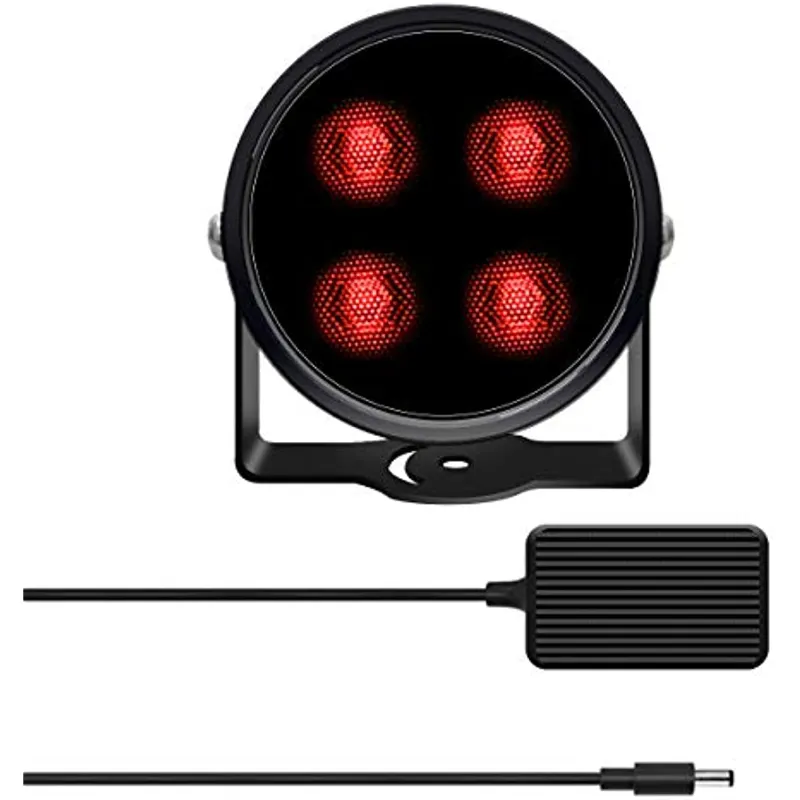
An infrared illuminator 850nm is worth adding when your OOSSXX camera sees objects at night but the image goes gray, washed out, or the camera's own IR reflectors wash out everything within a few feet. If your footage is genuinely pitch black with no image at all, an external IR lamp usually will not fix it, because that is a camera sensor or placement problem, not a lighting problem.
We test a lot of night footage from OOSSXX security cameras, and the single biggest misconception we see is that more IR always means better night vision. Sometimes it does. Sometimes it makes things worse. Here is how to tell which side you're on.
How an IR Flood Lamp Actually Works With Your Camera
Most night vision cameras, including every OOSSXX camera we've set up, have small built-in IR LEDs around the lens. These work fine for a porch or a doorway. But they are designed to throw light maybe 20 to 30 feet, and they create two predictable problems:
- Hot spot: the area right in front of the camera blows out white while the background stays dark.
- Limited range: past the LED throw distance, there is nothing for the sensor to reflect, so you get grain and noise.
A separate IR flood lamp fixes both. You mount it away from the camera, angled across the scene like a security light, except the light is invisible to the human eye. The camera's 850nm IR LED sensors pick up the reflection, and suddenly your yard or driveway is evenly lit in the footage even though it looks pitch dark to you.
The 850nm vs 940nm Question (It Matters More Than You Think)
This is the spec most buyers skip, and it's the one that decides whether the lamp works at all.
- 850nm IR produces a faint, faint red glow you can just barely see at the LED. Cameras are significantly more sensitive to it, so effective range is longer and image brightness is better. This is the standard for security cameras, and it's why we recommend an infrared illuminator 850nm for OOSSXX systems specifically.
- 940nm IR is completely invisible with zero red glow, which is nice for covert installs, but cameras see roughly 30-40 percent less at that wavelength. Range suffers.
The key rule: match the lamp's wavelength to what your camera is built to detect. OOSSXX cameras are tuned for 850nm, so a 940nm lamp will underperform even if the wattage looks identical on paper. If you want to go deeper on the physics, this 850nm vs 940nm comparison breaks down which wavelength suits which job.
| 850nm | 940nm | |
|---|---|---|
| Visible red glow | Faint dot at the LED | None |
| Camera sensitivity | Higher, longer range | Lower, shorter range |
| Best for | Security cameras, driveways, yards | Covert installs, bedrooms, nurseries |
| Works with OOSSXX | Yes, natively | Diminished performance |
When an External IR Illuminator Genuinely Helps
Based on our own test footage, these are the situations where adding an infrared illuminator 850nm pays off immediately:
- Large yards and long driveways. Anything past ~30 feet from the camera is beyond what built-in IR can light.
- Cameras mounted under eaves or soffits. The roof bounces the camera's own IR straight back into the lens, causing that foggy white glare. An external lamp mounted low and angled up fixes it.
- Total darkness scenes. Unlit backyards, side gates, detached garages.
- Backyard wildlife or license-plate capture. Even, wide-angle illumination reads far better than a narrow LED hotspot.
When It Won't Help (And What to Do Instead)
An IR lamp amplifies light the sensor can already detect. It cannot fix:
- A dirty or fogged lens. Clean the lens and check for condensation inside the housing first.
- Glass in front of the lens. If your camera shoots through a window, its own IR reflects straight back off the glass. No external lamp fixes that; move the camera outside.
- Wrong camera placement. If the camera is aimed at a light source (a streetlamp, a neighbor's porch light), the sensor is blown out and no IR helps.
- Sensor or cable faults. If footage is black in daylight too, the problem is upstream of lighting entirely.
Before you buy anything, pull up your night footage at 2 a.m. If you can see *something*, just not enough of it, IR helps. If you see nothing, troubleshoot the camera first.
Installing an IR Flood Lamp With a POE Security Camera System
If you run a POE security camera system, adding an IR lamp is one cable job. Here's the setup we use:
- Mount the lamp 10-15 feet from the camera, lower than the camera itself, aimed across the scene at a shallow angle. Never aim IR straight back at the lens.
- Weatherproof the connections. If the lamp is hardwired, a security camera junction box keeps the splice dry, and the same box works for the camera side if you're running new cable.
- Angle it wider than you think. IR falls off fast. A lamp aimed at the center of a 40-foot driveway leaves the edges black; aim it slightly wide to cover the full frame.
- Check the angle on the camera too. A poor mounting angle is often the real culprit. If your original bracket won't hold the position, a sturdier security camera mounting bracket is a cheap fix.
- Test and adjust at night. IR is invisible, so you tune it by watching the footage, not the lamp.
If your outdoor camera placement needs rethinking entirely, an outdoor camera mounted under an eave with an external IR lamp below it is the most reliable combo we've tested.
Is It Worth the Extra Hardware?
If your camera already covers the area you care about, skip the lamp. Built-in IR is genuinely good on modern cameras, and you'd be adding wiring and weatherproofing for no visible gain.
But if you've got a dark corner of the property, a camera under an eave, or grainy footage past 30 feet, an external IR lamp is one of the highest-impact upgrades you can make for the money. It's a cheaper fix than upgrading the camera itself.
Current pricing and bundle options change often, so check the latest price and grab the code before you order. OOSSXX runs a 10% off all orders offer right now, which applies to the lamps too.
One last practical note: before you buy any brand blind, it's worth scanning what actual buyers rate highest in the IR illuminator category to sanity-check build quality and range claims. Then match the wavelength to your camera, mount it low, and your 2 a.m. footage will look like a different camera entirely.
Frequently asked questions
Will an infrared illuminator 850nm work with any security camera?
It works with any camera that has night vision mode, but performance depends on the camera being sensitive to 850nm light. OOSSXX cameras are tuned for 850nm, so that wavelength is the safe match for these systems.
Why does my camera footage look foggy or white at night?
Usually the camera's own built-in IR is reflecting off a nearby surface like an eave, soffit, or window glass. Mounting an external IR flood lamp lower and angled across the scene, or moving the camera away from the reflective surface, fixes it.
Can I use a 940nm IR lamp instead of 850nm to avoid the red glow?
You can, but expect noticeably shorter range and dimmer footage. 940nm is fully invisible, which suits covert installs, while 850nm gives better range for security use.
How far should I mount the IR flood lamp from the camera?
About 10 to 15 feet away and lower than the camera, aimed across the scene rather than at the lens. This keeps the camera's field of view evenly lit instead of creating a hot spot right in front of the lens.
Does an IR lamp help if my night footage is completely black?
Probably not. Total blackness usually points to a placement problem, a blocked lens, or a sensor or cable fault. Check that the camera shows a normal daytime image before buying any IR lighting.
Do I need any extra accessories to install an IR flood lamp outdoors?
If you're hardwiring it, a junction box keeps the connections dry and protected, and a solid mounting bracket helps if the lamp or camera needs repositioning. Both are inexpensive and make the install last longer.